Showing posts with label vegan. Show all posts
Thursday, August 13, 2015
Everday Granola
I'm calling this everyday granola, because I eat it almost every day. This is not an exaggeration. After going through a spate of leftovers-for-breakfast, and then the boiled egg years, I am now firmly in a delicious rut of granola. It's my new go-to gift for friends who need a little culinary love. It's something I'm sure I have a fresh batch of before my friend arrives for house-/dog-sitting duty. It's something I just can't seem to get tired of.
This recipe came from Cook's Illustrated, as flagged by my dear friend Rebecca (though I've tweaked it a wee bit further). It's basic, brown, and, comparatively, not so exciting. It's also ridiculously delicious. I canNOT STOP making this.
This granola is, of course, perfect for breakfast. But it's also a perfect hold-me-over snack. And a perfect I'm-walking-by-the-jar-I-might-as-well-grab-a-handful indulgence. It's lightly sweetened, and clumps into crunchy clusters (thanks to a nice tamping-down before the oven). These summer days, I'm fond of it mixed with a bit of tart yogurt and juicy nectarines, but it's also lovely with just a splash of almond milk. I've occasionally dressed it up with a handful of buckwheat (which toasts to a surprisingly light crispness), and recently even tried a spoonful of fennel (lesson learned: don't). But mostly, I make it just as written. Again and again and again.
Everyday Granola
yields ~8 cups
1/3 cup light brown sugar
1/3 cup maple syrup
1/2 cup oil (olive oil is nice, though others work too)
1 tablespoon vanilla
1/2 teaspoon coarse salt
4 1/2 cups rolled oats
1 cup raw almonds, coarsely chopped
1/4 cup sunflower seeds
2 tablespoons flax seeds
Move your rack to the top third of the oven, and preheat your oven to 325° Fahrenheit (make sure it's fully preheated, or you risk scorching the bottom). Line a large rimmed baking sheet with parchment or silpat liner (reportedly this is not optional, unless you fancy chipping granola off a pan).
In a large bowl, whisk together the brown sugar, maple syrup, oil, vanilla, and salt, until well combined. Add the oats, almonds, sunflower and flax seeds, and stir, scooping the goo from the bottom, until everything is well coated.
Transfer the mixture to your pan, and smooth it into an even layer. Using a pancake spatula, press down firmly and evenly — like really, really firmly — to compress the mixture as much as you can. If you don't have a flat spatula, you can place another sheet of parchment on top, and then press down with another pan.
Transfer the pan to the oven, and bake ~30-40 minutes, until just lightly browned. Turn off the oven, and leave the pan in the residual heat for another 10 minutes. Remove the pan, and let it cool fully — this will take longer than you'd think (about an hour), but you need to wait in order for your granola to set and not crumble to bits. When cool, break into chunks of your desired size, and store in a covered container.
Saturday, June 20, 2015
Minted Lima Bean Dip
I have been preparing dozens and dozens of cookies for a friend's wedding (more on that later), which is a project that requires freezer space. And my freezer.... well, it does not have space. Instead, it has four-year-old coconut flakes. And bags of frostbitten vegetable trimmings I once intended to turn into stock. And... well... is that tomato paste? Chipotles in adobo? A curry base from that cookbook I checked out the library a few years ago? C'mere, take a sniff and tell me what you think. No? Fair enough.
So yeah, it's a bit of a(n overcrowded) state. To clear some room, I purged some of the more ancient and unidentifiable items. And then I set about trying to take some of the miscellaneous remainders out of the deep freeze, and into something edible.
I have absolutely no idea why I bought frozen baby lima beans. Were they on sale? Did I have some plan? Maybe some Persian recipe? Literally no idea. This bag expired a year ago, so the initial motivation is now lost to the ages. And yes, I probably should have thrown them in the compost — but I am just this kind of devil-may-care thrifty danger-skirter.
I briefly flirted with a Greek-inspired bake, pairing the beans with feta and dill and heaps of garlic. But it's a bit too hot to bake these days. So instead, I went for a dip (which, as bonus, could also involve several of the odd bags of baguette slices and bread heels also loitering around the freezer). I simmered the beans, and then tossed them in the food processor along with a few sprigs of mint (thanks, neighbors' garden!), some garlic and lemon, and a handful of spinach (not necessarily, but I always love me some greens). The result is simple, green, and fresh-tasting — and given its frost-bitten origins, that's quite a feat.
Minted Lima Bean Dip
yields ~2 cups
1 bag frozen baby lima beans (10 ounces)
1 handful spinach
a few sprigs fresh mint
1 large garlic clove, roughly chopped
juice of 1/2 lemon
glug olive oil
salt and pepper
Bring a small pot of salted water to a boil. Add the lima beans, and simmer until tender, ~15 minutes. Drain.
Throw the softened beans in the food processor, along with all of the other ingredients. Process, scraping down as needed, until a rough puree forms. Taste to adjust seasonings, and serve.
Tuesday, February 17, 2015
Grain Bowl with Barley, Mustard Greens, Chickpeas and Tahini
I often speak disparagingly of my old favorite of "hippie dinner." Some whole grain, steamed or sauteed vegetables, maybe a bit of tofu, and tahini. It's a healthy standard, sure, but it also pegs you as a dated, stubbornly unstylish old hippie. And then I happened upon a few articles, in the space of a week, that made me realize I was branding it all wrong. It wasn't hippie dinner, see —it was a grain bowl! My cooking is so au courant.
Thus rebranded, my quinoa-tofu-broccoli grain bowl seemed due for a bit of an update. Or, to be honest, I was thinking that I should try to put a dent in the enormous vat of barley that seems to have landed in my pantry. And then there were the mustard greens I had bought because they were just so pretty, but I didn't have much of a destination for (as my initial suggestion of "mustards pizza?" was roundly dismissed for the bad idea it so clearly was). And so, revamped hippie dinner! Excuse me, I mean, grain bowl.
As with hippie dinner of the so-dated past, grain bowls can really be anything. I had the aforementioned greens and barley, and some leftover chickpeas I'd simmered up a few days prior for whatever. I made up a standard tahini, but also tossed in some ground turmeric and freshly grated ginger (which both added a bit of flavor that stood up to the bitter blanched mustards, as well as some psychological witch doctor immunity against whatever late-winter illnesses seem to be circulating out there), and topped everything with a few random fresh herbs. Being trendy turns out to be delicious. I had no idea.
Grain Bowl with Barley, Mustard Greens, Chickpeas and Tahini
yields 2 servings
Ginger-Turmeric Tahini Sauce:
1/3 cup tahini paste
juice of 1/2 lemon or lime
1 clove garlic, pressed or grated
1-inch piece of ginger, grated
1/2 teaspoon ground turmeric
pinch each sugar and salt
Grain Bowl:
1 bunch mustard greens, washed and torn/chopped into bite-sized pieces
2 cups cooked barley (I favor cooking mine like pasta in big pot of boiling water, as I'm less likely to scorch it)
~ 3/4 cup cooked chickpeas (warm to at least room temperature if they're coming out of the fridge)
handful of fresh herbs, if you've got (I had some scallions and cilantro)
To make the Tahini: mix together the tahini paste, lemon juice, garlic, ginger, turmeric, sugar and salt. Add a splash of water, and mix, adding more water (or, if it seems like it needs more bite, lemon juice) until you reach a thick-yet-pourable consistency. Set aside.
Bring a kettle of water to a boil while you wash and chop the mustard greens. Place the greens in a large heat-proof bowl, then pour the water over them. Let sit for a few minutes to soften, then drain (this both cooks the greens and leaches out some of the bitterness, and has the added benefit of making it harder to overcook).
While the greens are blanching, assemble your bowls. Divide the barley between two bowls, then top with the chickpeas. Add the blanched and drained mustard greens, top with a healthy dollop of tahini sauce, then sprinkle on the fresh herbs.
Sunday, January 18, 2015
North African Oven Fries
Were we talking about comfort food? Well, the conversation cannot conclude until we mention potatoes. I mean really — who are we kidding here?
Oven-baked fries are something I seem to rediscover every few years. Buttery yellow potatoes, oil and heat and a mess of salt — instant deliciousness. And, you know, vaguely healthier than deep frying. Inspired by a sadly-no-longer-updated Algerian-American blog, I gave these potatoes a bit of a North African spin. They're tossed with a savory dose of cumin and paprika, and then given a bit of harissa for heat (optional, yet delicious). And then, after they roast up into soft, starchy, crisp-edged warmth, they're tossed with a bright hit of lemon juice, fresh herbs, and raw garlic (which gets just barely tempered by the hot potatoes). Pair with a pile of steamed greens, and it's a perfect dinner. Even the day after (apologies for my wan pictures), they make a fine lunch.
And if you're looking to learn a bit more about North Africa, I recently produced a story about the Berber New Year. I had only the most passing knowledge of the Berbers a few weeks ago, but had the good fortune to be able to dig into their history and culture, and how it all wraps up in a NYE blowout. In mid-January. You can listen over at NPR.
North African Oven Fries
adapted from 64 Square Foot Kitchen
serves ~3-4, especially paired with a nice green vegetable
2 teaspoons sweet paprika
1 teaspoon ground cumin
~3 tablespoons olive oil
2 teaspoons harissa, or your favorite hot sauce (optional)
6 large waxy potatoes (or more smaller ones), scrubbed but not peeled
1/4 cup chopped cilantro
1 tablespoon lemon juice
2 garlic cloves, pressed or minced
Preheat the oven at 400° Fahrenheit.
While the oven is preheating, mix the paprka, cumin, olive oil and harissa together in a large bowl. Peel the potatoes, and slice into wedges or fries, and add them to the bowl. Toss to coat the potato wedges with the oil and seasoning, and a generous sprinkle of salt.
Spread the potatoes on a baking sheet in a single layer, and bake until golden brown and crisp on the outside, about 25-30 minutes (depending upon how thick you've cut them), turning once.
While the potatoes are cooking, place the cilantro, lemon juice, and garlic in a bowl (you can re-use the same bowl you used earlier). When the potatoes are baked, tip them into the bowl, and toss to coat. The hot potatoes will temper the garlic, and everything should smell amazing. Taste, add additional salt or harissa as needed, and serve.
Thursday, October 23, 2014
Mushroom Barley Soup
Several years ago, the little hippie natural market down the street was going out of business. I must admit I wasn't terribly crushed to see it go — their prices weren't great, the in-house bakery didn't make the sort of breads and cookies I fancy, and they would never mark produce down to the half-priced bin until it was nearly in a state of active decomposition. But in addition to clearing the way for a less flawed grocery store to move in, their departure had another unexpected benefit: the Going Out of Business Sale.
I remember filling up a few bags of marked-down groceries, though all these years later I don't remember what they were. But here's what I do remember: an enormous, gallon-sized glass jar of dried porcini mushrooms.
Dried porcinis are the shortcut to deep, amazing flavor. They are also beyond expensive. So when I asked a clerk the price on the unmarked jar, I expected something ridiculous. "Um, $20?" he suggested. "But we're in our final days, so everything's half-priced. $10." I grabbed the jar, hit the checkout, and ran home before anyone reconsidered.
It's a deal so good I kinda feel a bit guilty. And it was quite the haul — although the dwindling supply has been transferred to smaller and smaller jars over the years, I'm still making my way through them. But that's okay. Because I can just keep making mushroom barley soup.
Like many with roots in Eastern Europe, I grew up with mushroom barley soup. It's hearty, delicious, and perfect for these blustery days. This recipe comes from the lovely Zingerman's deli, and uses the dried porcinis to add some fusty oomph to the sliced fresh mushrooms. I upped the vegetable component, because that's what I do, and even stirred in a few ribbons of tender baby collards. Even if you don't have your own stash of dried porcinis, it's still likely a good soup. But with them, it's even better.
Mushroom Barley Soup
adapted from Zingerman's Deli, via Joan Nathan's Jewish Cooking in America
yields one enormous pot of soup (which also freezes well)
1/4 cup dried porcini mushrooms
2 tablespoons butter, oil or margarine
1 large onion, diced
2 ribs celery with leaves, diced
1/4 cup parsley (I swapped this out with a few leaves of young collards, as I love me some greens)
2-3 carrots, peeled and diced
3 cloves garlic, chopped
1 pound fresh mushrooms (buttons or criminis), thickly sliced
1 tablespoon flour
2 quarts broth or water
1 cup whole barley
bay leaf
salt
Bring a kettle of water to a boil. Place your dried porcinis in a small heat-proof bowl, and pour the hot water over them to cover completely. Let soak half an hour. Swish out any dirt from the dried mushrooms, transfer to a cutting board, and pour the soaking liquid through a coffee filter or cheesecloth. Reserve this mushroom liquid. Coarsely chop the dried mushrooms, and reserve those as well.
Melt the butter or oil in a large soup pot over a medium heat. Add the onion, celery, half the parsley, carrots, and garlic. Add a pinch of salt and saute, stirring occasionally, until the vegetables are softened but not colored, ~5-7 minutes. Add the mushrooms, and cook until they give off their liquid and soften, another ~7 minutes. (If your pot isn't huge, you can split this process into two pots, and then combine at this point.)
When the mushrooms have softened, sprinkle on the flour, and stir until for a few minutes, until the mixture is well combined and beginning to thicken. Gradually add the broth or water, a cup or so at a time at first, stirring and raising the heat until it begins to simmer. Add all of the liquid, along with the reserved mushrooms and their liquid, and they bay leaf and barley. Stir well, add salt to taste.
Simmer, partially covered, stirring every now and then, for at least an hour, until the barley is tender and the soup is delicious (if you're a hippie like me and want to use some kale or collards, add them in for the last 15 minutes or so). Remove the bay leaf, add the remaining chopped parsley, adjust seasonings and serve.
Thursday, October 16, 2014
Ful Medames (fava puree)
I have split and peeled fava beans in my pantry, and they are generally there for one purpose only: to make falafel. This is a noble purpose, enough to warrant them permanent residence on my over-full shelves. But still, it seems a little silly. I can't but wish I had something else I could do with them. Which is why I was quite excited to come across a recipe for ful medames.
Ful medames are a beloved Middle Eastern fava bean preparation. Not the ridiculous-amount-of-work fresh favas, but the fully mature beans, cooked into a simple yet satisfying dish. I'm a big fan of the dish, but pretty much exclusively from a can. My local Middle Eastern store stocks a full shelf of ful cans with enthusiastic banners on the label — Egyptian style! Saudi style! Palestinian style! — each a slight tweak on whole or pureed beans, maybe some cumin, lemon juice, possible garlic or tomato paste. I love em all. But while the can is easy-peasy, I figured fresh was best. And cheapest. Also: I had the favas on my shelf.
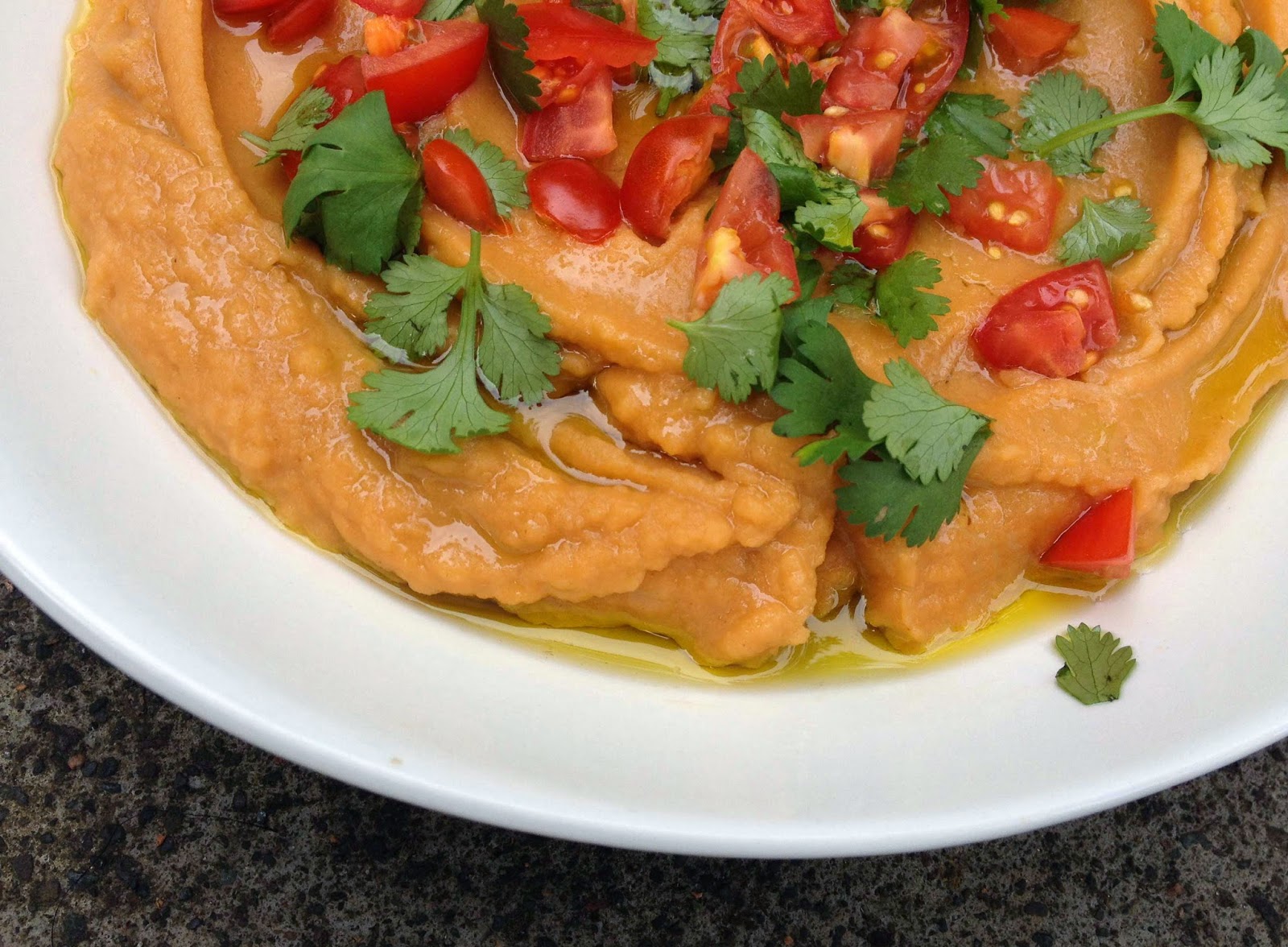
And so I tried this recipe. And I liked it. It's sort of like a tweak on your usual hummous, but with the favas' slightly deeper flavor (and, thanks to the dried beans being peeled and split, quicker cooking time). I soaked the beans overnight, then simmered them up to a mush (which I then pureed into an even smoother mush). Garlic, tomato paste, and lemon juice give it a nice balance, but really the fun comes in the toppings. I brought it to a brunch (as this dish is actually a common breakfast offering in the region), and sprinkled on some olive oil, cilantro leaves, and the *sniffle* last of the garden tomatoes. But you could just as easily go with a dollop of tahini, drizzle of yogurt, or sprinkle of aleppo pepper or sumac. With favas as your canvas, it's hard to go wrong.
Ful Medames (split fava puree)
adapted from Ya Salam Cooking
yields ~2 cups
1 cup dried split fava beans, soaked overnight
1 tablespoon tomato paste
3 cloves garlic, peeled
1 teaspoon cumin
1 tablespoon lemon juice
salt to taste
toppings: cilantro leaves, chopped tomato, olive oil, plain yogurt
Place the beans in a pot with water to cover by an inch or two. Bring to a boil over high heat, then reduce the heat until it's just high enough to maintain a simmer, and cook until the beans are totally soft, ~30-40 minutes. Halfway through, add the tomato paste and garlic cloves.
When the beans are cooked through, drain off the excess water, and transfer to a blender or food processor. Add the cumin and lemon juice, and a bit of salt, and process until smooth. Taste and adjust flavors — feel free to doctor it up to your taste (and keep in mind the lemon will fade upon standing).
Transfer the ful into a bowl (I like to create a bit of a depression, so as to better contain what's coming next), and top with any or all of the toppings. Scoop up with wedges of pita bread.
Monday, May 26, 2014
Spinach Salad with Bread, Dates and Almonds
When I make a green salad, it almost always looks the same: you've got your lettuce of some sort, toasted sesame or pumpkin seeds, thinly sliced radishes, and a citrusy vinaigrette. Sure, there are some variations beyond that — a handful of blanched asparagus in the spring, a few cubes of buttery avocado or crumbles of blue cheese (depending on what's left over in the fridge), maybe a carrot shaved into curls with a vegetable peeler. But really, it's pretty much the same old leafy template. Which is why it's so nice to find something so entirely different from my usual rut. And so delicious.
This recipe, as most things in the surprisingly-simple-yet-delicious-and-dusted-with-sumac category, comes from Yotam Ottolenghi. Baby spinach leaves, vinegar-pickled onions and sticky-sweet dates, and crisp buttery croutons and toasted almonds. So, so good. The original calls for torn-up pitas (as befits a cookbook called Jerusalem), but I used a freezer-burned ciabatta roll to equally delicious effect. It's a combination I never would have thought of, and it's wonderful.
Of late, I seem to be on a run of kitchen fails (hence my radio silence). There were the morning buns made from a "quick" croissant dough, which was not remotely quick, and after all that work was not even close to being as good as the real thing. There were the asparagus deviled eggs that were far, far more work than their non-asparagus brethren — and didn't really taste that much like asparagus. It's hard to recommend something with a low work-to-return ratio. But this salad? It's a simple salad. And it's different, and delicious, and I can't wait to make it again.
And speaking of surprising Middle Eastern flavors, I recently had the good fortune to spend the day with a visiting delegation of chefs, bakers, and food service folks visiting from Egypt, Algeria, Morocco and Oman, as part of the State Department's Diplomatic Culinary Partnership. You can hear more about the delicious exchange, and the larger ideals of gastrodiplomacy, over at NPR.
Spinach Salad with Bread, Dates and Almonds
adapted from Jerusalem, by Yotam Ottolenghi and Sami Tamimi
serves 4 (as a salad, though two people could make a meal of the whole thing)
1/2 small red onion, thinly sliced
half a dozen Medjool dates, pitted and cut lengthwise into quarters or sixths (depending upon size)
1 tablespoon white wine vinegar
2 tablespoons butter
2 tablespoons olive oil, divided
2 small stale pitas (or a stale roll), torn into bitze-sized pieces
1/2 cup almonds, coarsely chopped
2 teaspoons sumac
1/2 teaspoon chile flakes
several handfuls baby spinach leaves
juice of 1/2 lemon
Place the sliced onion and dates in a small bowl, and pour the vinegar over the top. Add a pinch of salt and stir. Let marinate for at least 20 minutes, then drain the vinegar.
While the onions are pickling, heat the butter and 1 tablespoon of the olive oil in a pan over medium heat. Add the bread and almonds and cook, stirring regularly, until the bread has toasted to a crunchy golden brown. Remove from the heat, and stir in the sumac, chile flakes, and a hefty pinch salt. Set aside to cool.
To serve, dress the spinach leaves with the remaining olive oil and lemon juice, and a pinch of salt. Top with the dates and red onion, and the seasoned bread and almonds. Serve.
Tuesday, May 06, 2014
Almond Granita with Minted Rhubarb
Rhubarb and I don't always get along. I usually thrill to see it in the markets, right around the time that the wintered-over apples are mealy, past-its-prime citrus isn't juicy, and ohmygosh why isn't there any fruit? feelings are running high. But then I take it home, and don't quite know what to do with it. A few weeks ago I slumped rhubarb into a compote to pair with a flourless almond cake, but ended up just eating the cake plain (well, plain except for whipped cream).
I think the problem is that I don't want stovetop sauces or oven-baked pies. I want fruit. I want something fresh and juicy and full of spring. Given rhubarb's tartness, it can be hard to find raw preparations where it delivers on this springtime promise. I've seen a few Mediterranean recipes that shave it into salads, but it's usually just a lone stalk or two. And I didn't want salad. I wanted dessert.
The original version of this recipe pairs the rhubarb with its old friend, the strawberry. I'm sure that's lovely, but our strawberries are still a few weeks away. And luckily my failure to wait for them yielded a truly delicious result. This almond granita is just a simple frozen almond milk, frozen into fluffy crystals (I made it fresh, but you could also freeze up a commercial version if you prefer). The milky sweetness is a perfect match for the spunky punch of pure fresh rhubarb, saucy with a bit of sugar. A little bit of mint (thanks to a friend's backyard) heightens the springtime brightness even further. I'm sure I'll eventually bake up some rhubarb into a pie (especially when the strawberries come in). But right now, this fresh-fresh-fresh bit of crunch and melt and sour and sweet is just what I needed to fall back in love with rhubarb.
Almond Granita with Minted Rhubarb
adapted from Apt. 2B Baking Co.
yields ~4 good-sized or 6 small serving
Granita:
1 cup raw almonds
2 1/2 cups water (plus more for soaking)
1 teaspoon vanilla extract or 1/2 vanilla bean, scraped
sugar to taste (~2-3 tablespoons)
pinch salt
Rhubarb:
~6 slim stalks rhubarb
~1/4 cup sugar
handful of mint leaves
To make the granita: Place almonds in a bowl, and cover with water. Let soak at least four hours, or overnight. Drain, place in a blender with the three cups water, and puree to bits. Strain the mixture through a few layers of cheesecloth, squeezing to get out all of the liquid you can. Add vanilla, sugar, and salt, and adjust seasonings to taste to yield a sweet, flavorful mixture.
Pour the mixture into an 8x8 or 9x9 baking dish. Slide the dish into the freezer, and chill for one hour. Remove the dish from the freezer, and scrape the milk with a fork to break up the crystals. Return to the freezer, and scrape the milk every 20 minutes or so, until it is frozen and, thanks to your work, fluffy crystals have formed (maybe another hour or so).
To make the rhubarb: Wash the rhubarb, and cut in a fine dice. Toss it in a bowl with the sugar, and let sit for about half an hour to let the juices come out, and the sugar dissolve into a syrup. Add the mint.
To serve, layer the granita and minted rhubarb in a glass, and slurp up before it melts.
Wednesday, March 26, 2014
Lavash Crackers
I generally am not a fan of single-use kitchen appliances. But I make an exception for my pasta machine. There are a few reasons for this dispensation: first and foremost, it makes amazing pasta, which is pretty near impossible without it. And secondly, my dear sister gave it to me. And third, it is a chunky metal machine with no electric parts (thus thrilling my Luddite heart, and nearly getting around the whole 'appliance' category). And this past weekend, I discovered another charm: it's not single use! In addition to making pasta, it also makes kick-ass crackers.
I was asked to bring appetizers to a party with a delicious Middle Eastern theme, for a reception in honor of one of the best books I've read in a long time. So I made some trusty hippie hummous, fancied up for the occasion with a topping of sumac, toasted hazelnuts, and fresh mint (for the record: highly recommended combination). But to go with? The pita bread at the closest grocery store was a bit underwhelming, and I wasn't up to schlepping to the Middle Eastern market. So I looked up cracker recipes. Namely lavash, in keeping with the evening's theme.
These lavash come from the amazing Peter Reinhart, and have many things to recommend them (beyond giving your pasta machine newfound purpose). They're fairly easy to make, cheap, and infinitely adaptable (I went with a topping of flaky salt and cumin seeds, as it seemed vaguely thematic). They're quite dramatic if you present them whole, and between their thin-ness and the yeast, they bake up deliciously light and crisp. And yes, you can roll them out with a rolling pin if you don't have a pasta machine. But if you have one, I highly recommend exploring this off-label application.
Lavash Crackers
Adapted from The Bread Baker's Apprentice, Peter Reinhart
yields enough lavash for a party
1/2 cup water
1/2 teaspoon active yeast
1/2 teaspoon salt
1 tablespoon honey
1 tablespoon olive oil
1 1/2 cups flour (or more, as needed)
toppings: coarse salt, whole seeds
Place the water in the bowl of a stand mixer (or just a large bowl, if you prefer to knead by hand), sprinkle in the yeast, and let soften a few minutes. Add the salt, honey, and olive oil, then knead in the flour (with a dough hook or your hands), until you have a firm dough, somewhat on the dry side (not quite as stiff as pasta dough, but fairly stiff — if the dough is too loose, it'll be hard to roll out later). Add more flour as needed to form a firm dough. Continue kneading for several minutes, until the gluten is well developed and the dough is smooth and supple. Place in an oiled bowl, swish around and flip over so that the now-oiled bottom is on top, and cover and set aside to rise until doubled (~90 minutes, though you can also do this in the refrigerator the night before).
When the dough is risen you're ready to make the crackers, line a few baking sheets with parchment or grease them very well (I haven't tried the latter, so it's possible there may be some sticking). Gather some toppings, and a spray bottle of water (or a dish of water with a pastry brush), and preheat your oven to 350° Fahrenheit.
You can roll these out as thin as you can with a rolling pin, but for best results, use a pasta machine. Take walnut-sized lumps of dough, and flatten with your hands until they can go through the machine at the widest setting. Run it through on thinner levels (because it's softer than pasta dough, you can likely skip levels), ultimately cranking it through level 5. Gently place the thin rolled-out lavash on your prepared cookie sheets. Spritz or brush gently with water, then sprinkle with desired toppings.
Let the prepared lavash rise for 5 minutes on the sheets, then transfer to the oven, and bake until mostly golden, ~15 minutes. Remove, let cool for a moment on the racks, and then transfer to a rack to finish cooling. Repeat with remaining dough.
Serve lavash whole for dramatic effect, or break into shards.
Tuesday, March 18, 2014
Hippie Krispie Treats
You know that thing wherein you think you're one of many people nibbling away at a particular snack? And then you find out that, in fact, everyone else has had just a bite or two, if that, and you've essentially eaten the entire thing yourself? This is one of those snacks.
Luckily this recipe is surprisingly healthy, a boon to those who end up finishing the majority of the batch (over a few days, but still). Ostensibly they're a take on scotcheroos, the krispie treat variation featuring peanut butter. And a cup of corn syrup. And a cup of sugar.
But this hippie version loses the refined sugar in favor of maple syrup, and instead of artificially flavored "butterscotch chips", gets caramel sweetness and heft from brown rice syrup. They are undeniably sweet, but not cloyingly so, especially when you enjoy it with a cup of tea. And then you enjoy another. And then another.
Hippie Krispie Treats
adapted, only slightly, from The Bojon Gourmet (brilliant!)
yields 8 squares
Bars:
1/4 cup (3 ounces) maple syrup
1/4 cup (2 3/4 ounces) brown rice syrup
1/4 cup (2 ounces) almond butter or peanut butter
1/4 cup (1 1/2 ounces) chocolate chips, or chopped chocolate
1 tablespoon (1/2 ounce) coconut oil
1/8 teaspoon coarse salt
2 cups crisp Rice Krispie-style cereal
Topping:
1 tablespoon (1/2 ounce) coconut oil
1/3 cup (2 ounces) chocolate chips, or chopped chocolate
2 tablespoons chopped, toasted almonds (optional)
1/8 teaspoon coarse salt (optional)
Line an 8x4 or 9x5" loaf pan with a sling of parchment paper.
In a large saucepan, bring the maple and rice syrup to a rolling boil for 1 minute, stirring frequently with a heatproof spatula or wooden spoon (be careful not to let it boil over).
Remove from the heat, and stir in all of the remaining bar ingredients except the cereal (nut butter, chocolate, coconut oil, and salt). Stir until the mixture is well combined, then fold in the cereal. Pour the mixture into your lined loaf pan, packing down firmly with a spatula or your hands.
In a small saucepan (or the same big one, if you've scraped it clean), melt the remaining 1/4 cup of chocolate and 1 tablespoon coconut oil together over very low heat, stirring constantly just until melted (be careful not to scorch the chocolate). Pour this chocolate mixture over the rice mixture, spreading to form a smooth top layer. Sprinkle the nuts and salt (if using) over the top.
Let the bars set at cool room temperature (about 1 hour) or in the fridge (about 1/2 hour) until firm. Lift the sling out of the pan, trim away the edges if you like (delicious!), and cut into 8 squares.
They will keep at room temperature for several days. Bojon Gourmet thought they were best the day of (with the cereal softening a bit thereafter), but I found them to be lovely for several days (in case the crisp secret lay in the cereal, it was Erewhon Crispy Brown Rice).
Wednesday, March 05, 2014
Chickpea and Kale Soup
In a lot of ways I am a big hippie. I store my bulk-bought rice in cleaned-out tomato sauce jars (poured through my trusty metal canning funnel, no less), and I sleep under a threadbare quilt stitched together from old fabric samples. But when it comes to food, hippies and I have some issues. Sure, I have eaten my share of tofu and tempeh. But there are so many areas where hippies are dead wrong. Like telling you that nutritional yeast is an acceptable substitute for grated cheese. And insisting that you should never, ever salt your dried beans until they're finished cooking.
A recent article helped bust open this hippie myth for me. Cooking beans with salt is my new favorite thing. And not just cooking them with salt — soaking them with salt. Although the good old hippie cookbooks warn that salt toughens bean skins, it's actually quite the opposite — advance salting helps soften bean skins, yielding beans that cook up evenly, consistently, and, most importantly, full of flavor.
Recently I put this newfound briny knowledge to good use by cooking up some chickpeas for a delicious soup. After a salty soak, beans are simmered with a bunch of aromatics and a glug of olive oil (and a bit more salt). A few of them are pureed with the two full bunches of kale, which yields a ridiculously green and flavorful base, and the rest of the beans bob along in the broth. It's clean yet satisfying, full of bright green flavor but also a protein-rich depth. So what turns such a simple preparation into one of the best soups I've tasted? Is it the kale? The olive oil (toned down from the original 1 1/2+ cups called for, but still)? Or is it the salt?
Chickpea and Kale Soup
adapted from Franny's: Simple Seasonal Italian
yields ~8 servings
2 cups dried chickpeas
1 carrot, peeled and cut into large chunks
1 celery stalk, cut into large chunks
1 onion, peeled and halved
11 garlic cloves
5 strips lemon peel
1 rosemary sprig
1 tablespoon kosher salt, or more to taste
3 quarts water
~1/2 cup olive oil (this is toned way down — if you want the full effect, throw in a full cup with the cooking beans)
¼ teaspoon dried chili flakes
2 bunches Tuscan kale
Freshly cracked black pepper
Lemon wedges
Finely grated Parmigiano-Reggiano
1 carrot, peeled and cut into large chunks
1 celery stalk, cut into large chunks
1 onion, peeled and halved
11 garlic cloves
5 strips lemon peel
1 rosemary sprig
1 tablespoon kosher salt, or more to taste
3 quarts water
~1/2 cup olive oil (this is toned way down — if you want the full effect, throw in a full cup with the cooking beans)
¼ teaspoon dried chili flakes
2 bunches Tuscan kale
Freshly cracked black pepper
Lemon wedges
Finely grated Parmigiano-Reggiano
Place the chickpeas in a large bowl and cover with plenty of water and a hefty spoonful of salt. Let soak for 8 hours or overnight, then drain.
Wrap the carrot, celery, onion, 3 garlic cloves, the lemon peel, and rosemary in a large square of cheesecloth and secure with kitchen twine or a tight knot. Place in a large pot with the soaked and drained chickpeas, the additional salt, the water, and 1/4 cup of the olive oil (alternately, if you don't want to deal with cheesecloth, you can just float all the aromatics in the broth, and fish them out later). Bring to a boil over high heat, then reduce the heat to medium-low and simmer until the chickpeas are tender, about an hour. Add more water if needed to cover.
While the chickpeas are cooking, finely chop the remaining 8 garlic cloves. In a large skillet, heat 2 tablespoons olive oil over medium heat. Add the garlic and chili flakes and cook until the garlic is fragrant but not golden, about 1 minute. Remove from the heat, and transfer the garlic to a blender or food processor.
Remove the center ribs from the kale (or not, if they're not too fibrous) and coarsely chop the leaves. In the same skillet you used for the garlic, heat a few tablespoons of olive oil over a medium-high heat. Add enough kale to fill the skillet, and cook, tossing, occasionally, until tender (~3 minutes). Remove, and transfer to the blender or food processor with the garlic. Repeat with the remaining batches of kale until it's all cooked, adding more oil to the pan if needed.
When the chickpeas are cooked, add 2 cups of them to the blender along with the kale and garlic, and a cup or so of cooking liquid. Puree until smooth. Return the puree to the pot and cook over medium-high heat until hot. Season with salt and pepper to taste.
Ladle the soup into bowls. Finish with a squeeze of lemon and some grated Parmigiano-Reggiano.
Tuesday, February 11, 2014
Pineapple, Avocado and Sweet Potato Salad
Preparing a vegan dish can feel like enough of a challenge for some cooks. But vegan and gluten-free? Oh, and also toddler-friendly? Facing these restrictions at a recent potluck dinner party, I contemplated some sort of plate full of tofu. It works, right? But instead, I decided upon this salad.
For the record, I happen to really like a plate full of tofu. But I also really, really like this salad. This is not a dish that screams out I meet a rigorous listing of dietary restrictions! It's a dish that says Hello! Would you like some tropical pineapple, broiled into caramelized sweetness? How about a buttery chunk of avocado?
The inspiration for this salad comes from a Cuban recipe, all sweet pineapple, smooth avocado, and snappy greens. I kept the basic format, but also added some wedges of sweet potato and a handful of beans, to make it more of a meal. And it's a good one. Topped with sweet-yet-healthy bites that toddlers will happily grab onto, sans animal products and gluten, and full of delicious.
Pineapple, Avocado and Sweet Potato Salad
adapted from Gran Cocina Latina: The Food of Latin America
serves ~4-6
3 small white or orange sweet potatoes, scrubbed & woody end bits trimmed off as needed
1 good-sized pineapple, peeled, cored, and cut into 1-inch thick slices
1 tablespoon sugar
1/4 cup olive oil, plus additional for sweet potatoes
1 clove garlic, pressed
2 tablespoons lime juice
hefty pinch salt
1 bunch arugula, washed and torn into bite-sized pieces
1 large buttery avocado, cut into cubes
1/2 red onion, thinly sliced
1/2 cup cooked black beans (optional)
Set the sweet potatoes in a large pot of water, and bring to a boil. Let simmer until just fork-tender, ~15 minutes, and remove from the pot and let cool slightly.
While the sweet potatoes are cooking, preheat your broiler. Place the pineapple slices on a baking pan, and sprinkle with the sugar. Broil until caramelized to a golden brown, ~5-10 minutes (broilers can incinerate things quite easily, so check often!). Remove from the oven and set aside to cool.
Turn your oven from broil to 450° Fahrenheit. Cut the par-baked sweet potatoes into wedges, and place them on a baking pan. Drizzle lightly with oil, and sprinkle with salt. Roast until they are butter soft and starting to become golden on the edges, ~20 minutes, turning once. Remove, and let cool.
To make the dressing, place the olive oil, garlic, lime juice, and salt in a covered jar, and shake to emulsify. Taste, and adjust as needed.
To assemble the salad, place the arugula in a large bowl, and top with the avocado, red onions, black beans, and reserved pineapple and sweet potato wedges. Top with the dressing, toss (if desired), and serve.
Monday, January 06, 2014
Greek Braised Cauliflower in Cinnamon-Scented Tomato Sauce
When I was young, my mother would often end up making something that we've jokingly come to think of as "the white meal" — mashed potatoes, some sort of baked flounder or sole fillet, and steamed cauliflower. Despite its ghostly nature, the meal was both healthy and tasty. In fact, I still get cravings for steamed-unto-softness cauliflower. But while I do love the subtlety of cauliflower's quiet background brassica notes (more on that sometime soon), I also find that it's perfect for pairing with other flavors. Like a cinnamon-scented tomato sauce.
Although this meal has a bit more color going on, it also has a similarly beautiful simplicity. The nearly melted grated onions and double hit of cinnamon (both stick and ground) in the tomato sauce manage to add both warm sweetness and savory depth, which the cauliflower gladly sops up. In some ways it's not all that different from a standard tomato sauce, but it's subtly so much more. I paired the flavorful braise with some garlicky lemony spinach and a briny wedge of feta, and scooped it all up with some crusty chunks of bread. Because if the world around you is cold and white (sorry, Midwest!), it's nice to have a warm bit of color on your plate.
Greek Braised Cauliflower in Cinnamon-Scented Tomato Sauce
adapted from the kounoupidi kapama on Souvlaki for the Soul
serves 2-4, as part of a larger meal
¼ cup olive oil (you can use less, but c'mon, it's Greek food)
1 onion, grated
2 cloves garlic, minced
1 cauliflower head, broken into florets
1 teaspoon ground cinnamon
1 cup tomato puree
¼ cup water
1 small stick cinnamon
salt and pepper to taste
feta (optional)
crusty bread
Heat the olive oil in a pot over a medium-high heat. Add the onions and garlic, and saute, stirring occasionally, until translucent but not colored, ~5 minutes (adjust the heat as needed).
Add the cauliflower, and saute for a few minutes, until it takes on a bit of color. Add the cinnamon, tomato puree, water, cinnamon stick, and salt and pepper. Bring to a boil, then reduce heat to low and cook, covered, until the cauliflower becomes tender, ~15 minutes. Stir occasionally (and gently).
Serve with feta, if desired, and crusty bread (and garlickly lemony spinach isn't too bad either).
Wednesday, October 30, 2013
Indian Spiced Pumpkin Seeds
I can eat pumpkin seeds until I explode (and often have). So why did I think it was a good idea to make them even more delicious? Scratch that. This is a brilliant idea. Pumpkin seeds are roasted along with a smattering of Indian spices, like a much fresher, lively version of a Bombay hot mix. The spices play off of the seeds' deep roasty flavor, and they're savory and crunchy and taste like the best Halloween ever.
And yes, I know most of you are far, far ahead of me in your autumnal preparations, and have already carved your pumpkins. But for those who are as late to the game as I am (or, say, have carved your pumpkins but left the seeds and guts in the fridge because yeah you're going to do something with them sometime really really soon), this is for you. Happy Halloween!
Indian Spiced Pumpkin Seeds
adapted from the amazing Ruchikala, with just a bit of tweaking because I like a pre-boil and longer roast
seeds from a good-sized pumpkin, rinsed free of pumpkin guts (~1 cup)
1 hefty tablespoon high-heat oil (coconut is especially nice)
3-6 dried red chilies (depending upon your taste for heat)
3/4 teaspoon black mustard seeds
1/4 teaspoon fennel seeds
15 curry leaves (available at Indian grocery stores — I buy em up, and keep them in the freezer)
1/4 teaspoon ground turmeric
hefty pinch asafoetida (or a clove of finely minced garlic)
1/2 teaspoon ground coriander
1/2 teaspoon ground cumin
1/2 teaspoon coarse salt
Place the pumpkin seeds in a pot of water, and salt generously. Bring to a boil, then reduce heat until it's just high enough to maintain a simmer. Cook for 10 minutes.
While the seeds are simmering, preheat your oven to 400° Fahrenheit, and gather your spices — place the chilies, mustard seeds, and fennel seeds in one small dish, the curry leaves, turmeric, and asafoetida in another, and the coriander, cumin and salt in a third. Then you're ready!
When the seeds have finished simmering, pour them out into a colander to drain. Heat an oven-proof skillet over a medium-high heat. When hot, add the oil, and the first dish with the chilies, mustard seeds and fennel seeds. Cook until the mustard seeds sputter and pop — this should just take a minute or two, and you will need a lid at the read to keep them from popping right out of the pan!
After the seeds have popped, dump in your second dish, with the curry leaves, turmeric, and asafoetida (or garlic). Stir to let the spices all hit the hot oil and toast, then dump in the pumpkin seeds. Stir to coat the pumpkin seeds with the spice mixture. Cook for 1-2 more minutes, then dump in the remaining spice dish (coriander, cumin and salt). Turn off the heat, and transfer the skillet to the oven (if you don't have an oven-proof skillet, you can just pour them out onto a rimmed cookie sheet instead).
Roast, stirring occasionally, until the seeds are crisp and lightly browned, ~10—20 minutes (depending upon your skillet, seeds, personal taste, etc). Let cool, then pour into a dish and serve.
Monday, September 16, 2013
Simple Stuffed Zucchini
There are so many zucchini recipes — especially as summer draws to a close, and fatigue sets in — that seek to sort of bury the squash. Shred it into a cake, where it's hidden behind chocolate, or perhaps a brown butter cornbread. And there's good reason to do this. Zucchini actually excels in these treatments, where it gives otherwise-starchy dishes a healthy dose of green, and some moisture to boot. Also: So! Much! Zucchini! But even in the midst of the onslaught, it's sometimes nice to have dishes that really let the zucchini shine. Like this stuffed zucchini.
There are versions of stuffed zucchini heaping with cups of breadcrumbs, or layered with gooey cheese, or spicy chorizo, or lord-knows-what. But this one is all about the zucchini. You scoop out the innards, and then cook them down with onion and tomato while the shells soften up a bit in the oven. You can add some basil (or not), and just the merest sprinkling of cheese (or not). Then a sprinkling of just enough breadcrumbs to bind the mixture, and the whole thing goes back in the oven. The end result doesn't have big bold flavors, or a magical where's-the-squash transformation. It tastes simple, rich and sweet. And a lot like zucchini.
Simple Stuffed Zucchini
serves 4
4 good-sized zucchini
2 tablespoons olive oil, plus additional for the pan and topping
1 onion, diced fine
2 cloves garlic, minced
2 good-sized tomatoes, diced
1 handful basil (optional), torn or chopped
scant 1/4 cup breadcrumbs (or as needed)
1 handful grated parmesan, optional
salt and pepper to taste
Preheat your oven to 400° Fahrenheit. Rinse the zucchini, and slice off the stems and any woody blossom scars on the ends. With a spoon, scoop out the innards (setting them aside), leaving a small rim around the end to keep things together. Drizzle a little olive oil in a large casserole dish, salt the insides of the zucchini, and lay them, cut side down, in the casserole. Drizzle a little more oil over the tops, and bake while you prepare the remaining ingredients (~half an hour).
Heat a large frypan or Dutch oven over a medium-high heat, and pour in the 2 tablespoons olive oil. Add the onions, along with a pinch of salt, and cook, stirring occasionally, until they are softened and translucent but haven't browned, ~5-7 minutes (adjust the heat as needed). While the onion is cooking, chop the reserved zucchini innards into a rough dice, and set aside. When the onion has softened, add the garlic, and cook for another minute to soften. Then add the zucchini innards and tomatoes, and basil if you've got it. Cook, stirring occasionally, until the zucchini is all cooked through (~10 minutes, give or take). It will give off a lot of liquid. Remove from heat, and add enough breadcrumbs to sop up the liquid into a moist stuffing-like consistency (the exact amount will vary depending upon how much liquid your particular zukes and tomatoes have given off, and how much of that has cooked away). Allow to cool slightly, then add parmesan, and season (rather aggressively) with salt and pepper to taste.
Remove the zucchini shells from the oven, and flip them back to boat position (being careful to avoid the steam!). Mound the filling back into the shells, and top with a drizzle of olive oil. Return to the oven and bake until everything is sizzly and delicious and just beginning to brown — about half an hour. Serve warm.
Friday, January 18, 2013
Gluten-Free Sesame Crackers
Years ago, my friend Emily was freaking out over an international trip she and her husband were planning, and the stress it would put on their tight finances. She mentioned these gnawing fears to an older neighbor, who gave her these words of wisdom: money is for travel and education. And she's so right.
As much as I am reduced to obsessive researching and wavering over any purchase totaling more than about $25 (beyond food), I know that those are the two categories where you must unequivocally open your purse strings. It's what the purse is for. There's no way around it — travel and education pretty much always come with a hefty price tag. But paying the price tag opens up the world to you, and makes your life so much richer for it.
A few months ago, my dear friend (and former housemate) was faced with a likely downsize at work. So he decided to opt for the most awesome of responses: he's packing up his belongings, renting out his house, and spending a full year traveling the world with his love. Morocco, Ghana, Italy, Croatia, Russia, China, India, Vietnam, New Zealand. And more. They got it right, and I'm so happy for them. And just a tiny bit fiercely jealous.
But the downside to this great idea is that some people I like a lot are going to be pretty far away. So when my friend mentioned a brief window in his packing/working/appointment-making/task-checking life yesterday, I jumped at the chance to come over. But I couldn't come empty handed. Since he offered to provide the fire and cocktail, I figured I could bring the cheese and crackers.
But how could I bring store-bought crackers for such an occasion? And especially, how could I bring store-bought crackers when my friend is gluten-free? GF crackers are often off-the-charts expensive, and/or of an entirely different species. They'll be rice-based, or just a small paving of seeds — good in their own right, but not the traditional cocktail hour cheese accompaniment. Also, who can bear spending $6 for a box of what is, essentially, flour and water? Well, also butter.
I was first converted to the cracker-making gospel by my friend Ivy, who kindly gave me some feedback on going gluten-free (namely too much cornstarch renders a cracker "thirsty," and butter gives a nicer flaky texture than olive oil). I also threw in some sesame seeds, because I love them, baked them up, and grabbed an assortment of cheeses and a nice crisp apple. And we sat down in front of the wood stove while my dog chewed some kindling, and ate our cheese and flaky, savory, delicious crackers, and drank a toast to the world. I hear it's lovely.
Gluten-Free Sesame Crackers
yield will vary depending upon cracker size, but should be ~3 dozen
4 1/2 ounces (a heaping cup) brown rice flour
2 ounces (~1/2 cup) sorghum flour
2 ounces (~1/3 cup) cornstarch
1 teaspoon baking powder
3/4 teaspoon coarse salt (plus additional for sprinkling)
1/2 teaspoon xanthan gum
6 tablespoons cold butter, cut into pats (you can substitute shortening for a vegan version)
3 tablespoons sesame seeds (or a bit more, if you like it extra seedy)
~1/2 cup cold water
Preheat your oven to 400° Fahrenheit. Take out two cookie sheets, a rolling pin, and a few sheets of parchment paper.
In a food processor or large bowl, mix together the rice flour, sorghum flour, cornstarch, baking powder, salt, and xanthan gum. Add the butter, and pulse (if using a food processor) or cut with a pastry cutter or two knives until it's reduced to little oatmeal-sized bits (don't over-process, as you want your crackers to be flaky). Turn the mixture into a large bowl, and mix in the sesame seeds. Add the water, starting with a scant half cup at first and adding more as necessary, until the mixture comes together in a nice ball of dough.
Divide the dough in half. Leave half in the bowl (covered, so it doesn't dry out), and place the other dough ball between two sheets of parchment paper. Roll out with a rolling pin until it's quite thin, ~1/16th-inch. Cut into cracker shapes of your choosing (you can use a pizza wheel to cut squares or rectangles, or make things more difficult for yourself and cut out rounds and re-roll the scraps). Place the crackers on a parchment-lined sheet (you don't need too much space between), dock them a few times with a fork so that they don't puff up, and sprinkle with bit of additional salt. Bake until browned, ~15 minutes. Let cool slightly, then serve with cheese to celebrate world travel.
Friday, October 19, 2012
Warm Butternut Squash and Chickpea Salad with Tahini
A friend once noted that despite living in Southern California, she could always tell when the sun was shining in Seattle. Because of all of the ohmygosh look at the sunshine! posts on Twitter. Sunlight can be so sporadic in the rainy Northwest that people feel compelled to note its presence on the rare times that it shines forth. Likewise, I can always tell when the season is turning to autumn. Because of all of the winter squash posts on the food blogs.
Not that I can blame people. The coming darkness of winter can be a bit hard to handle, especially after the endless warm summer evenings. And did I mention the rain? But winter squashes — butternut, kabocha, hubbard, delicate — are some of the best consolation prizes. They're dense and sweet, healthy, and their penchant for oven-roasting has the lovely side effect of warming up the kitchen on these cold days we're not quite yet accustomed to. And they're delicious. Especially in salads like this.
This recipe comes from the folks behind the Moro restaurant, who specialize in the Moorish cuisine that was at one time common in Spain. In some ways this dish reminds the lovely roasted eggplant with saffron yogurt I recently tried — a produce-driven recipe of simple ingredients in an unexpected combination. Rich golden chunks of squash are roasted until sweet and butter soft, then combined with whole chickpeas, red onions, garbanzos and cilantro. Then the whole thing is dressed with a nutty, lemony tahini sauce. It's got some winter heft with the warm squash, but still a last hurrah of sunny brightness. Perfect for the early days of autumn (because, in case you haven't heard, it's pretty much here).
Warm Butternut Squash and Chickpea Salad with Tahini
adapted from Casa Moro
serves ~4
Salad:
1 medium butternut squash (about 2 to 2 ½ lb.), peeled, seeded, and cut into 1 ½-inch cubes
1 clove garlic, pressed
½ tsp ground allspice
2 Tbsp olive oil
salt
2 cups cooked chickpeas (either drained from a can or cooked up yourself)
¼ of a medium red onion, finely chopped
1 handful coarsely chopped cilantro leaves (I opted to leave them whole, for a bit more pretty)
Tahini Sauce:
3 Tbsp tahini
1 clove garlic, pressed
1/4 cup lemon juice
2 Tbsp olive oil
2-4 Tbsp water, as needed
hefty pinch sugar
salt to taste
Preheat the oven to 425 degrees Fahrenheit.
In a large bowl, combine the squash cubes, garlic, allspice, olive oil, and a pinch or two of salt. Using a large spoon or your hands, toss until the squash pieces are evenly coated. Turn them out onto a baking sheet, and bake for 20-30 minutes, or until soft. Remove from the oven and cool.
Meanwhile, make the tahini sauce. In a small bowl, whisk together the tahini, garlic, lemon juice, olive oil, and the smaller amount of water. Add the sugar and salt, taste for seasoning, then add additional water until it thins to a thick-yet-pourable consistency.
To assemble the salad, scatter the squash, chickpeas, onion, and cilantro on a serving bowl or individual plates. Dress with the tahini sauce, and serve.
Wednesday, October 10, 2012
Mizuna, Melon and Pomegranate Salad
It's easy to get stuck in a particular idea of how things should be, and lose sight of the huge world of possibility out there. This past weekend I attended an amazing conference, where producers and sound artists talked about the new things they were doing with radio production. It's changed the way I think about the stories I make. And a few days earlier, in a slightly-less-dramatic-but-perhaps-more-delicious development, I had a breakthrough in salad.
Salads slip into boring ruts fairly often. A head of lettuce, a vinaigrette, maybe a few slices of radish or cucumber. We forget that they can easily be so much more. Anything, really. Luckily there are stellar recipes to remind us. Grilled kale with ricotta and plums. Rhubarb, beet and blue cheese, or roasted eggplant with saffron yogurt. And, drawing inspiration from these sources, my own contribution to the genre.
During a trip to the farmer's market, I picked up a head of peppery mizuna and an adorable softball-sized melon, swayed by both the latter's knock-you-out perfume and the farmer saying that this would be the last one, as he'd just pulled up his plants for the season (I am a total gather-ye-rosebuds sap, it turns out). The bitter greens play beautifully against the drippy-sweet melon, and the fresh taste of mint (taken from a neighbors yard), bright pop of pomegranate seeds, and sprinkling of nuts come together to form something that pushes the idea of what a salad can be. It's beautiful, really, a perfect showcase for the fruits and vegetables of the season. And it's delicious.
Mizuna, Melon and Pomegranate Salad
Serves ~4
1/2 bunch mizuna or other pepper green, torn into bite-sized pieces
1 very small melon, or 1/2 standard-sized, cut into small-ish chunks
1 handful mint leaves, torn
1 handful pomegranate seeds
1 handful lightly-toasted roughly-chopped hazelnuts or almonds
Dressing:
1 minced shallot (optional)
1 tablespoon fairly smooth vinegar, such as sherry
2 tablespoons olive oil
dollop honey
salt and pepper
Arrange all of the salad ingredients on a serving plate or individual plates. If using the shallot, add it to the vinegar in a small jar, and let sit for a few minutes to mellow. Add the remaining ingredients, stir to emulsify, and adjust to taste. Drizzle as needed on the salad, and serve.
Monday, September 24, 2012
Roasted Eggplant with Saffron Yogurt
As someone who allots about 15 minutes to shower, dress, and get out the door most mornings, it's possible I underestimate the importance of physical appearance. We should care about inner beauty, right? Not the creative hairstyles resulting from my shower-then-apply-bike-helmet morning ritual. Similarly, food should be eaten because it's delicious, right? Not because it's pretty or artfully fussed-over. Right?
Well, kind of. When it comes to food, sure, we're after delicious. But aesthetics are actually a kind of delicious, too. A counterpoint of colors, careful placement of items on the plate — all of these can shape your whole experience. I'm not talking about 80s-style fussy towers of food, or sauces applied with squeeze bottles in the home kitchen. I'm just talking about taking the smallest of moments to highlight something about the food itself, about the ingredients and occasion and wonder of it all. I'm talking about this salad.
This combination is classic Ottolenghi, just a few simple ingredients that come together in deliciously unexpected ways. And also: so gorgeous! Eggplant is roasted until butter-soft, then topped with a bright yellow saffron yogurt, fragrant green basil leaves, pine nuts, and pomegranates that provide a punchy little pop of tart flavor (as well as garnet-bright color). It's surprising, perfectly balanced, and easy. And beautiful.
Just as the fiery fall palette of leaves makes you take a deep breath in awe of the seasons, this gorgeous plate of late-fall produce captures a bit of that on a smaller scale. Sure, it's just a salad of fall vegetables, a bit of yogurt and nuts. But — as this presentation makes clear — that, in and of itself, can be beautifully amazing.
Roasted Eggplant with Saffron Yogurt
Both the eggplant and saffron yogurt can be prepared in advance, making this a perfect make-ahead dinner party dish. I tripled the amount of eggplants and salad elements and doubled the yogurt, and fed a Rosh Hashanah dinner party of 18 people with a bit of leftovers. You can also substitute a saffron tahini sauce for the yogurt sauce (as we did for one platter) for any dairy-free/vegan guests.
adapted from Ottolenghi: The Cookbook
serves ~4-5, or more as part of a larger spread
2-3 good-sized Italian eggplants, unpeeled
olive oil for brushing
2 tablespoons pine nuts, toasted
1 handful of pomegranate seeds (maybe 1/3 of a pomegranate, depending upon size)
1 handful of basil leaves
Saffron Yogurt:
1 pinch saffron, infused in a few spoonfuls of hot water for a few minutes
2/3 cup Greek yogurt
1-2 garlic cloves, crushed
juice of 1/2 lemon
3 tablespoons olive oil
salt to taste
To cook the eggplants: Preheat your oven to 425° Farenheit. Cut the eggplants into 1/2-inch thick rounds, brush each side with oil, and place in a single layer on a baking tray (you may need to do this in a few batches). Sprinkle with salt, and bake until they soften and brown on the bottom, ~7-10 minutes. Flip over, sprinkle with salt again, and return to the oven until the second side is browned and the eggplant is butter-soft. Transfer to a container and cool (if you don't use a ton of oil, the eggplant may dry out a wee bit on the edges, but if you transfer them to a covered glass container while still warm, they'll soften up beautifully). Let cool, and, if desired, refrigerate up to three days.
To make the saffron yogurt: Whisk together all ingredients until smooth, and adjust seasonings to taste (I was initially wondering whether olive oil was necessary, but it does a lovely job of rounding out the flavors). This can also be made up to three days in advance.
To assemble the salad: If you made the eggplant in advance, allow to warm to room temperature. Lay the eggplant slices on individual plates (or, ideally, a nice dramatic platter). Drizzle generously with the saffron yogurt, then sprinkle the pine nuts, pomegranate seeds, and basil leaves. Serve.
Subscribe to:
Posts (Atom)