Showing posts with label snack. Show all posts
Saturday, June 20, 2015
Minted Lima Bean Dip
I have been preparing dozens and dozens of cookies for a friend's wedding (more on that later), which is a project that requires freezer space. And my freezer.... well, it does not have space. Instead, it has four-year-old coconut flakes. And bags of frostbitten vegetable trimmings I once intended to turn into stock. And... well... is that tomato paste? Chipotles in adobo? A curry base from that cookbook I checked out the library a few years ago? C'mere, take a sniff and tell me what you think. No? Fair enough.
So yeah, it's a bit of a(n overcrowded) state. To clear some room, I purged some of the more ancient and unidentifiable items. And then I set about trying to take some of the miscellaneous remainders out of the deep freeze, and into something edible.
I have absolutely no idea why I bought frozen baby lima beans. Were they on sale? Did I have some plan? Maybe some Persian recipe? Literally no idea. This bag expired a year ago, so the initial motivation is now lost to the ages. And yes, I probably should have thrown them in the compost — but I am just this kind of devil-may-care thrifty danger-skirter.
I briefly flirted with a Greek-inspired bake, pairing the beans with feta and dill and heaps of garlic. But it's a bit too hot to bake these days. So instead, I went for a dip (which, as bonus, could also involve several of the odd bags of baguette slices and bread heels also loitering around the freezer). I simmered the beans, and then tossed them in the food processor along with a few sprigs of mint (thanks, neighbors' garden!), some garlic and lemon, and a handful of spinach (not necessarily, but I always love me some greens). The result is simple, green, and fresh-tasting — and given its frost-bitten origins, that's quite a feat.
Minted Lima Bean Dip
yields ~2 cups
1 bag frozen baby lima beans (10 ounces)
1 handful spinach
a few sprigs fresh mint
1 large garlic clove, roughly chopped
juice of 1/2 lemon
glug olive oil
salt and pepper
Bring a small pot of salted water to a boil. Add the lima beans, and simmer until tender, ~15 minutes. Drain.
Throw the softened beans in the food processor, along with all of the other ingredients. Process, scraping down as needed, until a rough puree forms. Taste to adjust seasonings, and serve.
Thursday, October 16, 2014
Ful Medames (fava puree)
I have split and peeled fava beans in my pantry, and they are generally there for one purpose only: to make falafel. This is a noble purpose, enough to warrant them permanent residence on my over-full shelves. But still, it seems a little silly. I can't but wish I had something else I could do with them. Which is why I was quite excited to come across a recipe for ful medames.
Ful medames are a beloved Middle Eastern fava bean preparation. Not the ridiculous-amount-of-work fresh favas, but the fully mature beans, cooked into a simple yet satisfying dish. I'm a big fan of the dish, but pretty much exclusively from a can. My local Middle Eastern store stocks a full shelf of ful cans with enthusiastic banners on the label — Egyptian style! Saudi style! Palestinian style! — each a slight tweak on whole or pureed beans, maybe some cumin, lemon juice, possible garlic or tomato paste. I love em all. But while the can is easy-peasy, I figured fresh was best. And cheapest. Also: I had the favas on my shelf.
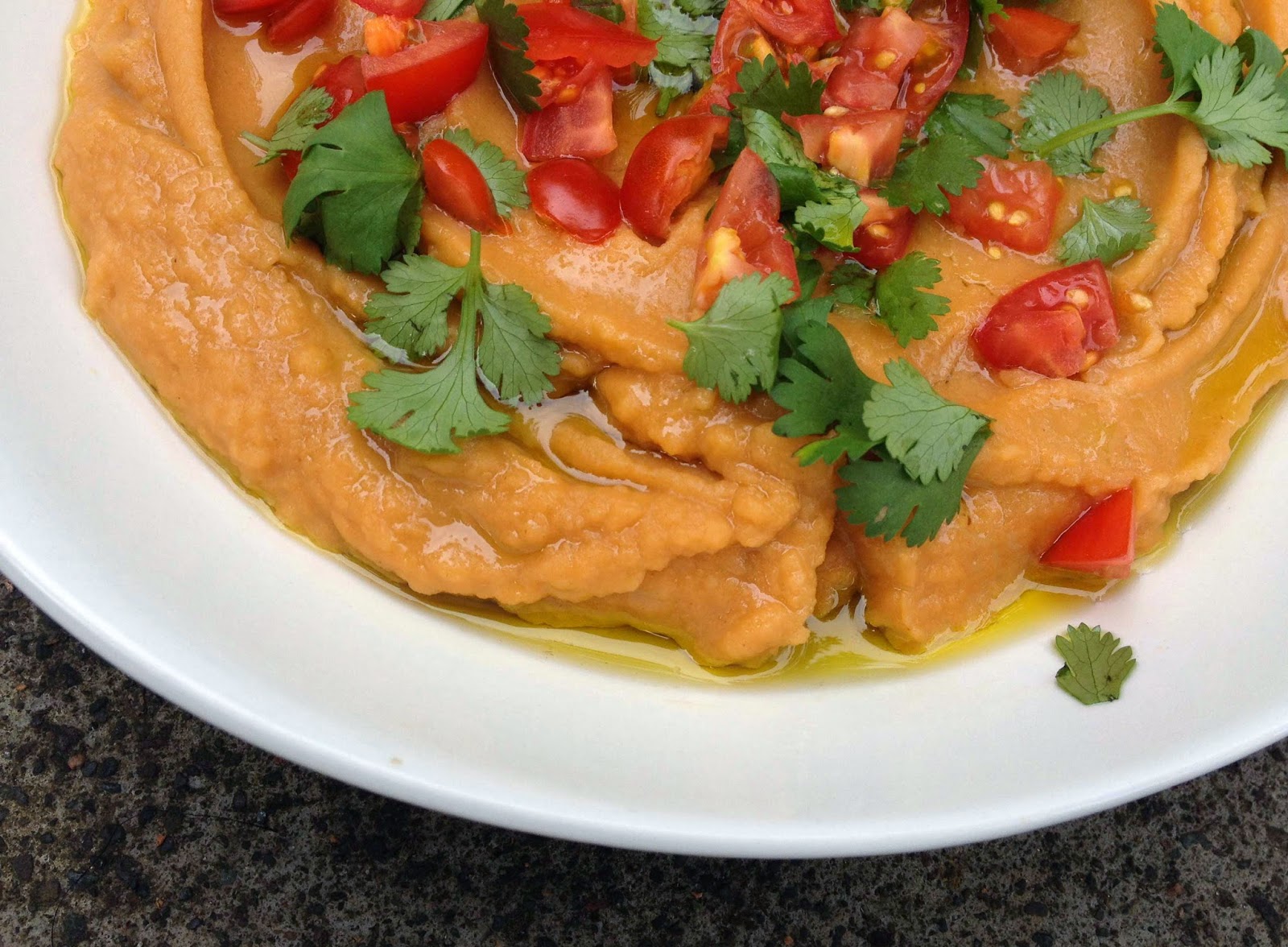
And so I tried this recipe. And I liked it. It's sort of like a tweak on your usual hummous, but with the favas' slightly deeper flavor (and, thanks to the dried beans being peeled and split, quicker cooking time). I soaked the beans overnight, then simmered them up to a mush (which I then pureed into an even smoother mush). Garlic, tomato paste, and lemon juice give it a nice balance, but really the fun comes in the toppings. I brought it to a brunch (as this dish is actually a common breakfast offering in the region), and sprinkled on some olive oil, cilantro leaves, and the *sniffle* last of the garden tomatoes. But you could just as easily go with a dollop of tahini, drizzle of yogurt, or sprinkle of aleppo pepper or sumac. With favas as your canvas, it's hard to go wrong.
Ful Medames (split fava puree)
adapted from Ya Salam Cooking
yields ~2 cups
1 cup dried split fava beans, soaked overnight
1 tablespoon tomato paste
3 cloves garlic, peeled
1 teaspoon cumin
1 tablespoon lemon juice
salt to taste
toppings: cilantro leaves, chopped tomato, olive oil, plain yogurt
Place the beans in a pot with water to cover by an inch or two. Bring to a boil over high heat, then reduce the heat until it's just high enough to maintain a simmer, and cook until the beans are totally soft, ~30-40 minutes. Halfway through, add the tomato paste and garlic cloves.
When the beans are cooked through, drain off the excess water, and transfer to a blender or food processor. Add the cumin and lemon juice, and a bit of salt, and process until smooth. Taste and adjust flavors — feel free to doctor it up to your taste (and keep in mind the lemon will fade upon standing).
Transfer the ful into a bowl (I like to create a bit of a depression, so as to better contain what's coming next), and top with any or all of the toppings. Scoop up with wedges of pita bread.
Thursday, July 31, 2014
Belarussian Bruschetta
I once read a line in a story about a sink that was filled with "summer dishes" — the detritus of 90+ degree days that is free of pots and pans and spatulas. Instead, it's the clink of water glass and iced tea glass, the puddle of melted ice cubes, and the drippy-sticky knives and boards and bowls left over from preparing fruit and salad.
That's pretty much what my sink looks like in these spate of summer days. And I have no regrets. It's been cold yogurt and jam for breakfast, and "meal" means salads full of butter lettuces and basil leaves and raw corn and peaches picked from over the office door. Sometimes there's a handful of chips of spoonful of ice cream, but that's pretty much it. Oh, and these Belarussian bruschetta.
I know, Russian food isn't most people's idea of summer dining. But, as I've argued before, it really should be. Yes, Russia is cold. But it also has hot, sticky summers. And people know how to make the best of them, with summer cabins and juicy-sour pickles and fresh sour cream. This tartine is my homage to that, an iteration of an open-faced sandwich that may never have been eaten in the motherland, but captures some of the best of its spirit.
My Brooklyn-Belarussian grandfather relished summertime meals, usually involving the tomatoes grown in his backyard buckets (after he ate the last one of the season, he would proclaim that he would not touch another tomato until the next harvest, which was a rather radical seasonal-dining manifesto in the 1980s). And on the hottest days, he would chop up a smattering of fresh herbs, mix them in with cottage cheese, and spread the mixture on some dark rye or pumpernickel bread. What more do you need?
As a good granddaughter, I've followed his example. I grabbed some farmer cheese instead of cottage cheese, though either would do fine. Instead of mixing everything together, I just lay a swipe of the cold cheese on toasted bread, then top with a few tomatoes, and sprinkle on the chopped herbs right before enjoying. The end result is a perfect Ruskie tartine, all sour bread and punchy herbs and mild cheese, tasting fresh and summery, but refreshing as a juicy dill pickle. It doesn't dirty much more than your cutting board, and it's just about perfect for a hot summer night.
Belarussian Bruschetta
makes as many as you'd like
sliced bread, preferably a nice dense rye or brown bread
farmer cheese
fresh tomatoes (halved, quartered or sliced, depending upon the size)
fresh scallions, thinly sliced
fresh dill, finely chopped
coarse salt and black pepper
Toast or (even better) grill your bread (if grilling, you can brush first with oil or melted butter). Spread with a generous swipe of farmer cheese, then pave with fresh tomatoes. Sprinkle on a generous dusting of fresh herbs, then season with salt and pepper. Enjoy.
Wednesday, March 26, 2014
Lavash Crackers
I generally am not a fan of single-use kitchen appliances. But I make an exception for my pasta machine. There are a few reasons for this dispensation: first and foremost, it makes amazing pasta, which is pretty near impossible without it. And secondly, my dear sister gave it to me. And third, it is a chunky metal machine with no electric parts (thus thrilling my Luddite heart, and nearly getting around the whole 'appliance' category). And this past weekend, I discovered another charm: it's not single use! In addition to making pasta, it also makes kick-ass crackers.
I was asked to bring appetizers to a party with a delicious Middle Eastern theme, for a reception in honor of one of the best books I've read in a long time. So I made some trusty hippie hummous, fancied up for the occasion with a topping of sumac, toasted hazelnuts, and fresh mint (for the record: highly recommended combination). But to go with? The pita bread at the closest grocery store was a bit underwhelming, and I wasn't up to schlepping to the Middle Eastern market. So I looked up cracker recipes. Namely lavash, in keeping with the evening's theme.
These lavash come from the amazing Peter Reinhart, and have many things to recommend them (beyond giving your pasta machine newfound purpose). They're fairly easy to make, cheap, and infinitely adaptable (I went with a topping of flaky salt and cumin seeds, as it seemed vaguely thematic). They're quite dramatic if you present them whole, and between their thin-ness and the yeast, they bake up deliciously light and crisp. And yes, you can roll them out with a rolling pin if you don't have a pasta machine. But if you have one, I highly recommend exploring this off-label application.
Lavash Crackers
Adapted from The Bread Baker's Apprentice, Peter Reinhart
yields enough lavash for a party
1/2 cup water
1/2 teaspoon active yeast
1/2 teaspoon salt
1 tablespoon honey
1 tablespoon olive oil
1 1/2 cups flour (or more, as needed)
toppings: coarse salt, whole seeds
Place the water in the bowl of a stand mixer (or just a large bowl, if you prefer to knead by hand), sprinkle in the yeast, and let soften a few minutes. Add the salt, honey, and olive oil, then knead in the flour (with a dough hook or your hands), until you have a firm dough, somewhat on the dry side (not quite as stiff as pasta dough, but fairly stiff — if the dough is too loose, it'll be hard to roll out later). Add more flour as needed to form a firm dough. Continue kneading for several minutes, until the gluten is well developed and the dough is smooth and supple. Place in an oiled bowl, swish around and flip over so that the now-oiled bottom is on top, and cover and set aside to rise until doubled (~90 minutes, though you can also do this in the refrigerator the night before).
When the dough is risen you're ready to make the crackers, line a few baking sheets with parchment or grease them very well (I haven't tried the latter, so it's possible there may be some sticking). Gather some toppings, and a spray bottle of water (or a dish of water with a pastry brush), and preheat your oven to 350° Fahrenheit.
You can roll these out as thin as you can with a rolling pin, but for best results, use a pasta machine. Take walnut-sized lumps of dough, and flatten with your hands until they can go through the machine at the widest setting. Run it through on thinner levels (because it's softer than pasta dough, you can likely skip levels), ultimately cranking it through level 5. Gently place the thin rolled-out lavash on your prepared cookie sheets. Spritz or brush gently with water, then sprinkle with desired toppings.
Let the prepared lavash rise for 5 minutes on the sheets, then transfer to the oven, and bake until mostly golden, ~15 minutes. Remove, let cool for a moment on the racks, and then transfer to a rack to finish cooling. Repeat with remaining dough.
Serve lavash whole for dramatic effect, or break into shards.
Thursday, December 19, 2013
Rosemary Hazelnut Cheese Shortbread Crackers
As I've made quite clear, I've got nothing against a sweet, buttery cookie. But this time of year, the sweets, they stack up. Sometimes when you head to a party, you want to bring a nibble that's a bit more savory. Like these cheese crackers.
For some reason, people seem to think it's hard to make crackers. But these are really just a riff on shortbread — a whole lot of butter and cheese, bound with flour and whatever additions or flavorings you want. I went with some front-yard rosemary and leftover Oregon hazelnuts, but the options are endless (walnuts, paprika, blue cheese, etc.). I brought them to a past-my-bedtime party (on a schoolnight!) last night, nicely packaged in a repurposed sauerkraut jar, where they were promptly demolished. Because clearly, it is cracker season.
Rosemary Hazelnut Cheese Shortbread Crackers
adapted, roughly, from Garde Manger: The Art and Craft of the Cold Kitchen
yields ~4 dozen small crackers, though yield will vary depending upon size
1/2 cup (1 stick) unsalted butter, softened to room temperature
8 ounces grated cheese (I used a mix of sharp cheddar, aged gouda, and a wee bit of Romano)
1 tablespoon minced fresh rosemary leaves
1 teaspoon coarse salt (or less, if your cheese is particularly salty)
1 cup all-purpose flour
scant 1/2 cup chopped hazelnuts
In a large bowl or a stand mixer, beat together the butter, cheese and rosemary until well combined (using a paddle attachment or a wooden spoon). Add the salt and flour, mix well, then add the nuts. Mix until it comes together into a smooth dough (you can sprinkle in a bit of water if needed — mine didn't).
Roll the dough into two logs (of the diameter you favor for crackers — I went with ~ 1 1/2-inch), and wrap in parchment or plastic. Chill in the refrigerator until firm, at least one hour (and overnight is fine too, if it works better).
When you're ready to bake, preheat your oven to 325° Fahrenheit. Line two baking sheets with parchment, or grease them well. With a sharp knife, slice into thin rounds (~1/4-inch), and place on the cookie sheet with a bit of space between (they shouldn't spread that much). Bake until lightly golden on the edges, ~15-20 minutes. Transfer to a rack to cool fully, then store in an airtight container until party time.
Wednesday, October 30, 2013
Indian Spiced Pumpkin Seeds
I can eat pumpkin seeds until I explode (and often have). So why did I think it was a good idea to make them even more delicious? Scratch that. This is a brilliant idea. Pumpkin seeds are roasted along with a smattering of Indian spices, like a much fresher, lively version of a Bombay hot mix. The spices play off of the seeds' deep roasty flavor, and they're savory and crunchy and taste like the best Halloween ever.
And yes, I know most of you are far, far ahead of me in your autumnal preparations, and have already carved your pumpkins. But for those who are as late to the game as I am (or, say, have carved your pumpkins but left the seeds and guts in the fridge because yeah you're going to do something with them sometime really really soon), this is for you. Happy Halloween!
Indian Spiced Pumpkin Seeds
adapted from the amazing Ruchikala, with just a bit of tweaking because I like a pre-boil and longer roast
seeds from a good-sized pumpkin, rinsed free of pumpkin guts (~1 cup)
1 hefty tablespoon high-heat oil (coconut is especially nice)
3-6 dried red chilies (depending upon your taste for heat)
3/4 teaspoon black mustard seeds
1/4 teaspoon fennel seeds
15 curry leaves (available at Indian grocery stores — I buy em up, and keep them in the freezer)
1/4 teaspoon ground turmeric
hefty pinch asafoetida (or a clove of finely minced garlic)
1/2 teaspoon ground coriander
1/2 teaspoon ground cumin
1/2 teaspoon coarse salt
Place the pumpkin seeds in a pot of water, and salt generously. Bring to a boil, then reduce heat until it's just high enough to maintain a simmer. Cook for 10 minutes.
While the seeds are simmering, preheat your oven to 400° Fahrenheit, and gather your spices — place the chilies, mustard seeds, and fennel seeds in one small dish, the curry leaves, turmeric, and asafoetida in another, and the coriander, cumin and salt in a third. Then you're ready!
When the seeds have finished simmering, pour them out into a colander to drain. Heat an oven-proof skillet over a medium-high heat. When hot, add the oil, and the first dish with the chilies, mustard seeds and fennel seeds. Cook until the mustard seeds sputter and pop — this should just take a minute or two, and you will need a lid at the read to keep them from popping right out of the pan!
After the seeds have popped, dump in your second dish, with the curry leaves, turmeric, and asafoetida (or garlic). Stir to let the spices all hit the hot oil and toast, then dump in the pumpkin seeds. Stir to coat the pumpkin seeds with the spice mixture. Cook for 1-2 more minutes, then dump in the remaining spice dish (coriander, cumin and salt). Turn off the heat, and transfer the skillet to the oven (if you don't have an oven-proof skillet, you can just pour them out onto a rimmed cookie sheet instead).
Roast, stirring occasionally, until the seeds are crisp and lightly browned, ~10—20 minutes (depending upon your skillet, seeds, personal taste, etc). Let cool, then pour into a dish and serve.
Friday, January 18, 2013
Gluten-Free Sesame Crackers
Years ago, my friend Emily was freaking out over an international trip she and her husband were planning, and the stress it would put on their tight finances. She mentioned these gnawing fears to an older neighbor, who gave her these words of wisdom: money is for travel and education. And she's so right.
As much as I am reduced to obsessive researching and wavering over any purchase totaling more than about $25 (beyond food), I know that those are the two categories where you must unequivocally open your purse strings. It's what the purse is for. There's no way around it — travel and education pretty much always come with a hefty price tag. But paying the price tag opens up the world to you, and makes your life so much richer for it.
A few months ago, my dear friend (and former housemate) was faced with a likely downsize at work. So he decided to opt for the most awesome of responses: he's packing up his belongings, renting out his house, and spending a full year traveling the world with his love. Morocco, Ghana, Italy, Croatia, Russia, China, India, Vietnam, New Zealand. And more. They got it right, and I'm so happy for them. And just a tiny bit fiercely jealous.
But the downside to this great idea is that some people I like a lot are going to be pretty far away. So when my friend mentioned a brief window in his packing/working/appointment-making/task-checking life yesterday, I jumped at the chance to come over. But I couldn't come empty handed. Since he offered to provide the fire and cocktail, I figured I could bring the cheese and crackers.
But how could I bring store-bought crackers for such an occasion? And especially, how could I bring store-bought crackers when my friend is gluten-free? GF crackers are often off-the-charts expensive, and/or of an entirely different species. They'll be rice-based, or just a small paving of seeds — good in their own right, but not the traditional cocktail hour cheese accompaniment. Also, who can bear spending $6 for a box of what is, essentially, flour and water? Well, also butter.
I was first converted to the cracker-making gospel by my friend Ivy, who kindly gave me some feedback on going gluten-free (namely too much cornstarch renders a cracker "thirsty," and butter gives a nicer flaky texture than olive oil). I also threw in some sesame seeds, because I love them, baked them up, and grabbed an assortment of cheeses and a nice crisp apple. And we sat down in front of the wood stove while my dog chewed some kindling, and ate our cheese and flaky, savory, delicious crackers, and drank a toast to the world. I hear it's lovely.
Gluten-Free Sesame Crackers
yield will vary depending upon cracker size, but should be ~3 dozen
4 1/2 ounces (a heaping cup) brown rice flour
2 ounces (~1/2 cup) sorghum flour
2 ounces (~1/3 cup) cornstarch
1 teaspoon baking powder
3/4 teaspoon coarse salt (plus additional for sprinkling)
1/2 teaspoon xanthan gum
6 tablespoons cold butter, cut into pats (you can substitute shortening for a vegan version)
3 tablespoons sesame seeds (or a bit more, if you like it extra seedy)
~1/2 cup cold water
Preheat your oven to 400° Fahrenheit. Take out two cookie sheets, a rolling pin, and a few sheets of parchment paper.
In a food processor or large bowl, mix together the rice flour, sorghum flour, cornstarch, baking powder, salt, and xanthan gum. Add the butter, and pulse (if using a food processor) or cut with a pastry cutter or two knives until it's reduced to little oatmeal-sized bits (don't over-process, as you want your crackers to be flaky). Turn the mixture into a large bowl, and mix in the sesame seeds. Add the water, starting with a scant half cup at first and adding more as necessary, until the mixture comes together in a nice ball of dough.
Divide the dough in half. Leave half in the bowl (covered, so it doesn't dry out), and place the other dough ball between two sheets of parchment paper. Roll out with a rolling pin until it's quite thin, ~1/16th-inch. Cut into cracker shapes of your choosing (you can use a pizza wheel to cut squares or rectangles, or make things more difficult for yourself and cut out rounds and re-roll the scraps). Place the crackers on a parchment-lined sheet (you don't need too much space between), dock them a few times with a fork so that they don't puff up, and sprinkle with bit of additional salt. Bake until browned, ~15 minutes. Let cool slightly, then serve with cheese to celebrate world travel.
Tuesday, March 27, 2012
Borek (Turkish Turnovers)

Last week's post was so delicious, I figured I'd continue the trend. So today, in the next installment of Delicious Dough-Wrapped Foods of the Mediterranean, I go from Spanish empanadillas to Turkish borek. These savory turnovers take various forms, from tangy lamb-filled phyllo triangles to rich puff pastry spirals filled with cheese. Snack time gets stepped up! You can read about borek and find several recipes over at NPR's Kitchen Window.
And speaking of NPR stories about delicious foods from other lands, I direct you to a recent radio story about Culture Kitchen, a California company that employs first-generation immigrant women as cooking instructors. I had the good fortune to sit in on a recent class, and am still thinking about those recipes. It's somewhat amazing to realize how vast the culinary and cultural world can be, and the delicious wealth of kitchen stories that are all around us...
Sunday, February 26, 2012
Quesadillas (Salvadoran Savory-Sweet Cakelets)
I'm often a creature of habit. To an embarrassing degree. In theory I am in favor of change -- but when it affects the constants of my own life, I tend to reconsider. I get huge comfort from the familiar, sometimes even clinging to it when it's a bad idea (when I should, you know, select something more growth-inducing instead). But I try to shake out of my routine. And there's nothing like a good trip to do it.
At home, I often have trouble breaking out of my usual work-write-cook-sleep-insomnia regimen. But last weekend I traveled to the Bay Area to celebrate my birthday with dear friends, and remembered how much fun change can be (and how I can minimize my aaah-things-are-different anxiety with trusted companions and stiff cocktails). I traded in the wintery slog of Portland for breezy sunshine. I picked meyer lemons off the tree, lingered at a museum, hiked windy bluffs, had a frighteningly thorough scrub at a Korean spa, and ate out more in 5 days than I normally do in several months. It was great fun, all of it. And amidst the adventure, I did get in a bit of cooking. Including these quesadillas.
As befitting the new-experiences-of-vacation mindset, these are like nothing I've ever had before. They're undeniably rich, thanks to the butter and sour cream, but are also light, with a moist, short texture. They take savory cheese (we used a dry old wedge of romano), and put it in a lightly sweet context. And they are, hands down, my favorite snack to enjoy with a cup of coffee. Change, you are delicious.
Quesadillas (Salvadoran Savory-Sweet Cakelets)
via The Food52 Cookbook
yields 18 muffins
I'm normally a fan of hulkingly large muffin-topped muffins, but these are so rich that just a small one suffices (that said, I have eaten two in a sitting).
1 cup rice flour
1 tsp baking powder
1 pinch salt
1 cup butter, softened to room temperature
1 cup sugar
3 eggs
1 cup sour cream
1/2 cup grated hard cheese, such as parmesan or romano
a few spoonfuls sesame seeds (these are optional, but add a nice nubbly counterpoint to the rich muffins)
Preheat the oven to 350, and grease 18 muffin cups.
Whisk together the rice flour, baking powder, and salt. Set aside.
In a mixing bowl, cream together the flour and sugar until light and fluffy. Add the eggs, one by one, mixing until incorporated and scraping down the sides as needed. Add the sour cream and cheese, mix, and then add the rice flour mixture (since this is gluten-free, you don't have to worry about making the muffins tough). Pour mixture evenly into muffin cups, then top with the sesame seeds.
Bake until set and just beginning to color, ~15-20 minutes. Let cool, and then enjoy with a cup of tea or coffee.
Saturday, October 01, 2011
Concord Grape Focaccia
I can be prone to hyperbole, especially when talking about my latest recipe obsession. But if I may: this concord grape focaccia is the Best Thing Ever. For reals. To illustrate: I have made it twice in the past two weeks, even though it involves painstakingly seeding several bunches of concord grapes (a process that takes much, much longer than you'd think it should). But the end result is so heavenly that it's totally worth it. I'm thinking of making it again. Right now.
And in other news of Italian-inspired deliciousness, my roasted figs with dolcelatte were profiled on Design*Sponge. You can check out the recipe, along with photos far more beautiful than those that come out of my kitchen, over here.
Concord Grape Focaccia
yields two 9" focaccia, enough for appetizers for 6-10, depending on their level of hunger/restraint
note: this recipe is started the day (or two) before you bake it
1 cup water
1 tsp active yeast
1 Tbsp coarse salt, divided
3 Tbsp sugar, divided
1/4 cup olive oil, divided, plus additional for greasing the bowl and handling the dough
2 ¼ cups (10 ounces) bread flour
heaping cup halved and seeded concord grapes (warning: seeding the grapes may take longer than you think)
2 tsp fresh rosemary needles
Combine the water and yeast in a bowl, and let sit for a minute or two to allow the yeast to soften and bloom. Add 1 teaspoon of the salt, 1 tablespoon of the sugar, 2 tablespoons of the oil, and the flour. Mix with a large spoon until fully blended, then cover and let sit for 5 minutes to fully hydrate. Mix for an additional minute or two, until the dough becomes smooth. Grease another bowl with a bit of oil, and, using a spatula, transfer the dough into the bowl. Cover and let rest for 10 minutes.
After the dough has rested, using wet or oiled hands, reach into the bowl under one end of the dough, and pull it gently to fold the dough in half. repeat with the other three sides of the dough, then flip the whole doughball over. Let rest 10 minutes, then repeat 2-3 more times. After the last folding, cover the bowl, and refrigerate overnight, or up to three days. These folds may seem a bit fussy, but achieve the dual purpose of folding in some air holes into the dough, and firming it up without using additional flour.
About 1 1/2 - 2 hours before you’d like to bake (depending on how warm your kitchen is), take the dough out of the refrigerator, and allow to come to room temperature for ~45 minutes to take the chill off. Line two baking sheets with parchment paper, or brush them heavily with olive oil. Gently divide the dough into two balls (they might be a bit more like blobs then balls), and place them on the prepared sheets. Let sit 10 minutes to relax, then, with oiled or wet hands, use your fingertips to sort of pat-and-push the dough out into 9” circles from the inside out, dimpling them without totally compressing them (if they resist, you can pat them out a little, let the dough rest ~5-10 minutes, then pat them out a little more and repeat as needed -- it’s important you press the dough out to out least this diameter, otherwise it will be too thick to cook properly). Let rise for 45 minutes to an hour (depending on the heat of your kitchen). While the dough is rising, preheat the oven to 500.
When the dough has risen, brush the focaccia with the remaining oil. Sprinkle them with the grapes, rosemary, and remaining 2 tablespoons sugar and 2 teaspoons coarse salt. (that's 1 Tbsp/tsp per focaccia). Place the trays in the oven, then turn down the heat to 450. Bake for ~20 minutes, until the focaccia has cooked to a golden brown (it may seem a little underdone in some parts around the grape divots, but as long as the non-grape parts are browned it will be fine). Let cool slightly, then serve warm or at room temperature (ideally within a few hours for optimum deliciousness).
1 tsp active yeast
1 Tbsp coarse salt, divided
3 Tbsp sugar, divided
1/4 cup olive oil, divided, plus additional for greasing the bowl and handling the dough
2 ¼ cups (10 ounces) bread flour
heaping cup halved and seeded concord grapes (warning: seeding the grapes may take longer than you think)
2 tsp fresh rosemary needles
Combine the water and yeast in a bowl, and let sit for a minute or two to allow the yeast to soften and bloom. Add 1 teaspoon of the salt, 1 tablespoon of the sugar, 2 tablespoons of the oil, and the flour. Mix with a large spoon until fully blended, then cover and let sit for 5 minutes to fully hydrate. Mix for an additional minute or two, until the dough becomes smooth. Grease another bowl with a bit of oil, and, using a spatula, transfer the dough into the bowl. Cover and let rest for 10 minutes.
After the dough has rested, using wet or oiled hands, reach into the bowl under one end of the dough, and pull it gently to fold the dough in half. repeat with the other three sides of the dough, then flip the whole doughball over. Let rest 10 minutes, then repeat 2-3 more times. After the last folding, cover the bowl, and refrigerate overnight, or up to three days. These folds may seem a bit fussy, but achieve the dual purpose of folding in some air holes into the dough, and firming it up without using additional flour.
About 1 1/2 - 2 hours before you’d like to bake (depending on how warm your kitchen is), take the dough out of the refrigerator, and allow to come to room temperature for ~45 minutes to take the chill off. Line two baking sheets with parchment paper, or brush them heavily with olive oil. Gently divide the dough into two balls (they might be a bit more like blobs then balls), and place them on the prepared sheets. Let sit 10 minutes to relax, then, with oiled or wet hands, use your fingertips to sort of pat-and-push the dough out into 9” circles from the inside out, dimpling them without totally compressing them (if they resist, you can pat them out a little, let the dough rest ~5-10 minutes, then pat them out a little more and repeat as needed -- it’s important you press the dough out to out least this diameter, otherwise it will be too thick to cook properly). Let rise for 45 minutes to an hour (depending on the heat of your kitchen). While the dough is rising, preheat the oven to 500.
When the dough has risen, brush the focaccia with the remaining oil. Sprinkle them with the grapes, rosemary, and remaining 2 tablespoons sugar and 2 teaspoons coarse salt. (that's 1 Tbsp/tsp per focaccia). Place the trays in the oven, then turn down the heat to 450. Bake for ~20 minutes, until the focaccia has cooked to a golden brown (it may seem a little underdone in some parts around the grape divots, but as long as the non-grape parts are browned it will be fine). Let cool slightly, then serve warm or at room temperature (ideally within a few hours for optimum deliciousness).
Friday, December 31, 2010
Blue Cheese and Jam Savories

I have an inability to connect the dots that's almost masterful sometimes. Take for instance these blue cheese savories. I test drove this recipe earlier in the week, after lusting over it since Food52's post a month ago. And it did not disappoint -- these are amazing. Truly. The cookie itself is salty and savory, piquant with blue cheese, and counterbalanced with a dollop of tart jam. And, as an added bonus, it has a delightfully short and flaky crumb (and is easy to make, with just a handful of ingredients). It's like the most elegant Cheez-It ever, the best of a cheese plate (cracker, cheese and preserves) all in one tiny little mouthful. This is a recipe that practically screams "I am your New Year's Eve party appetizer!" I sent messages to everyone I know telling them to make this cookie. And yet, I still managed to putter around my keyboard the past day or so, wondering whatever should I write about this week. Sigh. See what happens when I forget to take photos? Out of sight, out of.... Sorry, what were we talking about?
Although 2010 draws to a close tonight, hopefully some of you are laggards like me, and are still mulling over what to bring to your New Year's parties. And if these don't get made tonight, put them on your list for 2011.

Blue Cheese and Jam Savories
from The Runaway Spoon, via Food52
yields ~4 dozen cookies
The initial recipe called for fig jam, but I've now made this with three types of jam, and all were delicious. I'd recommend something on the slightly less sweet side, such as fig, apricot or pear. Also don't worry that the recipe doesn't call for salt -- the salt in the cheese will be enough.
1 cup flour, plus additional for rolling
1 stick (1/2 cup) butter, softened to room temperature, and cut into a few chunks
4 oz crumbled blue cheese (this was a scant cup for me, but the volume may vary)
ground pepper
~1/4 cup jam
Place the flour, butter, and blue cheese in a food processor, and top with a few grinds of black pepper. Pulse a few times, until both the butter and cheese are reduced to small bits. Do not over-process. Turn the dough out onto a bowl, and squeeze and fold it until it comes together (alternately, you can continue to process the dough in the processor until it comes together, then just turn it over a few times on the counter to finish the process, but I like to prevent over-processing and ensure flakiness with the other method). If you have a particularly moist blue cheese, you may need extra flour (I was working with a particularly dry cheese). Cover with plastic wrap or waxed paper, and chill it for half an hour (this step is optional, but I think it makes the dough nicer to work with).
Preheat your oven to 350 degrees.
Let the dough warm up a few minutes if chilled, and roll out on your floured countertop to a thickness somewhere between 1/8"-1/4". Cut out circles with a 2" cutter (you can use a smaller one if you favor wee savories, which will yield more cookies). Place the rounds on a cookie sheet (they'll spread a bit, but not too much -- more if the dough is warm). Make a small divot in the center, with your finger or the back of a measuring spoon or whatever you like. Fill the divots with ~1/4 tsp jam (I think I used more), and bake the cookies until the jam is bubbling and the cookies are just beginning to color, ~10 minutes. Let cool on the sheet for a few minutes, then move to a rack (or your mouth).
Tuesday, October 12, 2010
Bagel Chips
I love when multiple problems can be solved with a single act. To wit: a few weeks ago I attended a soup swap (more on that later), and needed to clear out some freezer space in anticipation of the quarts I was set to receive. It was a tall order, since my freezer is stocked to the gills with who-knows-what (my freezer inventory system is sadly no longer in effect). A significant chunk of freezer real estate was taken up by a bag containing a half dozen or so day-old bagels. And, concurrently, I needed to bring a snack to said soup swap. Hello, bagel chips!
Bagel chips are ridiculously easy to make. The hardest part is thinly slicing the bagels -- next time frozen bagels call out for en-chipping, I'll probably try to slice them up when they're still a bit frozen, so they'll hold together firmly for easy cutting. But beyond the slicing, it's just tossing with some oil, seasoning if desired (I used everything bagels, so I just added a sprinkling of salt, but you can add pressed garlic, chopped rosemary, or whatever sounds delicious), and baking. As an inveterate toast-burner, I erred on the side of well-browned crispness, but you can pull them from the oven whenever they're done to your liking. It's my new favorite way to clean out the freezer.
This is more of a loose guideline than an actual recipe, easily adapted to any amount of leftover bagels you may have in your possession (frozen or otherwise).
bagels, sliced as thinly as possible
olive oil
seasonings (salt, chopped or pressed garlic, fresh rosemary, etc.)
Preheat the oven to 350 degrees.
Place the bagels in a bowl, and barely coat them with olive oil (If you have one of those olive oil misters or a pastry brush, those work perfectly, but if you're like me, just drizzle with a bit of oil, place another large bowl over the top, shake madly, and repeat as necessary until they're all lightly coated). Toss with any desired seasonings, and turn out onto a cookie sheet(s) in a single layer. Bake, turning once or twice, until they're cooked to your desired level of browning, ~15-25 minutes. They will crisp up further upon cooling.
Tuesday, September 28, 2010
Borek with Greens and Feta
Several years ago I formed a lunch collective with a group of co-workers. We took turns bringing in food for each other, sharing the cooking load and saving each other from the truly dismal take-out options surrounding our office. In addition to saving time and money, the club exposed me to a whole library of other people's recipes. But amidst the culinary excitement, some trends started to emerge. There are some ingredients that seem ubiquitous across the continents, and seem to travel in pairs. For one: chickpeas and tomatoes. This classic combination cropped up in Indian, Italian, and general hippie recipes across the board. I think I ate 4-5 variations on the theme. And another combination, one dear to my heart: the savory greens pie.
Even on this blog which only recently passed its first birthday, I've already posted a few passes at this classic package. There's my favorite spanakopita recipe, a Greek-inspired pairing of spinach with creamy feta, cottage cheese, and fresh dill. And this Middle Eastern take, with individual spinach turnovers studded with pine nuts and lemony sumac. And evidently I can't stop, because now I'm going to tell you about the Turkish version: borek.
Borek is a catchall term that could describe a great range of savory pastries, from a phyllo-covered meat turnover to a little cigar-shaped package of cheese rolled in yufka dough. In this case, it's a light yeasted dough layered with greens, herbs and feta cheese. It's lovely, and much easier than the dramatic presentation suggests. The original recipe calls for spinach, but I cooked down some Russian kale instead, and mixed it with a bunch of flat leaf parsley (inspired by the similarly sesame-studded Izmir flatbread in my favorite Paula Wolfert cookbook). It's substantial without being heavy, and since you don't have to worry about flaky phyllo, it's a perfect travel food. There are reasons some things become classics.
Borek with Greens and Feta
adapted from Home Cooking in Montana, who translated it from the Romanian on Gabriela's Blog
yields 1 8" square borek
Dough
1/2 cup warm milk
1/4 cup plus 1 Tbsp warm water
1 3/4 tsp active yeast
2 cups flour (you can swap out half whole wheat flour--just add an additional Tbsp water)
3/4 tsp salt
Filling
1 Tbsp olive oil
1 bunch Russian or lacinato kale, washed and finely chopped
salt
1 small bunch flat-leaf parsley, washed and finely chopped
3/4 cup feta
To finish:
2-3 Tbsp melted butter or olive oil
1 egg, beaten
1 Tbsp sesame seeds
To make the dough: Pour the water and milk in a mixing bowl, sprinkle on the yeast, and allow to soften for a few minutes. Add the flour and salt, kneading with your hands or a dough hook for several minutes until you create a soft, pliable dough that just clears the sides of the bowl (if it doesn't, add a touch more flour). Cover and let sit for a few minutes while you prepare the filling.
To make the filling: Heat the oil over medium heat in a large pot. Add the kale and stir to coat with the oil, and sprinkle with a very light dusting of salt to draw water out. Cover and cook, stirring occasionally, until the kale is softened. Add the parsley, and cook an additional minute. Remove from heat and stir in the crumbled feta.
To assemble and bake: Divide the dough into 3 equal pieces. Roll out the first piece to form a large rectangle, ~15"x17". Drizzle it with the melted butter or olive oil, and then scatter half the filling evenly over the top. Roll out the second piece of dough, lay it on top of the first, and repeat the process with melted butter and the remaining filling. Roll out the final piece of dough, lay it over the top, and drizzle with the remaining butter.
Fold the right- and left-hand sides in, so that they meet in the middle (you can consult the pictorial on this page, which gives you a better idea of the whole process). Repeat with the top and bottom, so you have a nicely folded package. Flip it upside-down, so the smooth underside is on top. Roll it gently with a rolling pin, taking care to not tear the dough while you ease it into a roughly 8" square. If you have parchment paper, place the borek on a large square of it. With a large knife, cut through all the layers halfway through each side and on the diagonal, yielding 8 little triangles. Pick up the parchment, and transfer the cut square into an 8" brownie pan (if you don't have parchment, just make sure your pan is well-greased). Cover lightly with a clean dishtowel, and let rise for about 1 hour.
When the dough is almost done rising, preheat your oven to 375 degrees. Gently brush the dough with the beaten egg, and sprinkle with sesame seeds. Place in the oven and bake until lightly browned, ~30-45 minutes. Let cool and serve.
Monday, September 20, 2010
Granola Bars
There seem to be certain truisms of parenting an infant. Baby boys will pee on you about once a week. Finding the time to shower is shockingly difficult. And new nursing mothers crave nothing more than calorie-dense, healthy snacks that can be eaten with one hand.
I spent last weekend with my dear friend in Minneapolis, checking in on her and her adorable cooing baby boy. In addition to catching up, taking walks, and general infant detail, we cooked a staggering amount of food. Potato knishes (and their exciting cousins, broccoli cheddar potato knishes), red lentil soup, borscht, kreplach, chard and carrot salad, lentil walnut burgers, enchilada sauce, sloppy sauce, oatmeal raisin cookies, and some other things I’m probably forgetting. I’m surprised we were able to close the freezer. I can report that, based upon this small nonscientific sampling, any of the above would be happily received by a new mother. But these homemade granola bars might be our most exciting creation.
The majority of commercially-made granola bars are tooth-achingly sweet, more like a oaty alternative to a doughnut than an actual health food. Luckily Smitten Kitchen took on this quest for a delicious granola bar, and adapted a recipe from the venerable King Arthur Flour blog (the folks behind my favorite peanut butter chocolate cookies). I took this adaptation and tweaked it even further, cutting the sugar down yet again, swapping out honey for the corn syrup (or, as I believe it would like to be known, corn sugar), fussing with the spices, and replacing the butter with the oh-so-delicious coconut oil. This recipe is a lovely loose template, giving you a framework into which you can sneak any nuts, seeds, dried fruit, or other nubby goodness your pantry and heart steer you towards (we went with a pantry-cleaning mix of almonds, walnuts, pecans, sesame seeds, flax meal, coconut, dried cranberries and raisins). The bars are like your favorite granola, all toasty and nutty, pressed into a convenient hand-held cube. Irresistible. I doubled the recipe and left behind a lasagna pan’s-worth of bars behind me, but I doubt they’ll last the week.
Granola Bars
adapted from King Arthur Flour, via Smitten Kitchen
yields 1 8" square tray
Make sure you let these bars fully chill in the refrigerator before cutting. If you’re impatient and jump the gun (because, say, you needed to clear out the casserole dish in order to fill it with spanikopita), your bars may crumble a bit (in a related note, the crumbles are ridiculously delicious with yogurt). Chilling the bars fully sets them firmly, allowing you to neatly chop them into single servings.
1 2/3 cups rolled oats (aka oatmeal)
1/3 cup oat flour (if your pantry doesn’t contain this, just blitz oatmeal until it’s reduced to a floury powder)
1/3 cup sugar
1/2 tsp salt
pinch cinnamon
pinch cardamom
pinch nutmeg
2-3 cups dried fruits, nuts, seeds or grains of your choosing (walnuts, almonds, cashews, pecans, sesame seeds, pumpkin seeds, raisins, prunes, dried apricots, currants, flax seeds, ground flax meal, etc etc etc)
6 Tbsp coconut oil (substitute butter if desired)
1/3 cup almond butter (or peanut butter)
4-6 Tbsp honey (depending on your sweet tooth and honey availability)
1 Tbsp water
Preheat your oven to 350 degrees.
If your nuts aren’t toasted, you can toast them in the oven while you’re assembling the other ingredients (this step may sound fussy, but the depth of flavor you get is totally worth it—just make sure you don’t forget and burn everything).
Mix together all of the dry ingredients (including sugar) in a large bowl, and set aside. Line an 8” square pan with parchment, if you have it, or just grease the pan well and hope for the best. Set aside.
Place the coconut oil in a saucepan, and warm over a low heat until it melts (this won’t take long). Add the almond butter, honey, and water, let sit for a moment to warm and loosen, and then mix until well combined. Pour this syrupy mixture over your dry ingredients, and stir until well combined. Pour the combined dough into your pan, and press it down firmly to compact it evenly. Place in the oven and bake ~30-45 minutes, until the edges and top are lightly browned (if you like your bars chewy take them out as soon as this browning happens, when the bars seem barely set; for crisper bars wait until they are well-browned). Let the pan of uncut bars cool to room temperature, then move them to the refrigerator until they are fully chilled (~45 minutes). Remove the bars from the pan, and cut them into shapes of your choosing. Store at room temperature in a covered container, or in the refrigerator if the weather’s hot and humid. They also freeze beautifully.
Sunday, April 25, 2010
Potato Knish
Several years ago, I heard a public radio host talk about the Romantic poets. He read aloud poems that compared the agonies and ecstasies of love to freezing out in the cold one moment, and being burned by the sun the next. But to this Midwest-born host, that didn't seem so dramatic. That just sounded like springtime in Minnesota. It's a romantic time of the year.
Here in the temperate Pacific Northwest, we don't have quite the sun-or-snow range of springtime weather you'll see in middle America. But we do have a bit of a swing. We've had some ridiculously sunny days recently, with warm twilit evenings. They seem to call out for salads, maybe a light dinner cooked on the grill. And then there are the rainy gray days that drive you inside, looking for something a bit heartier. Like potato knishes.
In New York City, you can purchase a fried version of these Jewish turnovers at most hot dog stands. But the real deal (also, unsurprisingly, readily available in New York City) is so much better than that. An enriched dough is rolled out in a paper-thin layer, and wrapped repeatedly around a filling of seasoned mashed potatoes (or spinach mashed potatoes, or buckwheat, or whatever you want, but I'm partial to the classic potato). As you can see, it has some strudel-like delicacy from the layers of flaky dough:
But this lightness is anchored by the earthy potatoes and rich caramelized onions. Add a dollop of mustard to spice things up, and you've got a perfect snack.
Sharp-eyed readers may note that the pictures below were not taken in my usual kitchen (my own granite countertops, along with my dreams of a livable wage and international travel, seem to be on back order). As with most Things Wrapped in Dough, the knish is best made when you have a kitchen full of friends (or helper monkeys) to lend a hand. I made this batch during a visit with my sister, catching up as we peeled potatoes, broke down and caramelized several pounds of onions, and shaped a small army of knishes. We filled her freezer with flash-frozen trays, and then baked a few rounds to eat ourselves and share with friends. And then wished we had made more. I could end this post with a nice kicker about how potato knishes are the perfect snack to see you through the last chilly nights into the coming spring. And they are. But the truth is, I would eat a knish in most any weather. They're just that good.
Potato Knishes
adapted from the lovely egullet tutorial by the lovely Pamela Reiss
yields ~3 dozen knishes, depending on size (it's a lot, but they freeze beautifully)
Dough
4-4 3/4 cups flour
2 tsp baking powder
1 tsp salt
2 eggs
1 cup neutral oil, such as canola
2 tsp white vinegar
1 cup warm water
Filling
1/4 cup neutral oil, such as canola
2 lbs yellow onions, diced
5 lbs red potatoes, peeled and quartered
1 1/2 tsp salt
1/2 tsp black pepper
1 1/2 tsp garlic powder
2 Tbsp butter (optional)
mustard for serving
Mix 4 cups of the flour, baking powder, and salt in the bowl of a mixer. Beat together the eggs, oil, vinegar and warm water, and add to the dry ingredients. Mix with a dough hook for 8-10 minutes, adding additional flour as needed until the dough just clears the sides of the bowl (it will still be very soft). Divide the dough into two equal portions, form into balls, and let rest at room temperature, covered, for at least an hour.
While the dough is relaxing, prepare the filling. Heat the oil in a heavy skillet over a medium flame. Add the onions and saute until well caramelized, stirring every few minutes. You want them deeply browned, which will take ~30-40 minutes. Turn down the flame if this goes too quickly--lower heat=more even caramelization=more flavor.
While the onions are cooking, place the potatoes in a pot of water and bring to a boil. Lower the heat until it's just enough to maintain a simmer, and cook until the potatoes are fork-tender. Drain well, and mash well (or press through a ricer). Add the browned onions, salt, pepper and garlic powder, and mix well. Taste and adjust seasonings as needed, adding butter if desired. Let cool.
When the dough has relaxed and the filling has cooled, preheat your oven to 375 degrees and clean off a table or huge countertop. Take out one of the dough balls, and roll it into a rectangle as thin as possible--roughly 1 foot by 2 1/2 feet. If you'd like bigger knishes, you can make a wider rectangle. Some small holes are okay (the multiple layers of dough will cover them). If it's not rolling easily, let it relax a few minutes, and try again. Take half the potato filling, and evenly distribute it in a thick snaky line along the long edge, leaving about 1" of dough. Pull the edge of the dough over the filling, and roll until you get to the opposite edge, making a nice thick rope. You want the initial rolls to tuck the filling together neatly so that you don't have gaping airholes inside, but not ridiculously sushi-roll tight (otherwise you risk knish explosions in the oven).
Pinch the rope where you'd like to cut the first knish, slightly stretching the dough and drawing it together (I favor knishes that are a bit smaller than tennis balls). Twist it around a few times, creating a little twist of dough between the knish you're shaping and the main rope, and pinch off the knish. Repeat until all the knishes have been pinched off. If any of the pinched-off edges open, gently draw the dough over the top and pinch the ends together to re-seal. Press gently on the center, flattening it into a chubby puck, and creating a slight indentation in the center. Repeat to shape the remaining knishes.
Place knishes on a tray lined with parchment or silpat (or well-greased, if you don't have either of the former), and bake until lightly browned (~40 minutes, although time will vary depending upon knish size). If you would like to set some aside for the future, freeze them unbaked, on a lined tray, and then move to a bag or container. Bake as with fresh knishes, adding ~5 minutes to the baking time. Serve with mustard.
Wednesday, April 21, 2010
Pannukakku (Finnish Oven-baked Pancake)
A few days ago a friend found herself between appointments in the neighborhood, and gave a last-minute call. I happened to have a pot of homemade vegetable soup in the refrigerator, and a slice of fresh honey oatmeal flax bread to toast up and serve with it. I fed her, and we caught up on the several weeks that had passed since we'd talked. It was such a nice highlight to the afternoon, all the sweeter for its surprise.
Now I realize that I am more likely to have a fresh-baked treat on the counter than a lot of people. But it's also possible that my friend could have phoned when all I had in the house for snacking were some limp carrots and the leftovers of a disastrous cooking experiment. For times like those, there are a few secret weapons I keep in reserve. There are jars of dilly beans and pickled asparagus in the basement, and often some slices of crusty bread in the freezer and cheese in the fridge. And there's pannukakku.
Finland, like much of Scandinavia, is a country with a strong tradition of hospitality. Nearly a religion, in fact. You will be fed by your host before you depart, and you will be fed by your host when you arrive. Even if the two should occur in the space of a few hours. Coffee flows freely, and a spread of little snacks and delicacies is brought out. Even if it's just casual friends, you can't get away without something to nibble with your coffee.
Pannukakku is an ideal dish for the impromptu guest. It's a tender, puffy pancake, like a Dutch baby without the staggering amount of butter. It's easy to mix together from pantry staples of milk, eggs, and flour, and it bakes in the oven while you chat with your guests (or prepare a pot of coffee). It can be sweet or savory, topped with a puddle of jam or used to fancy up a slice of cheese or smoked salmon. I recently spent a full day picking and jamming strawberries with my sister (in Houston, where it's already 80 degrees and well into strawberry season), and her friend suggested pannukakku to enjoy with the fruits (jams?) of our labors. She called her Finnish husband, translated a recipe from deciliters, and before we knew it we were enjoying the eggy, pillowy pannukakku with our still-warm jam. But even if you don't have fresh syrupy strawberries, pannukakku will still make for a welcome treat. It's warm and inviting, with minimal fussing. Like the best of hosts.
Pannukakku (Finnish Oven-baked Pancake)
Adapted by Rebecca Rautio, from the classic Finnish cookbook Kotiruoka (Home Cooking), and her classic Finnish mother-in-law. This is best enjoyed the day it's made.
serves ~8 as a snack, ~4 as a light meal
3 eggs
3 1/4 cups milk
1 1/2 cups flour
3/4 tsp salt
toppings of choice (jam, cheese, smoked fish)
Preheat oven to 425 degrees. Line a jelly-roll pan (or similar pan with a thick rim) with overhanging parchment paper, if you have, and grease the parchment paper. Otherwise grease the pan liberally, and hope for the best.
Beat the eggs for several minutes, until thick and light. Mix together the remaining ingredients in a separate bowl, and then mix into the pannukakku. Let the batter rest 10 minutes, then pour into your prepared sheet pan. Bake 30 minutes, until fluffy and lightly golden in some spots. Cut into squares while still warm, and serve.
Monday, March 22, 2010
Middle Eastern Spinach Turnovers
An old college friend once told me that in Japan, the progress of the cherry blossoms is reported on the evening news. There are special color codes for buds, for partially-opened flowers, and for those in full bloom. These are placed upon green screen maps for television audience to see, and plan their picnicking accordingly. Maybe it's not so exciting in real life, but in concept it sounds slightly dreamy -- natural beauty making it into the evening news just for its own sake. Such excitement is understandable. Even if cherry blossoms aren't one of your national symbols, they're still breathtakingly beautiful. And right now in Portland, the blossoms are out in full force.
Although we officially crossed into Spring just a few days ago, we've been feeling it for quite some time. The trillium have blossomed out in the woods, and the daffodils have blossomed out on the lawns. Speaking of, we're already in need of a mow. I headed out the other day with nothing more than a cotton cardigan to protect me from the balmy weather. Spring, I have missed you.
This past weekend a few of our neighbors hosted a picnic to celebrate the cherry blossoms at a local park on a volcano. (What? Your town doesn't have one? And yes, it's defunct.) We sat amidst a shower of blossoms, which according to one guest were actually flowering plums, not cherries. But it's all relative. They were gorgeous. We caught up with friends and enjoyed the sunshine. And, of course, we ate.
Having recently mastered hamantaschen, I felt up to tackling another triangular turnover. Although I'm fairly besotted with a cheesy spanakopita, this leaner Middle Eastern version of the classic spinach pie seemed better suited to the occasion. It's a one-hand snack, with no drippy sauce or need for utensils. And the dough-encased turnovers were sturdy enough to survive the hike in a tupperware in my backpack, as my dog towed me the 30 or so blocks from home.
Instead of creamy cottage cheese and salty feta, the spinach in these turnovers is accented with just a bit of olive oil, lemon juice, pine nuts and onions. I snuck in a sprinkling of sour sumac and sprinkling of grassy/nutty za'atar, but both of these are quite optional. The spinach is rubbed with salt and squeezed, a nifty trick that releases liquid and reduces the volume, without sacrificing the fresh taste. The bright, slightly puckery filling inside the savory dough makes for a perfect Spring surprise. Be sure to pack some for your next picnic.
Middle Eastern Spinach Turnovers
Filling inspired by numerous sources, dough tweaked from Chicho's Kitchen, which I found via a comment on this very site. Thanks, internet!
yields ~30 small turnovers
Dough:
3/4 cup water, at room temperature
1 tsp active dry yeast
1 tsp salt
1 tsp sugar
1 egg
1/3 cup olive oil
1 cup whole wheat flour
1 cup white flour
additional flour as needed
Filling:
1 large bunch spinach, washed and chopped
1/2 tsp salt
3 Tbsp olive oil, divided, plus more for brushing
1 large or 2 small onions, finely diced
1 tsp sumac (optional)
1/2 tsp zataar (optional)
1/4 cup toasted pine nuts
1 Tbsp lemon juice
Pour the water in a large bowl (or mixer bowl, if you have a mixer with a dough hook. Sprinkle in the yeast, and allow it to soften for a few minutes. Add the salt, sugar, egg, olive oil, and whole wheat flour. Mix well. Add the remaining white flour until a slack-yet-workable dough is formed (this may take more or less flour). Cover the bowl, and set aside for ~1 hour.
While the dough is resting, prepare the filling. Sprinkle the salt over the spinach, and set aside to allow it to begin to give off water.
In a heavy pan, heat 1 tablespoon of the olive oil over a medium flame. Add the onions, and saute until soft and translucent, but not colored, ~7 minutes. Turn off the heat, and add the sumac and zataar if using. Set aside.
Take the salted spinach, and squeeze it to release as much liquid as you can. It will reduce slightly, and become a bit translucent, like a day-old salad. Place the squeezed leaves in a bowl, and toss with the onions. Sprinkle on the lemon juice, tossing, and add just enough additional olive oil until it is just moistened (better to err on the side of dry, otherwise your turnovers won't hold together). Taste and adjust seasonings if needed.
Preheat the oven to 400 degrees, and grease two baking sheets (or preheat pizza stones).
Turn your risen dough out onto a lightly floured countertop. Roll out to a thickness between 1/8" and 1/4". If the dough doesn't roll, let it rest a few minutes to relax the gluten, and try again. Cut out 3" circles. Place heaping tablespoons of dough in the center of the circles, and pull the sides up to form a triangular shape. Squeeze tightly to seal the edges! Place your triangles on the prepared sheets, brush with the additional olive oil, and bake until golden, ~20 minutes. Serve warm or cold, at the picnic of your choosing.
Subscribe to:
Posts (Atom)