Sunday, June 19, 2011

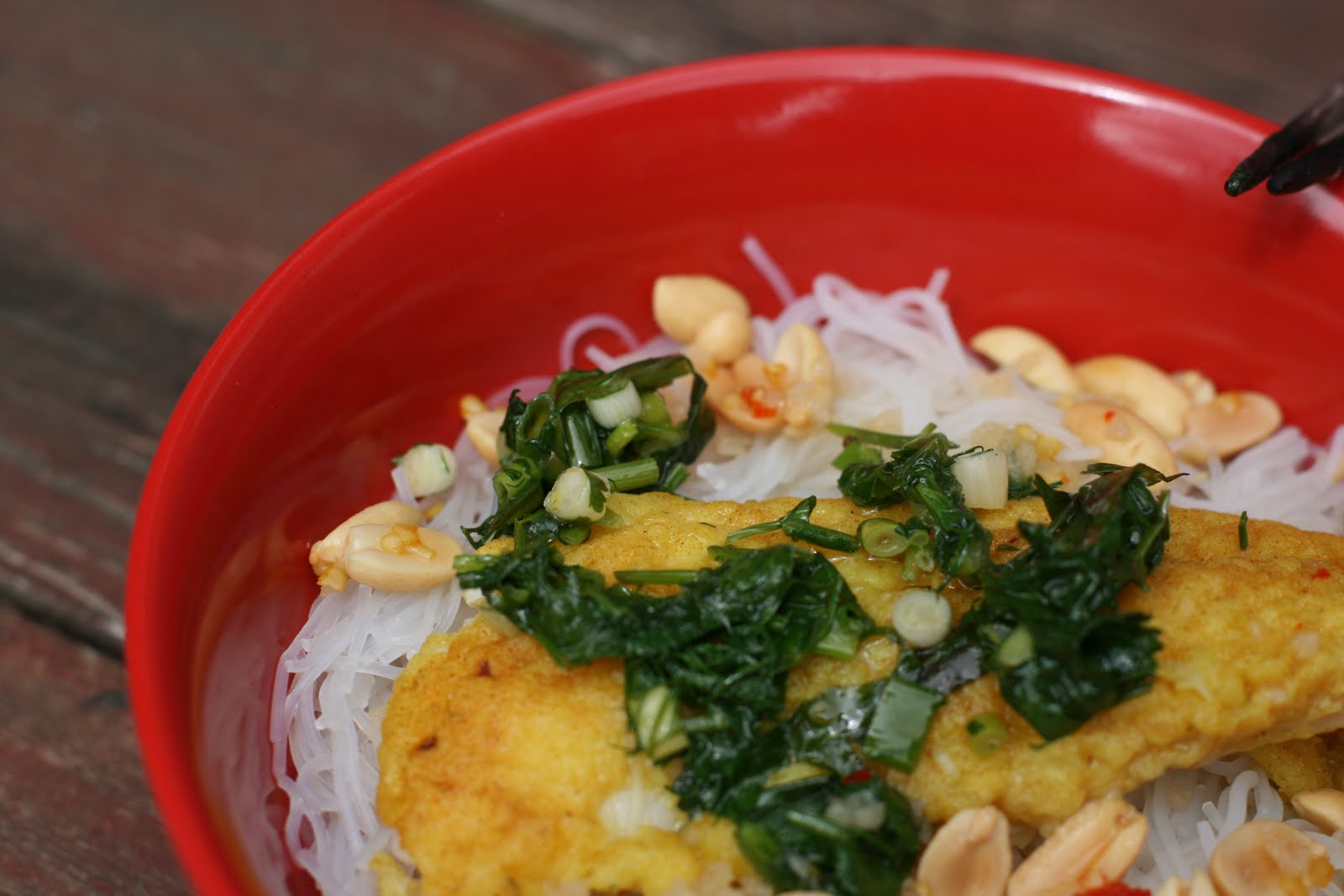
Vietnamese Turmeric Fish with Rice Noodles, Dill and Nuoc Cham


For many diners, all it takes to enjoy a meal is the right condiment. Some people (and, for convenience, we'll call them Midwesterners) douse any number of dishes with ketchup before consumption. Others carry around a small bottle of a favorite hot sauce in their purse. For me, the magic condiment is fish sauce and lime juice.

Okay, it's not quite as versatile as ketchup. And I realize that fewer Americans share this obsession. But I love, love, love this combination. Funky, salty, umami-rich fish sauce, mixed with a bright sour hit of lime? Perfect. Add a little sugar to sweeten out the edge, and some water to lighten things up (yielding nuoc cham, a favored dipping sauce), and there's nothing better. And lest you vegetarians feel left out, you can often find fish-free fish sauce substitutes at Asian markets (look for the Vietnamese word chay, which means vegetarian, and also look out that it doesn't use msg as a shortcut). Even if you're wedded to ketchup, you should give this combination a try.

I usually put together my favorite nuoc cham to dress rice noodle salads (or, if I must admit, frozen potstickers). But a few years ago I tried this amazing catfish dish at a local Thai restaurant. Catfish was dredged in a turmeric-heavy rice flour coating, then pan-fried and served on a bed of rice noodles. Some fresh herbs (including the I-didn't-know-it-was-used-in-Southeast-Asian-cooking dill) were sprinkled on top. And my beloved fish sauce dressing pulled it together beautifully. A basic fried fish, when it came down to it, with an exciting punch of flavors. I had to make it at home.

Trolling around the internet, I discovered that this recipe is famous in Vietnam, originating in Hanoi's Chả Cá Lã Vọng restaurant. Recipes vary -- some with fried shallots, some with grilled instead of pan-fried fish -- but the basic model of turmeric-scented fish, rice noodles, fresh dill and nuoc cham remains the same. I've made it several times, barely following a recipe, adapting to the fresh herbs on hand (as long as dill is in the mix), and often tossing in some totally non-traditional broccoli or spinach to green up the meal. Sometimes I fry whole fish fillets and break them into the rice noodles as I eat, other times I cut the fish into bite-sized pieces before dredging and frying. It's always great. It's also a lovely summer choice, as there's no oven involved, just a bit of pan-frying. So when I had some fresh dill left over recently after cooking up a pile of Swedish midsommar food, and when I realized I had never told you about this dish, it was the logical dinner choice. Perhaps it'll win over some new nuoc cham devotees.


Vietnamese Turmeric Fish with Rice Noodles, Dill and Nuoc Cham

serves 4
adapted from several sources, notably Mai Pham's
The Flavors of Asia


Sauce:
1/3 cup lime juice
1/2 cup fish sauce
1-2 Tbsp sugar
1/2 cup water
1 clove garlic, minced
4 small fresh chilies (or more or less to taste), sliced into rings

Noodles, Fish and Herbs:
6 ounces rice vermicelli (1/2 package)
1/2 cup rice flour
1 tsp turmeric
1/2 tsp salt
2 large fillets (~1 lb) catfish, tilapia, or similar fish (I'm currently smitten with the cheap-and-delicious Swai), left in fillets or cut into 2" pieces, as you prefer
2-3 Tbsp high-heat oil for cooking, such as canola
1 bunch scallions, thinly-sliced (~1/2 cup)
1 bunch dill, roughly chopped (~1 cup), divided
1 handful basil leaves, roughly chopped
1 handful cilantro, roughly chopped
1/4 cup roasted peanuts
hot sauce, such as sriracha

Prepare the dressing by mixing together all of the dressing ingredients in a bowl. Adjust as needed to get the hot-sour-salty-sweet balance to your taste. Set aside.

Cook the rice noodles according to the directions on the package, and set aside at room temperature.

Heat a large frypan over a medium-high heat. On a plate, mix together the rice flour, turmeric and salt until well-combined. Place the fish on the plate, and press into the rice flour coating so that it adheres. Turn the fish over over and coat the other side.

When the pan is hot, add ~2 Tbsp oil. Add the fish, and fry on each side until done, ~3-5 minutes per side, depending upon the size of your pieces. Remove from the pan and set aside. In the same skillet (adding another Tbsp of oil if it's dry), add the scallions and half of the dill. Saute for a minute or two, until the herbs soften and just begin to cook. Turn off the heat, and add the remaining dill and the other fresh herbs.

To serve, place a pile of rice noodles into a bowl. Top with a portion of fish and some of the herb mixture. Sprinkle with peanuts, dress with the fish sauce dressing, and add hot sauce as desired.

Sunday, June 12, 2011

Chocolate Cinnamon Cookies


Recently a reader expressed an interest in a vegan version of this rich pistachio pudding. Despite its dairy-filled indulgence, that recipe actually lends itself fairly well to veganizing: the ground pistachio contribute a richness that compensates for any less-than-creamy faux-creams you want to swap out, and it's thickened with a cornstarch slurry instead of eggs. But the problem comes in putting together the whole package: part of the pudding's perfection comes in pairing it with bittersweet snappy-crisp chocolate cookies, to offset all that smooth. And so, here's an alternative: a dairy-free, egg-free, snappy-crisp chocolate cookie. Don't say I don't aim to please.

The recipe comes from the doyenne of vegan cookies, Isa Moskowitz. She introduced these as Mexican hot chocolate snickerdoodles, but due to my disagreements with cayenne, I ended up just adapting them as a regular ole chocolate cookie. But they are still quite exciting. The texture is perfect, crisp-but-not-too-crisp, and they crackle beautifully in the oven. The bit of cinnamon in the dough (and in the cinnamon-sugar dusting it gets before the oven) doesn't overwhelm the cookie, but nicely complements the chocolate flavor. They're perfect for enjoying with a cold glass of milk (or soymilk), sandwiching with some summer ice cream (or soycream), or dunking into a dish of rich, smooth pudding.


Chocolate Cinnamon Cookies

adapted from Isa Chandra Moskowitz, from her book Vegan Cookies Invade Your Cookie Jar
yields ~4 dozen cookies

Topping:
1/3 cup sugar
1 tsp cinnamon

Cookies:
1 2/3 cup flour
1/2 cup cocoa powder
1 tsp baking soda
1/2 tsp salt
1/2 tsp cinnamon
1/2 tsp cayenne (optional, for a spicy cookie)
1/2 cup canola oil
1 cup sugar
1/4 cup maple syrup
3 Tbsp milk (or soymilk)
1 tsp vanilla extract

Preheat the oven to 350 degrees. Line two baking sheets with parchment paper, or grease well.

Mix together the cinnamon and sugar for the topping in a small dish, and set aside.

In a bowl, sift together the flour, cocoa powder, baking soda, salt, cinnamon and cayenne (if using). Set aside.

In a mixer or large bowl, mix together the oil, sugar, maple syrup, milk and vanilla until well combined. Add the dry ingredients, stirring until dough comes together.

Scoop out tablespoons of dough (a mini ice-cream scoop makes this ridiculously easy, though it can also be done with two spoons), and plop them into the dish of cinnamon-sugar. Roll around to coat, then transfer to the prepared cookie sheets. Repeat with the remaining dough, leaving ample space for the cookies to spread. Press on each cookie to flatten it into a not-too-thick disc (a little thicker than the finished cookie, as they will continue to spread in the oven). Transfer to the preheated oven and bake ~10 minutes, until the cookies have spread and gotten crackly on top (they won't be entirely set). Remove, and let cool on the cookie sheet for 5 minutes, until firm enough to transfer. Move to a cool rack to cool completely.

Monday, June 06, 2011

Tomato Biryani


There's an old piece of advice regarding good hostessing and housewifery: never try out a new recipe with company. I'm not fully on board -- sometimes produce-driven inspiration strikes, or you find the perfect recipe right before a party (or you just want something special and new to excite you). But I understand the reason for the rule. As someone who cooks a lot, I've had my share of culinary flops. And I wouldn't want to subject my guests to these sorts of sunken cakes, crumbly breads, and underwhelming entrees. So for the most part, when others are involved, I stick to known commodities.

But sometimes I just don't take my own good advice. A few years ago, I took a bad idea even further: instead of cooking a strange recipe for a dinner guest, I brought it along for a bulk cooking project with a friend. The plan was to bust out her shiny new food-storage machine (the kind that seals food in plastic and sucks the air out), and make 10x a few recipes, and thus be set with insta-meals for months to come. We made my beloved spanikopita, a tomato-chickpea curry I'd tried before, and then, against better judgment, a new recipe for biryani. I knew it was dicey to end up with pounds upon pounds of an untested recipe, but c'mon, it's biryani! Just Indian seasoned rice and vegetables! How could it be bad?

As you may have figured from my dramatic lead up, it was bad. Really bad. So-bad-even-thrifty-me-threw-it-out bad. The seasonings were wrong, the vegetables didn't work together, and the rice was mushy. I tried to choke down a bit of the awful mixture, but ended up moving the contents of those neatly-sealed bags from the freezer to the compost. Thus scarred, I avoided both bulk cooking and biryani for several years. But now, biryani has been redeemed.

When I first saw this recipe, I thought it was almost boring. Just tomatoes? No saffron or other such excitement? But it works, and it's perfect. Warm spices like cinnamon and cardamom combine with savory garlic, onion and tomatoes, creating the complex spicy interplay of flavors common to dishes from India's Moghul tradition. It's a simple thrifty pantry meal, easily dressed up if you want (I freestyled a spinach raita, which made a lovely complement). I prepared this for a potluck, where it stood out alongside grilled asparagus and a Greek egg-lemon soup, and was promptly devoured.

And if you're interested in exploring bulk cooking (with a well-tested recipe), I direct you towards this recent article on making your own freezer burritos (I've tasted the results of this recipe, and can vouch for its deliciousness). And, while I'm sending the links, I'll direct you to an NPR story I produced about a new type of training program at the local women's prison. Here's to delicious success, in the kitchen and in life.


Tomato Biryani

adapted from Pauljoseph via Food52
serves ~3

1 cup basmati rice
2 Tbsp butter, ghee, coconut oil, or canola oil
1/4 tsp whole cloves (don't overdo this one - cloves are potent)
6 cardamom pods
2 cinnamon sticks (~3 inches each)
2 blades mace (if you don't have this, no worries)
1 small red onion, cut in half and sliced thinly into half-moons
1 tsp julienned fresh ginger
4 cloves garlic, thinly sliced
2 hot red or green chiles, cut into thin strips or slices
into thin strips (seeds included -- I used two frozen red Thai chiles, and they provided a good amount of heat)
1 can (14.5 ounces) diced tomatoes
1 tsp coarse salt
1/4 tsp turmeric
1/4 cup minced cilantro

Place the rice in a bowl, and cover with water. Swish around, then drain, and repeat until the water no longer turns cloudy. Cover the rice with fresh water, then let sit for 20-30 minutes until the grains soften.

Heat the butter or oil in a pot over a medium-high heat. Add the cloves, cardamom pods, cinnamon sticks and mace (if using). Let sizzle until fragrant, ~15-30 seconds. Add the onion, and saute until brown around the edges, 5-7 minutes.

When the onion slices have browned, add the ginger, garlic and chiles. Cook, stirring, for 1 minute
(the garlic won't be fully cooked, but that's fine), then add the tomatoes, salt and turmeric. Simmer, stirring occasionally, until the tomatoes are softened, ~5-7 minutes.

When the tomatoes are soft, drain the rice and add to the pot, stirring well. Add 1 1/2 cups water, and cook, uncovered, over the same medium-high heat, until the water cooks down to the surface level of the rice, and craters are beginning to appear in its surface. At this point you can give it a stir to mix, then reduce heat to its lowest possible setting and cover the pot. Cook, undisturbed, for 10 minutes, then turn off the heat and allow to sit for another 10 minutes.

When the rice has cooked and rested, remove the lid, and fluff with a fork. Remove the aromatics if you like (trying not to mush the rice overmuch), or just make sure to warn diners about them. Sprinkle with cilantro and serve.

Sunday, May 29, 2011

Garlicky Sesame-Cured Broccoli Salad


My neighbor is a somewhat evangelical member of a local women's gym. In addition to the usual elliptical trainers and weight machines, the gym has one feature she prizes above all else: a light room. This small tiled room, just big enough for four chairs, features a large full-spectrum light, an aromatherapy machine, and a pile of trashy magazines. On these rainy Northwest days (which we are still having), gym members love nothing more to sit and soak up a little vitamin D and tabloid gossip. The smell of eucalyptus will now be forever associated with the Kardashians.

Thanks to the magic of the Groupon, I've joined my neighbor these last few weeks. I've sweated and gasped through cardio workouts that probably wouldn't phase a ten-year-old, and ended up painfully sore from lifting teensy weights. And I've spent a good amount of time sitting in the light room. I keep meaning to bring my own reading material (my book club is now planning an unseasonable summer-long trip through Dickens' Bleak House), but why do that when I can read about the romantic lives of celebrities I've never heard of?

Last week I was leafing through one such magazine in the faux sun, which featured an article on weight-loss lifestyle tips of nutritionists to the stars. In addition to the usual strategies of not eating every appetizer at the party (a strategy I forgot to keep in mind last night), they recommended limiting your diet to a short list of approved foods. The idea wasn't just to keep you from eating unhealthful items, but to literally bore you into weight loss. If you're only allowed egg whites, chicken breasts, and blueberries, you evidently start eating less because you're tired of egg whites, chicken breasts, and blueberries. Which just seems sad.

Like most people, I crave variety in my diet. I try new foods and new preparations, get excited about unfamiliar techniques and cuisines. And I reckon to say that I'm more satisfied with a meal that packs an excitingly novel punch of flavors. I get on short-lived kicks where one particular ingredient or dish goes into heavy rotation, but for the most part I want to try to do new things in the kitchen. Except when it comes to green vegetables.

My preparation of chard, broccoli, spinach and the like looks like this:

1. heat a bit of olive oil
2. add garlic, saute until fragrant
3. add green vegetable, cook until done
4. squeeze lemon wedge and sprinkle salt over the top
5. eat

Every now and then I'll throw said vegetable in the defective rice cooker that serves as our steamer basket, or turn it into a Thai curry or Indian saag, but 9 times out of 10 I run through the steps above. Other members of the household have mentioned a desire for something other than garlicky lemony greens, but I generally push these requests aside. It's a culinary rut I can't seem to break out of. But that all might change with this garlicky sesame-cured broccoli salad.

This recipe comes from the never-disappointing Melissa Clark. The broccoli is technically raw, but it gets tossed with a bit of vinegar and salt (as well as some warm garlicky oil). As the broccoli sits, the acid softens it, leaving it with an addictive crunchy-yet-yielding texture, somewhere between raw and cooked, and a beautifully bright green flavor. A bit of toasted sesame oil and some cumin seeds give it a nutty depth (and go together so well I wonder why I haven't paired them before), and a pinch of chili flakes provide heat. Variety never tasted so satisfyingly delicious.


Garlicky Sesame-Cured Broccoli Salad

adapted from
Melissa Clark in The New York Times

serves ~4

2 tsp vinegar of your choosing (Clark recommends red wine, we used a mix of rice wine and balsamic)
1 tsp coarse salt
2 lbs broccoli crowns (~2 large heads), washed and broken into small florets
1/3 cup olive oil
4 large cloves garlic, minced
2 tsp cumin seeds
2 tsp toasted sesame oil
large pinch crushed red chile flakes

In a large bowl, mix together the vinegar and salt. Add the broccoli, and toss to combine. Set aside.

In a large skillet, heat the olive oil until hot but not smoking. Add the garlic and cumin seeds, and cook until fragrant (it should only take a minute). Add the sesame oil and chile flakes. Turn off the heat, and pour the hot mixture over the broccoli, tossing well so that the hot oil coats everything. Let sit for at least an hour, for the broccoli to soften and the flavors to develop. Taste before serving and adjust seasonings if needed.

Saturday, May 21, 2011

Pistachio Pudding with Chocolate Cookies


Neither pistachios nor pudding get the respect they truly deserve. To whit: order a pistachio-flavored dessert, and you will invariably be served something that's almond-flavored. But colored green, see, so it's pistachio (to give props, this realization was attributed to the amazing pastry chef Shuna Lydon). And pudding -- according to a friend, in Turkey you can find entire restaurants devoted to pudding. Just pudding. It boggles the mind. Stateside, unless you count its fancy euro-sounding cousins of mousse and pot-de-creme, pudding isn't likely to make it onto the dessert menu at all. Most of the time, it's served in individually-sealed plastic snack cups, or plopped out of industrial-sized tubs onto cafeteria trays. This is all a shame, because both pistachios and pudding have a lot to offer by the way of dessert. Especially when they are combined together.

This sweet combination has all I look for in a final course. The pudding is rich, deep and smooth, with a true pistachio flavor (I was worried that the cinnamon would overpower, but it just serves to deepen the pistachio's aromatic notes). It is a bit thick from the ground nuts, so the sweet blob of whipped cream provides a welcome lightness. And then the cookies lend a delicious snap and bittersweet edge (I reduced the sugar a bit, upon advice from Smitten Kitchen), as well as their basic chocolatey goodness (which we all kinda want from a dessert anyways). It's a pudding fancypants enough to serve at your next dinner party. It's a pudding that might just redeem pudding (and pistachios) forever.


Pistachio Pudding with Chocolate cookies

pudding adapted, somewhat heavily, from Cookshop, as told to the Amateur Gourmet, cookies adapted from Retro Desserts, as flagged and adapted by Smitten Kitchen
yields ~6 portions puddings, and ~2-3 dozen cookies


For the Cookies:
1 1/4 cups flour
1/2 cup dutched cocoa powder
1 tsp baking soda
1/4 tsp baking powder
1/4 tsp salt
1 cup sugar
1 1/4 sticks (10 Tbsp) unsalted butter, softened to room temperature
1 egg

Preheat the oven to 375 degrees. Line a few cookie sheets with parchment paper, or grease them well and hope for the best.

Place the flour, cocoa powder, soda, baking powder, salt and sugar in the bowl of a food processor or mixer. Pulse or mix a few times to combine the dry ingredients. Add the butter and egg, and pulse or mix a few times until it just comes together.

Scoop tablespoons of the mixed dough onto the prepared cookie sheets, leaving some space between cookies (these will spread). Flatten slightly, wetting your hand if needed to keep the dough from sticking. Bake for ~9 minutes, until just set. Let them cool on the sheet for a minute or two to set, then remove to a rack to cool completely.

For the Pudding:
4 cups cream, divided
2 cups milk
2 cups toasted pistachios
2 sticks cinnamon
1 cup sugar, plus more for the whipped cream
3 Tbsp cornstarch
vanilla to taste

Place 3 1/4 cups of the cream (set aside the remainder in the refrigerator), the milk, pistachios and cinnamon in saucepan. Bring to a simmer, then turn off the heat and allow to steep for 1/2 an hour. Get some cups ready for the finished pudding.

When the cream/pistachio mixture has steeped, blend it fully, and then strain it back into the saucepan (I had to sort of persuade it through the strainer with a spatula, clearing out the nutty detritus a couple of times during the process, but results may vary depending upon your blender and strainer). Whisk together the sugar and cornstarch in a bowl, and then add enough of the strained cream mixture to create a smooth paste. Whisk in the remainder, then pour it back into the pot. Heat over a medium flame, whisking, until it comes to a boil. Lower the heat until it just maintains a simmer, and simmer, whisking constantly, for 3 minutes. Pour into cups in your desired amounts, and chill.

Before serving, whip the remaining cream into soft peaks, and add sugar and vanilla to taste. Top the pudding with whipped cream, and serve with a chocolate cookie (or three).

Monday, May 16, 2011

Red Lentil Dal with Cabbage


Portland recently took a turn for the chilly. There are still asparagus and rhubarb to be had, but right now I'm not thinking of icy semifreddos or springy pizzas. I'm thinking about cabbage and beans.

I've always been a fan of Indian dals, the soupy bean dishes beloved by all protein-seeking vegetarians. They're dirt cheap, easy to make, and keep spectacularly well. I always simmer up a massive pot, thinking I'm going to stash some portions in the freezer for future lunch emergencies, and end up eating it all within a few days. I'm currently smitten with a curry-leaf version from Madhur Jaffrey's latest cookbook, which might be the most brightly flavorful dal I've ever made. But recently I'm craving something heartier and humbler. Like cabbage dal.

This recipe is ridiculously easy. The beans -- red lentils, in this case -- are lightly scented with spice (including the you-wouldn't-think-it-works-but-it-totally-does cinnamon stick), and then simmered until they break down into a creamy mess. An entire head of cabbage gets chopped and thrown into the pot, and, amazingly, melts away until you barely know it's there. The resulting dal is a great complement to a tomato-studded curry (I served it with a saucy spinach-pea-tomato concoction), or fine with just a bit of rice or naan and blob of yogurt as its companions. Add some of Patak's garlic chutney (an obsession of mine for several years), and it'll warm you right up until spring rolls around.


Red Lentil Dal with Cabbage

adapted from She Spills the Beans
serves ~6


1 Tbsp high heat oil, such as canola or coconut
3 Tbsp butter or coconut oil
1 tsp cumin seeds
1 tsp mustard seeds
1 onion, finely chopped
3 cloves garlic, minced
2 cups red lentils
1 head cabbage, chopped into 1" lengths
1 stick cinnamon
4 dried chilies (adjust depending to your taste)
1 bay leaf
6 whole cloves
handful of curry leaves (optional)
1 tsp garam masala
salt to taste

Heat the butter and oil in a large pot over a medium-high flame. Add the cumin and mustard seeds, and cook for a minute, until they begin to pop (have the lid at the ready, to keep them from popping out of the pot). Add the onion, and saute until translucent, and beginning to pick up a few brown spots. Add the garlic, and stir for a minute. Add the lentils, cabbage, whole spices, and then add water to just barely cover. Bring to a boil, then reduce heat until it's just high enough to maintain a simmer. Simmer, stirring occasionally, until the lentils are broken down (~1 hour, although it only gets better with time, so 2 hours is better). Season with the garam masala and salt to taste.

Sunday, May 08, 2011

Roasted Rhubarb with Creme Fraiche Semifreddo


Rhubarb! Rhubarb! Rhubarb! After singing the praises of seasonal produce and asparagus last week, talking about rhubarb seems a natural next step. Rhubarb's ruby stalks stick around a bit longer than asparagus, but when they first break through the sad, fruit-free depths of winter, it's no less a spring awakening. In my first-fruits rapture, I bake it into a custard tart, simmer it down into a syrup, or wait patiently (well, somewhat patiently) as it infuses into liqueur. But last week I had a rare extra carton of creme fraiche, which made me think how lovely rhubarb's tartness complements a sweet and creamy dessert. Thus the semifreddo.

For those who haven't been so lucky as to taste their creamy deliciousness, semifreddos are Italian desserts, sort of like a frozen mousse. Most recipes start with a saboyan, whipping (and sometimes heating) together a shockingly large number of egg yolks and some sugar, then lightening the whole mixture with some whipped cream and freezing it in a mold (a loaf pan is fine, which lets you cut dramatic slices). The beaten-in air lightens the mixture, giving you all of the luscious creamy lightness of ice cream without an ice cream-maker. Win!

This recipe is inspired by Suzanne Goin's Sunday Suppers at Lucques, which pairs a rhubarb compote with a vanilla semifreddo. Goin's version is a little less yolky than most, featuring only three eggs, and folds in beaten egg whites as well for an even more light-as-air result. It's ridiculously simple for such a sophisticated dessert, doing away with the stovetop custard bases and fancy machinery, and requiring no more than a bunch of beating and folding. I cut down the cream a bit in Goin's recipe, replacing it with a small amount of cultured creme fraiche instead. It's a small enough amount that it doesn't overwhelm, adding just the merest hint of tang to offset the creamy vanilla. And then there's the rhubarb.

In Goin's original recipe, she pairs the semifreddo with a rhubarb compote, cooked down to a deliciously tangy slump. I've made compotes (both hers and others') and loved them. But since I'm still in the Holy Crap It's Spring! mindset, I wanted to show rhubarb off a little more. Instead of the jammy compote, I went with Canal House's recommendation of roasting the stalks. This recipe still features the rhubarb+sugar+vanilla+wine combination Goin favors (Canal House called for red, but I replaced it with the lighter white that Goin used -- it is Spring, after all), but bakes everything in the oven instead of stewing it on the stovetop. If you're careful enough with your gentle turning, the chunks of rhubarb soften but hold their shape, yielding a tart accompaniment to the creamy semifreddo that's beautiful as well as delicious. And if you serve it promptly (instead of waiting for it to melt, as I did in my picture below), it makes for an elegant plate. Spring dinner party, anyone?

And speaking of Spring, here's a gift for Mother's Day I wrote up for The Oregonian, on how to show love to the new moms in your life (with food, of course).


Roasted Rhubarb with Creme Fraiche Semifreddo

semifreddo adapted from Suzanne Goin's Sunday Suppers at Lucques, roasted rhubarb adapted from Canal House Cooking, Volume 3

serves ~6


Semifreddo:
3 large eggs, separated
2/3 cup sugar, separated
1 cup heavy cream
1/4 tsp vanilla extract
1/2 vanilla bean
1/4 cup creme fraiche (can be omitted if you don't have, or increased for a more pronounced flavor, but this small amount works quite well)

Roasted Rhubarb:
1 lb rhubarb, cut in 2" lengths
1/4 cup white wine
1/3 cup sugar
1/2 vanilla bean (from making semifreddo)

Line a 9" loaf pan with plastic wrap or parchment (if using plastic wrap, you can try to smooth out any wrinkles that will imprint themselves on the finished semifreddo, but I usually fail at that task). Set aside.

Place the egg whites in the bowl of a large mixer, and beat, gradually increasing the speed to high and sprinkling in 1/3 cup of the sugar. Beat until stiff peaks form, then transfer to another bowl (it can be a small one) and set aside.

Add the cream to the mixing bowl, and beat on medium until stiff peaks form. Transfer to a large bowl and set aside.

Place the reserved egg yolks in the mixing bowl, and add the seeds scraped from the vanilla bean (reserve the pod for the roasted rhubarb), vanilla extract, and reserved sugar. Beat until the mixture has lightened in color and thickened and doubled in volume, ~3 minutes. Whisk in the creme fraiche until it is just combined.

Take the yolk mixture, and gently fold it into the bowl of whipped cream. Add the beaten egg whites, and fold in in a few additions, until there are no streaks left, taking care not to deflate the mixture. Pour it into the prepared loaf pan, and place in the freezer. Freeze until solid, at least 4 hours.

When the semifreddo is ready, prepare the roasted rhubarb.

Preheat the oven to 350. Place the rhubarb, wine, sugar, and left-over half of the vanilla bean in an oven-proof pan (I used an 8" square casserole dish, which worked perfectly). Stir to evenly distribute ingredients. Place the pan in the oven and bake for about half an hour, turning the rhubarb once (gently!), until the rhubarb is totally tender but hasn't lost its shape. Remove from the oven, and let cool slightly (or fully, depending upon your taste). Discard the vanilla bean.

To serve, cut thick slices of the semifreddo, and serve topped with the roasted rhubarb and its syrupy juices.