Showing posts with label seafood. Show all posts

Friday, March 13, 2015

Fresh Pasta in Lemon Cream Sauce with Seared Scallops


Sometimes I make meals that transform humble, dare-I-say-cheap ingredients into something fancier. Roasting some carrots and dressing them up with sauce and garnish, or elevating potatoes with a pile of North African spices. All delicious. And then there are meals on the flip side — where I take fancy, indulgent, special occasion ingredients. And do almost nothing to them, and just let their simple deliciousness shine through. Like I did the other night.

I recently had a friend over for dinner, and did that lovely fake math wherein you decide well, since we're not eating out as we'd initially planned, I'm still actually saving money by buying these fancy ingredients, right? Perhaps you are familiar with these batshit calculations? Anyways, in this case, it involved a leisurely walk down pick up some fresh-made pasta, and a tub of creme fraiche. Then some scallops — which, admittedly are terrifyingly expensive, but luckily you only need a few per person for a transcendent meal. And this was transcendent.

This is one of those meals that's more about shopping than cooking. After we enjoyed a delicious salad (butter lettuce, leftover roasted cauliflower, kumquats and feta), I ducked back in the kitchen to pull this together in just minutes. The scallops seared, the pasta boiled, and a plop of creme fraiche, lemon, and arugula hit the pan. That's it. I took a hasty cellphone pic, and we ate in amazement.


Fresh Pasta in Lemon Cream Sauce with Seared Scallops

inspired by the pasta dish in Amanda Hesser's Cooking for Mr. Latte, but tweaked beyond recognition
serves 2

~6 large fresh scallops
high-heat oil, like grapeseed
1 pound
1 cup creme fraiche
zest and juice of a meyer lemon
a few handfuls arugula, washed and torn into bite-sized pieces

Bring a large pot of salted water to a boil, and bring a large skillet to a screaming high heat. Set the scallops out to dry (I just set them out on a plate lined with a piece of a brown paper bag).

When your pan is very hot, pour in a bit of oil to slick the surface, and place in the scallops. Sear for a few minutes, until they develop a nice crust, then flip and sear on the other side. Remove from the pan, and set aside. Salt.

Place the pasta in the boiling water, and cook until done. Drain (I like to pour some of the pasta water into the serving plates to warm them, as this dish is best warm). Turn the scallop pan back on, and add the creme fraiche and lemon juice/zest. Stir to mix everything together (including that delicious flavor from the pan), then stir in the arugula and pasta, and toss everything together until the arugula is just wilted. Salt to taste. Drain your serving plates if you filled them with pasta water, then fill with pasta, and top with scallops. Serve. Moan. Enjoy.

Monday, December 29, 2014

Armenian Pilaf with Shrimp, Cilantro and Feta


For the record, I am a big fan a brown rice. Nubby, healthy, delicious. It's my weeknight staple. But I also love love LOVE white rice. A few months back I invested in a mega-sack of Basmati rice. How big is the sack? I don't know, as it's shoved out of the way on an inaccessible shelf, decanted into a more manageable jar as needed. I don't dip in very often, but when I do — oh man. It's aromatic, amazing, delicious. It's like a big warm good-smelling hug. Others may slide into a bowl of mac'n'cheese, or mashed potatoes. And I do so love the both of those. But a delicious pilaf with buttery white rice — that's my comfort food.

A few weeks back, I had some friends in need of a good comforting dinner. So I took my trusty rice, along with some delicious shrimp, and an Armenian cookbook I've had out from the library. I cooked up this easy dish, leashed up my dog, and hauled the cast iron pot through the neighborhood (along with a salad, and mason jar full of Mai Tais). And it did the trick.

This recipe is one of those simple, greater-than-the-sum-of-its-parts bits of magic. Shrimp shells are simmered in stock, to give an extra richness to the rice, which is further bolstered with saffron and tomato paste (the original recipe offered either, but I, in my wisdom, opted for both). The shrimp are stirred in at the last minute, so they stay nice and tender (I take the extra step of brining, which also helps), and then everything is topped with feta and cilantro. The end result is intriguing enough to keep you reaching for bite after bite — yet simple enough to wrap you up in starchy comfort. 


Armenian Pilaf with Shrimp, Cilantro and Feta

adapted from The Armenian Table by Victoria Jenanyan Wise
serves ~4

1 pound uncooked shrimp, in shell
3 cups broth (vegetable or chicken)
2 tablespoons butter or olive oil
1/4 cup finely diced onion
1 1/2 cups long grain white rice
1 tablespoon tomato paste
1 hefty pinch saffron
1 large handful cilantro leaves, plus additional for serving
1/2 teaspoon coarse salt
1/4 teaspoon aleppo pepper, plus additional for serving
1/3 cup crumbled feta cheese

Shell the shrimp, leaving the tails intact (if you fancy, for dramatic effect), and reserving the shells. Place the shrimp in a small bowl of water, along with a hefty pinch of salt and a small bit of sugar (this brining is optional, but I feel improves the flavor and texture). Place in the refrigerator.

Place the reserved shrimp shells in a small saucepan along with the broth. Bring to a boil over high heat, then lower the heat until high enough to maintain a brisk simmer. Cook until the shells are pink, about 3 minutes. Turn off the heat and set aside.

To make the pilaf, melt the butter (or pour the oil) in a good-sized saucepan or pot over a medium-high heat. Add the onion and rice, and saute until the rice is translucent (but not colored), ~2 minutes. Strain the shrimp broth into the pot through a fine-mesh strainer. Add the tomato paste, saffron, cilantro, salt and aleppo pepper, and stir to combine. Bring to a boil over high heat, then reduce the heat to low, cover, and simmer for 22 minutes, until the rice is tender.

When the rice is done, turn off the heat, and take your shrimp from the refrigerator. Drain, and stir into the pilaf. Cover the pot again, and let sit for 5 minutes, until the residual heat cooks the shrimp until they're just barely pink. Serve warm, garnished with the feta cheese, and additional cilantro and aleppo pepper, if desired.

Monday, August 04, 2014

Chilled Cantaloupe Soup with Poached Shrimp


The heat continues! Temperate Portland has been in the 90s for weeks. Weeks! Yes, there are hotter places in the world. But for us, this is far from our usual no-need-for-air-conditioning state of affairs. I realize that even a functional planet has cycles and oscillations and all that, but it's hard not to feel like we're on a march toward some sweaty inevitable crash course with the sun. Or perhaps I'm being dramatic? I can't tell. It's hard to think straight, what with all this heat.

So yes, the world does seem to be on a path that ends in fire. But, on the bright side, I've rediscovered cold soups.

Now this may seem a strange combination. But it's not too far from gazpacho, a similarly sweet-savory blend of cooling summer produce. Also, it's dead simple, one of those dishes whose flavor and wow factor far exceeds the effort involved. Basically it looks like this: cantaloupe, cucumber, and a touch of onion get tossed in the blender, seasoned and smoothed with olive oil and vinegar. Then poached shrimp are tossed on top, and the whole thing is finished with a sprinkling of olive oil and chives. What more do you need? And, more importantly, on these tropical days, what more do you have the energy for?


Chilled Cantaloupe Soup with Poached Shrimp

adapted from A Day That is Dessert (thanks!)
yields ~4 cups, as small appetizer-y servings

1 small cantaloupe melon (or one large one, with about 1/3 reserved for snacking), ripe and fragrant
1 small cucumber or 1/2 large cucumber, peeled and roughly chopped
1-2 tablespoons chopped onion
2 tablespoons olive oil, plus more for drizzling
1 tablespoon sherry vinegar
salt and white pepper
~12 small or medium-sized shrimp (either standard or salad shrimp will work — I used a small bag of frozen spot prawns)
a small handful of chives, minced

To make the soup: Place the melon, cucumber, the smaller amount of onion, olive oil, and vinegar in a blender, along with a splash of water. Process until smooth. Add salt and pepper to taste, and adjust seasonings as needed, adding remaining onion if desired. Process again to blend, and add additional water if needed to create a smooth soup. Set aside in the refrigerator to chill while you prepare the shrimp.

To poach the shrimp: Bring a small pot of heavily salted water to a boil (I also like to throw in a pinch of sugar as well). When it's boiling, add the shrimp, then turn off the heat and cover the pot. Let sit until the shrimp turn opaque and pink, ~5 minutes (it will be more or less depending upon the size). While they're sitting, prepare a bowl of ice water, and when they're ready, drain the shrimp, and slip them in the ice water to stop the cooking. Peel the shrimp from their shells. If the shrimp are large, you can chop them, but if they're smaller you can leave them whole.

To serve, pour out a small cup of soup, and top with a portion of shrimp. Scatter on a drizzle of olive oil and some chives, and serve.

Monday, June 30, 2014

Halibut with Carrot Puree, Early Summer Vegetables, and Pistou


Apologies for this single, hasty, unfocused photo. I just snapped a quick record for my own documentation, figuring I'd never blog something that required such an insane amount of preparation. And then I tasted it. And oh my. I thought about going back and getting the camera for proper pictures, but really, I couldn't leave my plate.

This deliciousness came about because I was tasked the other day with bringing dinner (and moral support) to a friend who was spending a first day on solo infant duty. I thought about cooking up a big load of freezer-friendly food — perhaps spanakopita and tomato biryani, or a few pints of carrot coriander vinaigrette. But then I saw a new restaurant cookbook waiting for me at the library. And I thought about just going fancy instead.

A freezer full of food is a wonderful thing. But you know what? So is a little luxury. And the latter is in woefully short supply when you're waging a sleep-deprived battle to meet basic life needs. So I set aside my casserole plans, and went to the farmer's market for bushels of early summer bounty — fat carrots, curly green garlic scapes and pea shoots, juicy spring onions and the first fragrant basil. And then, after just a few insane hours of cooking, and washing nigh everything in the kitchen (steamer basket and Dutch oven and mortar and pestle and pot and frying pan and food processor), the elements were ready. And all that was left was to sear the fish, bring the dish over, and whisk the baby away for a miraculously tearless diaper change while this perfection was savored.

In some ways, this meal reminds me of my beloved butterscotch budino — multiple elements (each with significant levels of fuss), requiring more time than a usual few days' kitchen efforts combined. But the end result is just transformative. It's like the best restaurant meal you've ever had. It's like a dream about food.

In this case, the dream rests on a bed of carrot puree (carrots first steamed with basil stems before browning in olive oil, natch). The resulting smoothness has a clean flavor, but also a roasty sweetness from the caramelization. And the glug of olive oil doesn't hurt either. This is topped with a buttery saute of spring vegetables — the recipe called for asparagus, but since we're just past the season, some garlic scapes made for a nice substitute. And then pea shoots, lending their adorable tendrils and green flavor (plus a fun little play on peas and carrots, which is always a good time). On top of this saute rests a marinated and seared halibut fillet, and then a dollop of creme fraiche (or, in my case, the last little bit of sour cream mixed with a bit of yogurt), then, finally a simple pesto of basil, garlic and oil. Each element alone is perfect. And together, as they mix on the fork and plate? It's just beyond. It's a celebration of this early summer moment. It's something to helps you forget about those sleepless nights, and drink in how delicious it all can be.

Halibut with Carrot Puree, Spring Vegetables, and Pistou

adapted from The AOC Cookbook by Suzanne Goin
serves 4

As stated, this is an insane amount of work. But you can break it down — I'd recommend making the carrot puree and pistou the day before (the latter will darken, but it'll still be delicious). This would make a show-stopping dinner party dish, and could likely even be made vegan by swapping the seared fish for some seared cauliflower and omitting the dairy. Goin's original recipe pairs this amount of accompaniment with 6 fillets instead of 4, but it's so delicious that 4 seems a bit more accurate.

For the carrot puree:
2 pounds carrots, peeled, cut into 1/4-inch rounds
handful of basil stems (from the basil you're using for the pistou)
~1/2 cup extra-virgin olive oil, divided
1 cup diced white onion
1 1/2 teaspoons coarse salt

For the pistou:
1/2 clove garlic
1/4 teaspoon coarse salt
1 cup tightly packed basil leaves
2 tablespoons chopped flat-leaf parsley
1/2 cup extra-virgin olive oil

For the fish:
4 Alaskan halibut fillets, 5 to 6 ounces each
zest of 1 lemon
1 tablespoon thyme leaves
2 tablespoons coarsely chopped parsley
salt and pepper
olive oil for cooking

For the spring vegetables:
1 1/2 cups sliced spring onions, plus 1/2 cup sliced spring onion tops
3/4 pound asparagus, sliced into pieces, or a handful of garlic scapes
1/2 teaspoon coarse salt
3 tablespoons butter
4 ounces pea shoots (a few big handfuls — they wilt down)
lemon juice to taste

To finish:
1/4 cup creme fraiche or sour cream
flaky salt

To make the carrot puree: Steam the carrots with the basil stems for about 20 minutes, until nice and tender.

When the carrots are almost done, heat a heavy pot over high heat for 1 minute. Pour in 1/4 cup of the olive oil onions, and season with the salt. Cook for about 5 minutes, stirring often, until the onions are translucent. Add the carrots, and continue to cook, stirring and scraping up the bottom, until the carrots are lightly caramelized, ~8 minutes.

Transfer the mixture to a food processor, and puree until very smooth, drizzling in a few additional spoonfuls of olive oil. Taste to adjust seasonings. Set aside.

To make the pistou: If using a food processor, press the garlic clove, then add that and 1/3 of the basil leaves. Pulse until well combined, then add the rest of the basil and parsley. Slowly add the olive oil as needed to make a pourable mixture, and season to taste with pepper and more salt if desired.

If using a mortar and pestle, start by pounding the whole garlic clove and salt until broken down. Add 1/3 of the basil, pound until well broken down, then add the remaining basil and parsley. Pound pound pound pound, then add the olive oil as needed to make a pourable mixture, and season to taste with pepper and more salt if desired. Set aside, making sure the mixture has enough oil on top to cover. Set aside.

To start the fish: In a small covered container, season the fish with the grated lemon zest, thyme, and parsley. Cover and refrigerate at least 4 hours or overnight.

To make the vegetables: Heat a large Dutch oven or enormous saute pan over medium heat for 1 minute. Add the 2 tablespoons olive oil, let heat for a minute, and then add the sliced spring onions, asparagus (or garlic scapes), salt, and a pinch of pepper. Cook over medium heat for 2 to 3 minutes, stirring, until onions are translucent.

When the onions have cooked, add the butter and 1 tablespoon water. Swirl the pan, and when the liquid comes to a simmer, toss in the pea shoots and onion tops. Immediately remove from the heat, stir, and squeeze a little lemon juice over everything. Taste and adjust seasoning.

To finish the fish and assemble the dish: Remove the fish from the refrigerator, and let it sit out for about 15 minutes to come to room temperature (one of the keys to even cooking).

Heat a large saute pan over high heat for 2 minutes. Swirl 2 tablespoons olive oil into the pan and wait 1 minute. It'll be hot!

Season the fish on both sides with salt and pepper. Carefully lay fish in the pan and cook for 3 to 4 minutes, until it’s got a nice lightly browned crust. Turn the fish over, lower the heat to medium low and cook for a few more minutes. When it’s done, the fish will *just* begin to flake and separate a little, and the center will still be slightly translucent (it will continue to cook as it rests, so err on the side of under-cooking). Remove from pan and let rest.

To assemble the whole thing, warm up the puree (if made in advance and refrigerated). Spoon plops of the warm puree onto 4 plates, forming a nice little bed. Tumble the vegetables over the puree, then place a fish fillet over the top. Top each fillet with a dollop of creme fraiche, then spoon the pistou over the creme fraiche and the fish and around the plate. Eat in rapturous pleasure.

Friday, January 24, 2014

Harissa Salmon with Lemony Herbed Couscous


Although it seems hard for me to imagine (as I shiver every time the temperature drops into the low 40s), I spent my college years in Minnesota. And for the most part, I stomached the arctic cold with good grace. I pulled on my long underwear, and layers upon layers, and trundled to class and library and work and coffeeshop without too much complaint. But there came a point — usually around late January/early February — when I was just done. Tired of being bundled into countless layers, tired of the fact that the very air itself would hurt my face. It felt personal, it felt painful, and I just wanted it to stop already.

These days, I live a somewhat more temperate existence, where the winds never bite into your skin and crush your soul. But culinarily, I go through a similar winter fatigue. This time of year, I eat my root vegetables, my kale, my roasted squash. And then I eat them again. And after a while, it can feel a bit tired and monotonous, a whole lot of muddy wintery brown, and I just want it to stop already.

When I hit my winter weather fatigue in Minnesota, I would usually take that as a sign to strip off my layers and go swimming (indoors, of course), to easily move without the weight of long johns, surrounded by welcoming warmth. And when I hit my winter culinary fatigue here in Oregon, I take it as a sign to put away my roasted squash and root vegetables, and surround myself with excitingly bright flavors. Like piles of fresh herbs and lemon juice. Like spicy North African harissa paste and floral saffron. Like this recipe.

This dish is like a bright shaft of sunlight in these heavy winter days. Salmon is rubbed with an exciting, fragrant (yet ridiculously easy) marinade, then simply baked and flaked atop a lemony, herb-packed couscous. It cuts through the heavy layers of winter roots, lets you move through warm, inviting flavors that you've missed for too long. Because even though long-cooked, stick-to-your-ribs meals do a fine job of fortifying you through the long slog of gray and brown, it's nice to be reminded that the bright and sunny world is still out there.


Harissa Salmon with Lemony Herbed Couscous

adapted from Lizzie Kamenetzky's Great British Bake Off: Winter Kitchen
serves 4-5

2 tablespoons harissa paste (this North African spice paste can usually be found at Middle Eastern markets and well-stocked grocery stores — they recommend rose harissa, which I cleverly faked with some regular old from-the-tube harissa combined with some dried rose petals)
1 tablespoon coriander seeds, lightly bashed in a mortar and pestle
salt and oil as needed
1 lemon, zested and juiced
1 pound salmon fillet
1 tablespoon olive oil, plus more as needed to finish
2 cups Israeli couscous
2 1/2 cups vegetable broth
hefty pinch saffron
several large handfuls herbs, roughly chopped (parsley, cilantro, mint, scallions)

In a small bowl, mix together the harissa, coriander seeds, and half the lemon zest (reserve the remaining zest and juice). If your harissa is particularly thick, you can drizzle in some oil to make it spreadable.

Lay the salmon fillet out on a baking sheet, and gently spread the harissa mixture over it. Let it marinate at room temperature while you preheat the oven to 350° Fahrenheit. Bake the salmon until it just barely begins to flake (or think about flaking), ~10 minutes or so, depending upon thickness. Remove, and let sit for a few minutes.

While the salmon is baking, prepare the couscous. Heat the olive oil over a medium heat in a medium pot, then add the couscous and stir for a minute to toast. Add the broth and saffron (and additional salt if your broth isn't terribly salty), and raise the heat to a boil. Lower until it's just high enough to maintain a simmer, and cook, covered, until the liquid is absorbed and the couscous is tender, ~10 minutes.

When the couscous is done, stir in the reserved lemon zest and juice, and the fresh herbs. Add an additional drizzle of olive oil if needed to moiston, and salt to taste. Turn out onto a serving platter or individual plates, and top with the salmon, flaked.

Tuesday, August 20, 2013

Poached Salmon with Cucumber Sauce


Salmon and cucumber seems like a combination from a long time ago. I'm not sure if I come by this opinion from my own personal history, or obsessive reading of old cookbooks (it's hard to tease apart the two sometimes). Regardless, it pulls up thoughts of gelatin-set salmon molds, of cucumber slices made to look like fish scales, and other tropes that were the height of luncheon catering some twenty-five years past. But I clearly need to readjust my thinking. Because poached salmon with cucumber sauce is a timeless combination. It's what I had for dinner last night, and last week as well. And what I should be having once a week every summer.

The inspiration for this particular incarnation of the classic comes from the always-in-style Julia Child. And it couldn't be simpler. Salmon is slipped into a barely-simmering bath of water, where it manages to delicately set without overcooking (and, thanks to a generous helping of salt and vinegar, doesn't wash out but instead gains even more flavor). And then it is served with a cool, slippery sauce (if you could even call it that) of sour cream, Greek yogurt, cucumbers and dill. Pair it with a simple summer salad (I went with arugula, peaches and corn), maybe a chunk of leftover bread for sopping up the plate, and you've got a summer meal that's just about perfect. Timeless, even.


Poached Salmon with Cucumber Sauce

inspired by Julia Child's The Way to Cook
serves 4

Cucumber Sauce:
1/2 cup sour cream
1/2 cup Greek yogurt (not nonfat)
1/2 teaspoon sugar
1/2 teaspoon coarse salt
1/2 teaspoon vinegar (cider or sherry work well)
1 cucumber, chopped in a 1/4-inch dice
~2-3 tablespoons chopped fresh dill

1 pound salmon, cut into 4 slices
salt and white vinegar (see below)

To make the cucumber sauce: In a bowl, stir together the sour cream, Greek yogurt, sugar, salt and vinegar until well combined. Taste, and adjust as needed. Stir in the cucumber and dill, and set aside to chill while you prepare the salmon.

To prepare the salmon: Pour water into a very deep-walled saucepan, or wide-bottomed pot, to a depth of three inches. For every quart of water this requires, add 2 teaspoons coarse salt, and 3 tablespoons vinegar. Bring to a boil, then slip in the salmon, and adjust the heat so that it is just barely about to simmer. Cook at this level until done, meaning it has a bit of internal firmness, and is thinking about flaking but not quite there yet — the exact time will vary depending upon the thickness of your fish, but start checking before 5 minutes are up. Remove with a slotted spoon (no need to rinse off), let drain a moment, and serve with cucumber sauce.

Friday, March 29, 2013

Perfectly Seared Fish with Fennel Arugula Salad


There's always a thrill of pride when you figure out how to coax some restaurant-only type dish out of your own humble kitchen. And find out how it's been within reach all along. Blistered loaves of bread, say, or an airy souffle. Or perfectly seared fish.

I have come a bit of a ways from my always-overcooked-all-the-time method of fish preparation (the secret: pull it from the heat just before you think it's done, a method I long heard but only recently followed).  But even though my technique improved, I could never get that perfect treatment I found in restaurants, where the fish is butter-soft and just barely flaking, yet the skin is a beautifully crisped omega-filled chip. What sort of kitchen wizardry are they using?

Turns out it's surprisingly user-friendly. All you have to do is get a good piece of fish, glug of oil, and use a ridiculously high heat. I picked up a fillet of steelhead from a local shop, followed the instructions carefully laid out on this blog, paired it with a tangle of salad made from a fennel bulb and dollar bag of arugula, and turned out a meal worthy of any restaurant (and if the blog and my own home's case study are any indication, this restaurant-worthy assessment will be a universal reaction). Who knew that simply turning up the flame (and conquering my fear of fire/oil burns) would yield such an amazing result? It's the sort of kitchen magic that should be trotted out at dinner parties (except for the whole smell-of-hot-oil-and-fish part), but it's also the sort of kitchen magic that you should bust out any time you get a good piece of fish. It's the sort of magic that's going into the regular kitchen rotation.


Perfectly Seared Fish with Fennel Arugula Salad

serves 2
inspired by Kenji Lopez-Alt, as prepared by The Amateur Gourmet

Dressing:
2 tablespoons olive oil
1 tablespoon meyer lemon juice, or mild vinegar
dollop honey
salt and pepper
Salad:
2 handfuls arugula
1 small bulb fennel, or 1/2 large bulb fennel, shaved into thin slivers
1 orange, supremed into sections
1 handful olives, pulled into pieces

Fish:
3/4 pound skin-on fish fillets, all pin bones removed, cut into two pieces
2-3 tablespoons high heat oil, such as grapeseed or canola
salt and pepper
olive oil

Take the fish out of the refrigerator, and let sit at room temperature for a few minutes to take the chill off. Mix together the dressing ingredients until combined. Toss the salad with the dressing, and divide onto two plates.

Blot the fish dry with paper towels or brown paper bags, and season each side with salt. Heat a large skillet or two small ones over a high heat. Add the oil, and let get really hot, almost to the point of smoking (handy tip: when the oil's hot, if you stick a wooden spoon in it should bubble vigorously around the edges). Add the fish, skin side down, and turn down the heat just slightly. Cook until the skin detaches from the skillet, and the fillet slides around a bit when you shake the pan (~2 minutes). If it's a thick fillet, wait another minute past this point, then flip the fillets with a spatula (in order to avoid dramatic fires that can result from hot oil splashes, I pull the pan away from the burner for the few seconds it takes to execute this maneuver). Cook on the other side until the fillets are cooked through, another two minutes or so, depending upon thickness (Lopez-Alt recommends cooking to 120 degree internal temperature, but I just went by sight and then tested them).

Use a spatula to remove from the pan, let the fry oil drain a bit, then plate with the salad. Season with salt and pepper, and drizzle with additional olive oil.


Tuesday, January 29, 2013

Shaved Brussels Sprouts with Kumquats and Scallop


Every now and then you make a dish so show-stoppingly delicious, so interesting and elegant and just plain perfect that your friends will ask why it is that you don't just open a restaurant. This salad is such a dish.

To be fair, I actually did steal the inspiration for this salad from a lovely local restaurant, where my friend and I were lucky enough to enjoy it just about a year ago. And, like the best of these no-home-chef-could-have-thought-of-that dishes, it's actually surprisingly simple. Brussels sprouts are shaved into thin slivers, dressed with a basic vinaigrette, then tossed with skin-and-all slices of of the season's tiniest, punchiest citrus (my local natural market happened to have both kumquats and mandarinquats for a fun bit of variety, but just one type would be fine). And then the whole affair is topped with a perfectly seared scallop (and yes, these tend to be expensive, but you only need one or two per person to create the magic).

The end result is ridiculous, just miles from your standard dinner salad. Crunchy sprouts, juicy sour citrus, and the sweet, briny scallop. It's perfect as a jaw-dropping first course for a dinner party, or a date night in (hello, Valentine's Day!). We served ours with a crusty baguette, a rich and creamy soup, and a cold bottle of Trader Joe's cheapest white wine. We joked about the restaurant I could open (named, for reasons too ridiculous to discuss, Cloen), and the price this meal could command ($50 per was suggested). But really, who wants to worry about restaurant rents and staffing and overhead (and other things we know next to nothing about) when we can just light some candles, call our next door neighbors to come over, and enjoy a dish like this on a Monday night?


Shaved Brussels Sprouts with Kumquats and Scallops

inspired by a dish at Evoe
serves 4

8 good-sized scallops (if they're ridiculously large, you can just use 4)
2 tablespoons olive oil
2 teaspoons mellow vinegar, such as sherry, or fresh lemon juice
small dollop of honey or pinch sugar
salt and pepper
~1 1/2 cups Brussels sprouts, washed and peeled of any bad outer leaves
~8 kumquats, or 4 kumquats and 2-4 mandarinquats
high-heat oil, such as grapeseed, for frying the scallops

Place the scallops on a paper towel-lined plate, and refrigerate, uncovered, for 30 minutes to dry out and enable a good sear (in the name of posterity, I would like to state that I got a crazy good sear on mine, but we ate too late for pictures so I shot this with leftovers — do not judge me by my morning-after softened scallop).

To make the dressing, whisk together the olive oil, vinegar, and hone/sugar in a small dish, and season to taste with salt and pepper (the citrus will contribute acidity, so your dressing can be a bit on the oily side). Set aside.

With a mandoline or knife (if you, like me, don't have a mandoline), slice the Brussels sprouts as thinly as possible. Place in a bowl, and toss with the dressing, to separate the shreds and coat with dressing. Divide among your serving dishes. Slice your kumquats (and/or mandarinquats) relatively thinly as well, flicking out any seeds, and divide among the plates.

Take the scallops out of the refrigerator, and season with a sprinkling of salt. Heat a large pan (not non-stick) over a medium high heat. Add a slick of oil, and when it just begins to smoke, add the scallops. Cook until they develop a nice crust and release from the pan, then turn and sear on the second side. Top each salad with two scallops (or one, if they're large and you're using half the amount), and serve.

Saturday, November 19, 2011

Txipirones en su Tinta (Squid in Ink Sauce)


According to every American website and magazine, I should be spending these days thinking about pies and cranberry relish, about on-sale luxury gifts for my holiday lists. But I'm not. I'm still thinking about sweet and briny shrimp the size of your thumbnail,


horses sunning themselves on wind-swept mountains,


and bucolic towns in rolling hills (which also have Michelin-starred restaurants).


And squid.


Okay, I realize that many out there are not fans of squid (and I also realize that my somewhat turd-like picture probably doesn't help the cause). Squid are, for lack of a better word, kind of oogy. It's hard to see those tentacles without imagining them wrapping wetly around your ankles (or is that just me?), and jet-black is not generally an appetizing color when it comes to sauces (or, really, any food item beyond olives and caviar). But despite its aesthetic handicaps, this is one heck of a dish.

I've heard it said that squid should be cooked either two minutes or two hours. There's some truth to this -- a quick turn in the pan leaves squid tender, but cook them for more than a few minutes and they toughen up to an unappetizingly rubbery consistency. If you want to return them back to a chewable delicacy, you've got to stew them for a good long time until they soften again. This traditional recipe takes the long view, which not only softens the squid, but deepens the flavor of the dark, briny sauce. And while the squid picture lacks the majesty of my other shots of the Basque Country, it captures the same spirit: a simple, un-fussy approach to some of the best ingredients in life.

Txipirones en su Tinta (Squid in Ink Sauce)

traditional, as interpreted by Iñaki Guridi
serves 4

1 1/2 lbs squid, cleaned
1/4 cup olive oil, divided
2 red onions, diced
1 green pepper, diced
2 packets squid ink
1/4 cup red wine
1 cup water or fish/seafood broth, plus additional as needed
2 slices baguette, cubed
bread or rice for serving

Take the tentacles of the squid, and stuff them inside of the tubes (squid in the Basque Country are conveniently sold this way, but if yours come separately this step won't take much time). Don't worry about closing the tubes around their contents -- as the squid cook both the tubes and tentacles will swell, sealing them into neat little packets.

Heat half of the olive oil in a soup pot or large skillet over a medium-high heat. Add the squid in a single layer (you may need to do this in batches), sauteing until they brown lightly, ~3-4 minutes per side. Remove and set aside.

Add the remaining oil, lower the heat to medium-low, and add the onion and pepper. Saute, stirring occasionally, until totally softened but not browned, ~30 minutes.

While the onion and pepper are cooking, carefully open the ink packets (unsurprisingly, this stuff kinda stains), and squeeze into a small glass. Add the wine and the water/broth, stirring well to blend.

When the onions and pepper are soft, add the ink-wine mixture, and saute for a few more minutes. Add the cubed bread, and cook another 5 minutes. Transfer to a blender (or use an immersion blender), and blend until the mixture is smooth. Add additional water/broth if needed, to create a gravy-like consistency.

Return the squid to the pan, along with the ink sauce. Bring the mixture to a simmer, then cover and lower the heat until it just barely maintains its simmer. Cook for an hour. Serve with bread or rice to sop up the sauce.

Monday, November 07, 2011

Fish a la Bilbaino


Like most of my fellow cooks, I have a fairly burgeoning spice cabinet. I love the fusty notes of turmeric, the Eastern European sharpness of dill, the nutty depth of sesame oil and surprising savory-sweet brightness of cardamom. I also love how a seasoning palette can come together, like the instruments of an orchestra, to create a symphony of flavor. Sure, if used with a heavy hand, they can become muddy. But at their best, they transform your basic building blocks, elevating them to something richer and better.

It turns out that not everyone shares my enthusiasms. And despite having a renown gastronomy, the Basque spice cabinet is... a little bare. If you don´t count each type of pepper separately, my friend Iñaki´s tiny shelf contains only the addition of thyme, cumin, saffron, and a dusty container of curry powder that´s probably never been opened. We´ve had lengthy debates about the benefits of seasonings, with Iñaki maintaining that they´re just a crutch of people who need to hide sub-par ingredients. Last week we rode the Artxanda Funicular to panoramic beauty on the top of BIlbao, and looked at a monument to the many groups that fought against Franco (where the expected socialists and communists were joined by batallions of local hiking clubs). As we looked down the lists of names, I asked Iñaki about his political affiliations. ¨I have no party,¨ he claimed. ¨I am only anti-spices.¨

And much to my surprise, I am gradually undergoing a similar political conversion. Despite the lack of seasoning (or perhaps because of it), the amazing local ingredients shine. Farm-grown vegetables and just-caught seafood really don´t need much adornment, beyond a drizzle of olive oil and salt. And lest you, like me, furrow your brow at the idea of a beloved dish composed of little more than fish in a garlicky vinaigrette, let me tell you: it´s great.

As with most simple preparations, the beauty of this is in the details. Needless to say, you start with great fish (we´ve prepared it with hake and horse mackeral, both locally-caught and fresh). What could just be a boring vinaigrette is given depth from sauteed garlic, then poured over the fish and back into the saucepan to emulsify with the fish gelatin, adding flavor and body to form a rich, cohesive sauce. I still maintain a love for the full symphony of complex, seasoned dishes (and even managed to win fans for this Moroccan herb jam, although it contains both smoked paprika and cumin). But the art of simple cooking, like a haunting solo performance, can be its own sort of perfection.


Fish a la Bilbaino

via Iñaki Guridi (with tips for sauce emulsification courtesy of his sister)
serves 4

~1 1/2 lbs relatively mild-flavored fish
3 Tbsp olive oil
4 cloves garlic, thickly sliced
3 Tbsp white wine or sherry vinegar
1 handful parsley, finely minced
salt to taste

Bake or poach the fish until fully cooked (details of this will depend upon the source and size of the fish used).

While the fish is cooking, begin the sauce. Heat the olive oil in a small skillet over a medium-high heat, and saute the garlic until just begins to darken (we have made this with both golden and barely-colored garlic, and I think I prefer the former). Add the vinegar and parsley and boil for a minute, stirring to emulsify. 

When the fish has finished cooking, pour the sauce over it. Let sit for a moment, then gently tip to sauce back into the skillet. Bring to a boil for a minute or two, stirring rapidly to emulsify, until the sauce has reduced very slightly (if your fish gave off a lot of liquid in cooking, this may take an additional minute or two). Transfer the fish to a serving plate, pour the sauce over the top, and serve. Add salt to taste.

Monday, July 25, 2011

Summer Stir Fry


A few years back I was discussing the television show The Wire with a friend, talking about its gritty depiction of drugs, police and poverty in Baltimore. My friend observed that it was this amazing, compelling window into a world that she just never, ever, ever wanted to visit. To a limited extent, I feel that way when I read certain blogs.

Like many blog readers, I have a mild obsession with The Pioneer Woman. I linger dreamily over her descriptions of life on a ranch, of storybook romance, of the grown-up fantasy of Little House on the Prairie meets a Viking range and high speed internet (and without the smallpox and scarlet fever). But the recipes? I generally am not going to go there.

As a produce-loving vegetarian (well, fishatarian), it's understandable that I wouldn't find too much to drool over coming out of a cattle ranch kitchen. Sure, I share the love of butter. But not as a fundamental food group building block. And while there are the occasional forays into what she jokingly calls "cowgirl food," the bulk of the entries are steak, chicken, steak again, etc. So generally after reading and loving the witty introductions and descriptions of daily Oklahoma life, I tend to skip the actual recipes. Until I saw this summer stir fry.

This recipe is great. It's just a whole pile of sweet corn and zucchini, studded with briny-sweet shrimp. I've tweaked it a bit to suit my taste and incorporate elements of other recipes I've loved, adding a hit of lime juice, a sprinkling of summer basil, and buttery chunks of avocado. The result is somewhere between a stir-fry and a salad, all light and summer and vegetable, but surprisingly satisfying. I could eat this three days a week.

And in other news of surprising culinary cultural exchanges, here's a recent radio story I produced about the past and present of food cart fusion cuisine. Perhaps Korean tacos will be next on the menu.


Summer Stir Fry

inspired by The Pioneer Woman
serves ~3-4


1-2 Tbsp butter or olive oil
2 cloves garlic, thinly sliced
3/4 lb shrimp
2 zucchinis, thinly sliced
3 ears of corn, kernels sliced off (if you have a bundt pan, jamming the ear into the center ring and slicing so that kernels fall into the pan works brilliantly)
juice of 1/2 lime
1 handful basil, thinly sliced
salt and pepper to taste
1/2 avocado, cubed

Heat a large skillet over a medium-high flame. Add 1 tablespoon of the butter or oil, and then the garlic and saute until just beginning to turn golden. Add the shrimp, and cook, stirring occasionally, until the shrimp are just barely cooked through. Pour the shrimp and garlic out into a large bowl, and set aside.

Add the zucchini to the pan, with additional butter or oil if needed. Sautee until softened and beginning to color. Remove from the pan (you can just add it to the same bowl as the shrimp and garlic).

Add the corn to the skillet, and cook just a minute or two until it turns a darker color but is still crisp. Turn off the flame, and add the corn to the shrimp and zucchini. Season the mixture with the lime juice, basil, and salt and pepper. Mix well, and adjust seasonings as needed. Add the cubed avocado, and stir gently to mix. This is great warm from the skillet, or cold from the fridge.

Sunday, June 19, 2011

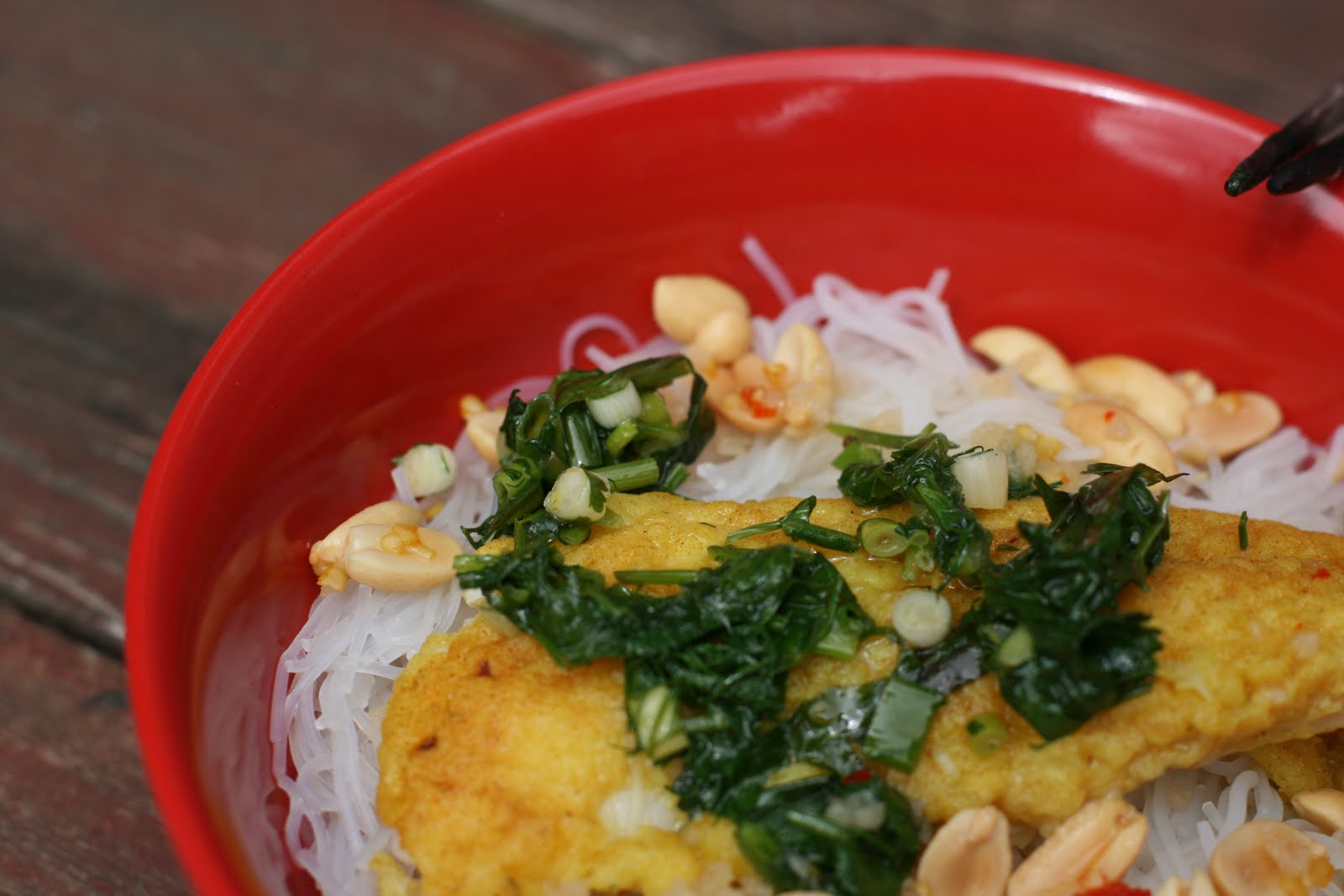
Vietnamese Turmeric Fish with Rice Noodles, Dill and Nuoc Cham


For many diners, all it takes to enjoy a meal is the right condiment. Some people (and, for convenience, we'll call them Midwesterners) douse any number of dishes with ketchup before consumption. Others carry around a small bottle of a favorite hot sauce in their purse. For me, the magic condiment is fish sauce and lime juice.

Okay, it's not quite as versatile as ketchup. And I realize that fewer Americans share this obsession. But I love, love, love this combination. Funky, salty, umami-rich fish sauce, mixed with a bright sour hit of lime? Perfect. Add a little sugar to sweeten out the edge, and some water to lighten things up (yielding nuoc cham, a favored dipping sauce), and there's nothing better. And lest you vegetarians feel left out, you can often find fish-free fish sauce substitutes at Asian markets (look for the Vietnamese word chay, which means vegetarian, and also look out that it doesn't use msg as a shortcut). Even if you're wedded to ketchup, you should give this combination a try.

I usually put together my favorite nuoc cham to dress rice noodle salads (or, if I must admit, frozen potstickers). But a few years ago I tried this amazing catfish dish at a local Thai restaurant. Catfish was dredged in a turmeric-heavy rice flour coating, then pan-fried and served on a bed of rice noodles. Some fresh herbs (including the I-didn't-know-it-was-used-in-Southeast-Asian-cooking dill) were sprinkled on top. And my beloved fish sauce dressing pulled it together beautifully. A basic fried fish, when it came down to it, with an exciting punch of flavors. I had to make it at home.

Trolling around the internet, I discovered that this recipe is famous in Vietnam, originating in Hanoi's Chả Cá Lã Vọng restaurant. Recipes vary -- some with fried shallots, some with grilled instead of pan-fried fish -- but the basic model of turmeric-scented fish, rice noodles, fresh dill and nuoc cham remains the same. I've made it several times, barely following a recipe, adapting to the fresh herbs on hand (as long as dill is in the mix), and often tossing in some totally non-traditional broccoli or spinach to green up the meal. Sometimes I fry whole fish fillets and break them into the rice noodles as I eat, other times I cut the fish into bite-sized pieces before dredging and frying. It's always great. It's also a lovely summer choice, as there's no oven involved, just a bit of pan-frying. So when I had some fresh dill left over recently after cooking up a pile of Swedish midsommar food, and when I realized I had never told you about this dish, it was the logical dinner choice. Perhaps it'll win over some new nuoc cham devotees.


Vietnamese Turmeric Fish with Rice Noodles, Dill and Nuoc Cham

serves 4
adapted from several sources, notably Mai Pham's
The Flavors of Asia


Sauce:
1/3 cup lime juice
1/2 cup fish sauce
1-2 Tbsp sugar
1/2 cup water
1 clove garlic, minced
4 small fresh chilies (or more or less to taste), sliced into rings

Noodles, Fish and Herbs:
6 ounces rice vermicelli (1/2 package)
1/2 cup rice flour
1 tsp turmeric
1/2 tsp salt
2 large fillets (~1 lb) catfish, tilapia, or similar fish (I'm currently smitten with the cheap-and-delicious Swai), left in fillets or cut into 2" pieces, as you prefer
2-3 Tbsp high-heat oil for cooking, such as canola
1 bunch scallions, thinly-sliced (~1/2 cup)
1 bunch dill, roughly chopped (~1 cup), divided
1 handful basil leaves, roughly chopped
1 handful cilantro, roughly chopped
1/4 cup roasted peanuts
hot sauce, such as sriracha

Prepare the dressing by mixing together all of the dressing ingredients in a bowl. Adjust as needed to get the hot-sour-salty-sweet balance to your taste. Set aside.

Cook the rice noodles according to the directions on the package, and set aside at room temperature.

Heat a large frypan over a medium-high heat. On a plate, mix together the rice flour, turmeric and salt until well-combined. Place the fish on the plate, and press into the rice flour coating so that it adheres. Turn the fish over over and coat the other side.

When the pan is hot, add ~2 Tbsp oil. Add the fish, and fry on each side until done, ~3-5 minutes per side, depending upon the size of your pieces. Remove from the pan and set aside. In the same skillet (adding another Tbsp of oil if it's dry), add the scallions and half of the dill. Saute for a minute or two, until the herbs soften and just begin to cook. Turn off the heat, and add the remaining dill and the other fresh herbs.

To serve, place a pile of rice noodles into a bowl. Top with a portion of fish and some of the herb mixture. Sprinkle with peanuts, dress with the fish sauce dressing, and add hot sauce as desired.

Sunday, May 01, 2011

Asparagus and Shrimp Pizza with Leek and Mascarpone


I am usually not an impulsive shopper. In fact, I'm quite the opposite. I deliberate each purchase in painful detail before I part with my hard-earned money, whether it's a piece of furniture or a sandwich. To give an idea, I've been looking for a new dresser for months -- months! -- while an off-the-tracks shelf from my busted current model is sitting on the floor, displaying my ratty old t-shirts to everyone who needs to walk past to use the bathroom. But there is one purchase that I make without hardly any painful mulling at all: produce. And specifically, seasonal produce.

Here in Portland, we have a small chain of local grocery stores with insanely good produce distributors. It's like having a farmer's market just a few short blocks from my house. They routinely sample their staggeringly delicious fruits and vegetables, and chances are good that once I taste something, I can't resist (although I still held back from the sticker-shockingly $2.99/lb Golden Nugget tangerines a few weeks ago, despite them being the sweetest thing I ever tasted). Their other secret weapon against my miserly indecision is a simple plastic sign with four words: Peak of the Season.

This little sign will get me to buy anything. Anything. Sure, I may not have come to the store for (insert seasonal produce of choice here), but it's the Peak of the Season! Time is fleeting! Life is fleeting! Gather ye Golden Nugget tangerines while ye may! And don't forget the asparagus!

Asparagus is the one vegetable that might as well have "Peak of the Season" tattooed on its butt. As soon as you seem them in the store (and I'm talking about the real local deals, not the shipped-from-another-hemisphere knock-offs), the stopwatch starts ticking. You've only got a few weeks to wolf down as many as you can before they're gone, not to return until the calendar has a whole new year on it. Luckily this is not hard.

Asparagus are lovely, lovely, lovely. I eat heaps of them during their all-too-brief appearance. I roast or steam them, eating them plain or with a simple topping of vinaigrette with lemon and sieved egg. I pickle them to eat all year, or mix them with some angel hair pasta, lemon, and goat cheese (and, if I've got it, precious drizzle of truffle oil). For a while, one of my favorites was this pizza, topped with goat cheese and briny anchovies, and brightened up with a sprinkling of lemon zest. But fickle me, I have a new favorite asparagus pizza. And oh, is it wonderful.

I found this combination on the amazing craftacular blog Posie Gets Cozy. Leeks are sauteed up with butter, and mixed into creamy mascarpone. After you spread your pizza dough with this rich and savory spread, you top it with shrimp and a pile of thin spring asparagus. I'm someone who tends to insert a tangy edge into every meal, and was tempted to replace the mascarpone with cultured creme fraiche, or add a grating of citrus zest. But I'm glad I stuck to the original vision, because it's great. I'm including a recipe for two pizzas, because trust me, you want to make at least that many. After all, it is the peak of the season.


Asparagus and Shrimp Pizza with Leek and Mascarpone

adapted from Posie Gets Cozy
yields 2 pies

This recipe is simple, but a few little tweaks (which I learned between making the first and second pizzas) keep the shrimp from drying out: a quick brine in salt water, and placing them on the pizza under the asparagus.


2 balls of pizza dough, ~10 ounces each
1/2 lb shrimp, peeled (if they're very large, slice them in half lengthwise)
1 Tbsp butter
2 leeks, washed and sliced thinly
1 small tub (8 ounces) mascarpone
~3/4 lb thin asparagus, either left whole (dramatic!) or sliced into short lengths (easier to manage!), tossed with a bit of olive oil and a pinch of salt -- if you don't have thin ones, simple thinly-slice larger stalks

Preheat your oven, with a pizza stone if you have, to 500 degrees for an hour. If your pizza dough has been refrigerated, let it sit, covered, at room temperature for about the same amount of time.

In a small bowl, place a cup of water, a tablespoon or so of salt, and a splash of oil. Add the shrimp, and place back in the refrigerator while you're preparing the rest of the pizza.

Heat a saucepan over a medium flame. Melt the butter, and add the leeks. Sprinkle with a bit of salt. Saute, stirring occasionally, until the leeks are totally softened but not colored. Turn off the flame, and add the mascarpone to the warm pan of leeks, stirring as it melts. Taste and add more salt if needed.

Now assemble your first pizza: Place one ball of the pizza dough on a lightly-floured counter top, and press outward into a thick disk (leaving a 1" unpressed area along the edge as the crust). Pick up the disk and let it drape over the backs of your hands, letting gravity help you stretch it into a 12-14" circle. If the dough resists, let it relax for a few minutes, then try again. Place the stretched dough on a peel (or overturned cookie sheet or cutting board) that's lightly dusted with semolina or other type of flour.

Gently spread 1/2 of the leek/mascarpone mixture over the dough, leaving a 1" rim around the edge. Drain the brined shrimp, and scatter half of them over the pizza, then top with half of the asparagus. Slide the pizza onto the preheated stone in your oven, reduce the heat to 450, and bake ~7-10 minutes, until the crust browns and the shrimp and asparagus are cooked. Remove the pizza from the oven, let cool for a moment, and slice and serve. Repeat for your second pizza.

Monday, February 07, 2011

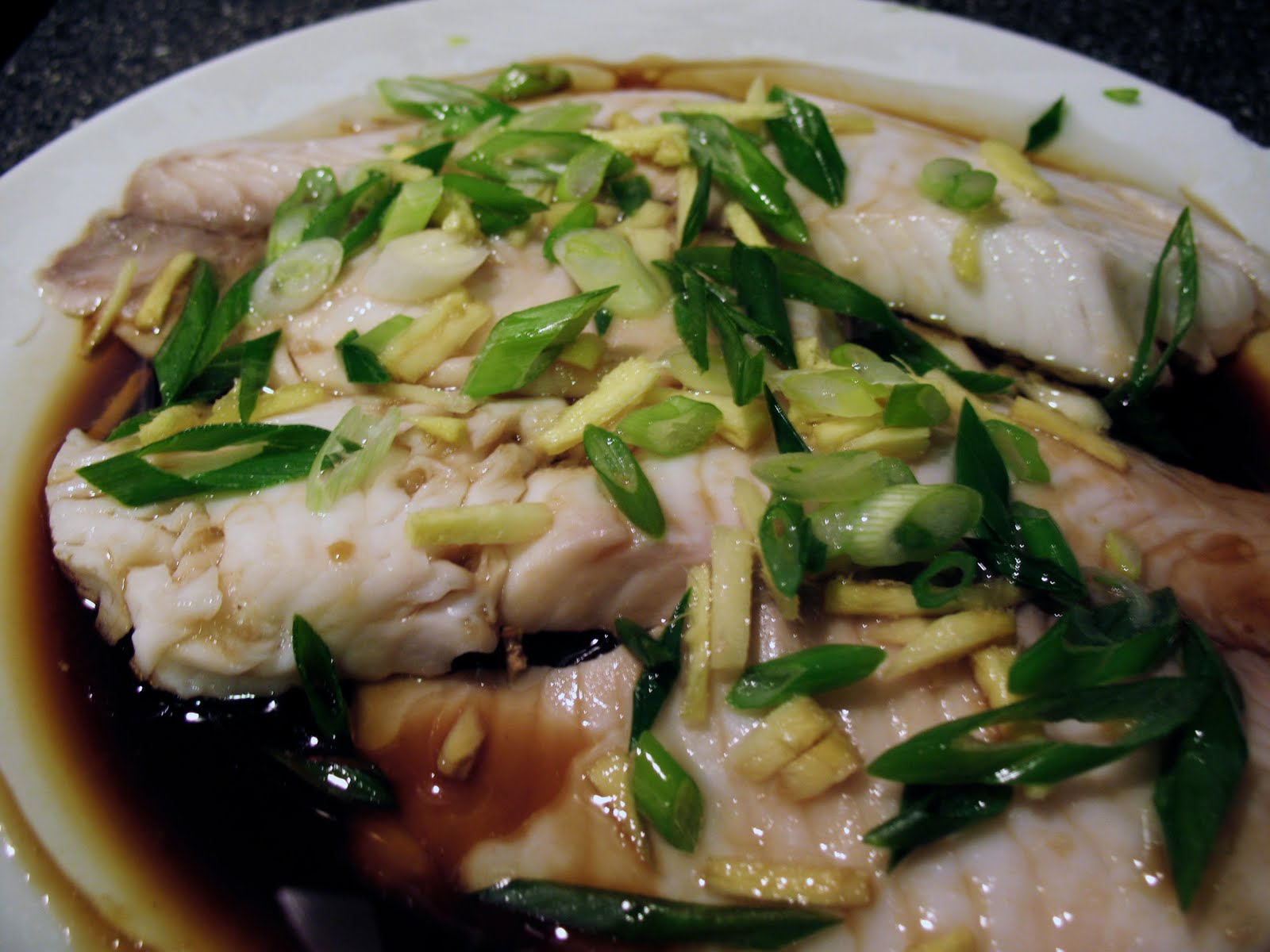
Chinese-style Steamed Fish with Sizzled Ginger and Scallions


Having a food blog can give a false impression of one's culinary prowess. Sure, I can freestyle a healthy kale & quiona pilaf, bake up a rustic-yet-elegant rosemary honey apple galette, and decorate deliciously naughty baby shower cookies. But behind the scenes are my secret failures. For one, there's my inability to produce a decent pot of rice. Rice, people. I don't know if it's my proportions, my pot, or my inability to let it cook without peeking (or some combination of the three), but it's never that absolutely perfect rice of my dreams. And another: no matter my best intentions, I seem constitutionally incapable of preparing fish without overcooking it. Until now.

The secret to my newfound success? Steaming. I've pan-fried, baked and roasted before, but never steamed. Which is a shame, because this method is great: the gentle heat lets the fish cook slowly and evenly, and the steam keeps it nice and moist. The subtle flavor of the fish comes through clearly, and even repeat offenders like me end up with a perfectly-cooked dish.

This particular recipe comes from my friend Sally Li, who prepared it for a recent dinner in celebration of the Chinese New Year. Fish is an auspicious new year's menu item, its characters sounding like the word for abundant wealth. And who doesn't want that? Any fish dish will suffice, but Li chose a traditional preparation where steaks or fillets are gently steamed, along with a few coins of ginger to remove any "fishy" smell. The simple steamed fish is then topped with fresh ginger and scallions, and a bit of sugar, soy sauce and wine, which all come together into a beautifully cohesive dish when topped with a dramatic drizzle of hot oil. You can find the recipe here, and read more about Sally's New Year celebration at The Oregonian. Next up: perfect rice.

Monday, June 14, 2010

Leftover Salmon Kedgeree


I have a thrifty streak that runs a mile wide. Recently I discovered that the local grocery store sells whole wildcaught salmon, and they go on sale for as low as $2.99/lb. How can I not buy one? But the catch: when I say whole salmon, I mean whole salmon. You only get this price when you take home the entire fish. As one can imagine, a 4 lb salmon + 2 person household = lots of leftovers. A day or two of baked salmon is lovely, but after that I start looking for ways to add a bit of excitement. For a while, the winning treatment was a pan-fried version of fish tacos, slicing the leftovers and frying them up with a homemade mixture of chili and spices. But the new favorite is salmon kedgeree.

Kedgeree is a traditional Indian pilaf, where seasoned rice is mixed with legumes. But when the Brits came over, they replaced the lentils with their beloved smoked haddock. The whole affair is spiced with curry seasonings, perked up with lemon juice and fresh cilantro, and served with hard-boiled eggs. For breakfast. Even a leftovers-in-the-morning fan like myself finds that a bit hard to swallow. But as a lunch or dinner, kedgeree is fantastic. Especially with salmon.

Sharp-eyed readers may note that a version of this recipe appeared on the website Food52 a few weeks ago, and I'm embarrassingly just getting around to posting it here now. The time, she does fly. And in another example of what I believe the kids call a "cross post," last week's sloppy sauce was featured on Salon.com. I'm ridiculously happy to see it sitting there in such a nice layout (and among such nice company).


Leftover Salmon Kedgeree

I came up with this recipe to use up leftovers, but it's good enough to make from scratch--just bake or poach a pound of salmon and start from there. The spinach isn't remotely traditional, but I can't resist adding some greens to make this a one-pot meal.

serves 4


1 Tbsp canola oil (or ghee, if you've got it)
1 Tbsp mustard seeds
1/2 tsp turmeric
1-3 Tbsp Indian-style jarred curry paste, such as Patak's (if you don't have this, you can substitute 1-3 Tbsp curry powder (depending on your taste and the spiciness of your curry), mixed with a splash of oil and 1/2 tsp tomato paste)
1 onion, finely chopped
1 clove garlic, minced
1 thumb-sized piece of ginger, julienned or grated
~5 cups cooked long-grain white rice (yeah, my picture has overcooked short-grain brown rice, but long grain white would be better)
1 lemon, juiced
salt
1 lb cooked salmon, flaked into bite-sized pieces
1/2 bunch spinach, washed, dried and roughly chopped (optional)
1 bunch cilantro, washed, dried and roughly chopped
yogurt for serving (optional)

Heat the oil or ghee over a medium-high flame in a heavy pan. When the oil is rippley-but-not-smoking, add the mustard seeds and cover. The seeds will sputter and pop.

When the popping has subsided, add the turmeric and curry paste or powder (start with the smaller amount). Let the seasonings toast for a few seconds, then add the onion, garlic and ginger. Stir to combine. Reduce heat to medium and saute, stirring occasionally, until the onion is translucent (~5 minutes).

When the onion is cooked, add the rice and stir gently but thoroughly to combine. Add the lemon juice and salt to taste, and more curry paste if desired. When it's seasoned to taste, add the salmon, spinach (if using), and ~ 3/4 of the cilantro, and stir gently to combine. Cook until the fish is warmed through and the spinach has wilted. Garnish with remaining cilantro and serve with yogurt if desired.

Thursday, May 13, 2010

Shrimp with Green Garlic


Spring is all about green shoots and new growth. We tilt towards the sun, the ground warms, and the first spring crops come peeking through. Last week I helped transplant tomato starts outside, my hands full of that green-spring tomato-leaf smell. It sort of makes you heady with thoughts of what's to come.

But amidst all of this potential, there's a bit of destruction as well. I refer to the inevitable springtime thinning of the garden. For those who don't grow, here's how it works: when you plant seeds directly into the garden soil, you've got to hedge your bets against the inevitable non-starters, and sprinkle in a few extra. Or sometimes they're just so darned tiny it's hard to keep track. But often the seeds prove you wrong, and sprout up in a thicket. In order to give your plants enough room to grow, you've got to pull up a bunch of these little green babies.

Sometimes you can find a friend whose garden needs some extra seedlings, or sometimes you set a box of uprooted plants on the curb to seek a new home. Sometimes you're so weary from crouching in the dirt that you just toss them on the compost pile. And sometimes, in the case of green garlic, you can eat them.

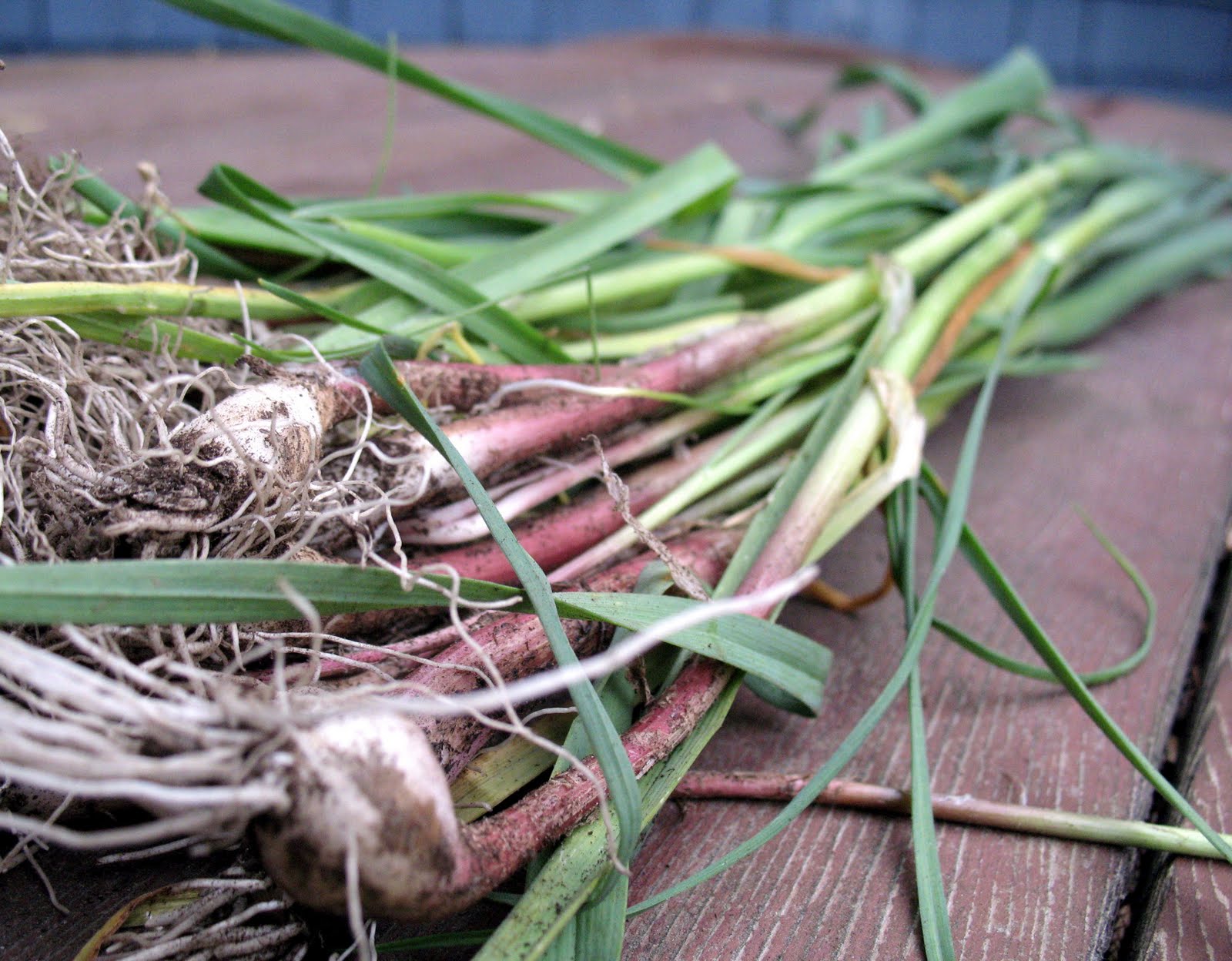
Green garlic, which is available at farmer's markets now (at least in the Pacific Northwest), looks a bit like scallions:


In fact, it's just your standard garlic plant, but uprooted before the cloves have had a chance to fully form and swell (the ones you'll see in the markets are generally a bit thicker than the home-harvested examples above). They're a bit too nippy to eat like scallions, but are lovely when pounded into a pesto, or incorporated into a saute. Cooked, they mellow and soften, yielding a flavor that has both a garlicky depth and a springtime green freshness.

This particularly recipe, adapted from the lovely Chez Pim, is like green garlic itself: both springtime-light and full of flavor. Shrimp and green garlic are sauteed with a simple sauce of curry powder and fish sauce. In my limited Southeast Asian seasoning pantheon, fish sauce is always bff with lime juice, and seldom ventures out alone. And certainly not with curry powder. But they work shockingly well together, forming a sauce whose flavor seems to be much greater than the sum of its simple parts. Pulling up green shoots before their full prime can be a bit sad. But with green garlic, and dishes like this one, it's a fairly delicious sacrifice.


Shrimp with Green Garlic

adapted from Chez Pim, but simplified and tweaked a bit
serves 2-3


1 Tbsp neutral oil, like canola
1/2 cup (or more, if you have it) green garlic, julienned into 2" matchsticks
1 lb shrimp, shelled (I like to sit mine in a saltwater brine for about 15 minutes before draining and cooking to add flavor and moisture, but that's optional)
1 tsp curry powder
1 Tbsp fish sauce
splash water (1-2 Tbsp)
cooked jasmine rice for serving

Heat the oil in a heavy skillet over a medium-high heat. When hot, add the green garlic, and saute, stirring often, until it softens but doesn't color (~3-5 minutes). When the green garlic is soft, add the shrimp, cooking a few minutes until just shy of done (time will vary depending on the size of your shrimp and how well-done you like them, but it shouldn't take long). Sprinkle on the curry powder, stir to combine and toast the powder, then add the fish sauce and water to form a bit of sauce. Let cook a moment to remove the harsh edge, then remove from heat. Serve with the rice.

Sunday, March 28, 2010

Smoked Whitefish Gefilte Fish with Horseradish Mayonnaise


There are some ethnic foods that can easily win fans outside their native lands. Even if you've never heard of Tibetan momo, chances are that you'll adore the flavorful dumpling of meat or vegetables wrapped in a soft and slippery dough. And you might be hard-pressed to spell dacquoise, but who wouldn't love disks of nut-enriched meringue layered with luscious buttercream? These foods seem to hit upon cravings and tastes that hold wide appeal, regardless of your background.

And then there are the foods that are a somewhat harder sell. It's like learning a language: if you're not exposed during that critical period in childhood, chances are it's never going to come easily to the tongue. At least not without a good deal of work. Gelatinous chicken feet, and ripe cheeses that smell like unwashed socks (Taleggio, I'm looking in your direction). And while I adore the fermented funk of shrimp paste, I can see why some, like my boyfriend, think it stinks like something that died on the beach. Which brings me to one of the least popular foods of my people: gefilte fish.

Gefilte fish gets a bad rap. It's a classic peasant food, a poached patty made of a mix of lake fishes that have been chopped and mixed with matzoh meal, eggs and seasoning, and poached in broth. Like meatloaf, it's a way of stretching an expensive or valuable ingredient, making sure everyone gets a taste of fish even when there aren't quite enough fillets to go around. It's similar to (and arguably developed from) the quenelle of French high court cuisine. But that's not how most people know it. To most Americans, gefilte fish comes in a jar from Manischewitz, surrounded by a yellowish jellied stock. It's not delicate, and it's not delicious.

But it doesn't have to be that way. In its traditional form -- made from fresh fish, and seasoned well -- it can be a lovely dish. Here on the West Coast, people often make their gefilte fish from salmon and halibut. It makes for a great variation, but I want something with just white-fleshed fish to meet my craving for tradition. The usual lake fish of Eastern Europe (or suburban New York) are pretty hard to come by out here. But last year I discovered a variation made with smoked whitefish. I grew up eating this delicacy on deli brunch trays, and am a sucker for its flavor. In this gefilte fish, the dense smoked fish is combined with tender sole. The salty/smoky flavor is offset by sweet carrots, mellow cooked onions and nippy scallions. The mixture is so tender it must be steamed on cabbage-lined trays instead of poached, but the resulting gefilte fish has a delicate, pate-like texture. Nobody's feeding this version to the dog under the table. I daresay it will win converts, even outside of the chosen people. (And yes, the smell of steaming cabbage + fish is exactly as awesome as you're thinking.)

And while I have some hesitation in mixing my Blog Life with my Real Life, I humbly direct you toward a radio story I produced on gefilte fish's historical preparation and West Coast incarnation. Perhaps that version will make it onto our Seder table next year.


Smoked Whitefish Gefilte Fish with Horseradish Mayonnaise
adapted from Jayne Cohen's Smoked Whitefish Gefilte Fish with Lemon-Horseradish Sauce in Bon Appetit, May 2002

yields ~15-20 patties, depending upon size of patties, and amount of additional matzoh meal required

Gefilte Fish
3/4 cup sliced peeled carrots
1/2 cup matzoh meal
2 Tbsp olive oil
1 cup chopped onion
1 cup chopped scallions
4 eggs
1 Tbsp lemon juice
1 1/2 lb sole (or other mild fish, such as flounder), cut into cubes
3/4 lb smoked whitefish, flaked off the bone
3/4 tsp salt
1/4 tsp pepper
1 head cabbage

Horseradish Mayonnaise
2 garlic cloves, pressed
1/3 cup prepared horseradish
2 Tbsp lemon juice
1 cup mayonnaise
1 Tbsp dill leaves, chopped (optional)

Place the carrots in a saucepan with water to cover, and simmer until beyond tender (and nearly mushy), ~7-10 minutes. Drain, reserving 1/2 cup of the cooking liquid in a large bowl. Add the matzoh meal to the cooking liquid, and place carrots in a food processor.

Heat the olive oil over a medium flame in a heavy skillet. Add the onions, and saute until soft but not browned, ~5 minutes. Add the green onions, and stir 1 minute more. Remove from heat, allow to cool slightly, and add to the carrots in the food processor. Add matzoh meal mixture, and puree until smooth.

Crack 3 of the 4 eggs into a large mixer bowl, and beat until foamy and thickened, ~3-4 minutes. Add the carrot/onion/scallion/matzoh meal mixture, and mix well.

In your now-empty food processor bowl, add the fish, salt and pepper. Pulse until finely chopped, but not pureed. Add the remaining egg, and pulse until just combined. Add this mixture to the vegetable/egg mixture, and stir to combine. Cover and refrigerate until very cold, ~2 hours. Check after an hour -- if the mixture seems like it's too soft to shape, add additional matzoh meal.

After the fish mixture has chilled, set a steamer basket (or multiple steamer baskets if you've got) over simmer water. Peel the leaves off of the cabbage, and use them to line the baskets. Scoop out 1/3 cup of the fish mixture, form into a patty shape of your choosing, and place on the cabbage-lined steamer. Repeat, leaving a bit of space between (the gefilte fish will swell slightly upon steaming). Top with more cabbage. Cover and steam until the gefilte fish is firm and cooked through, ~40 minutes. Remove the cooked patties to a container (along with their cabbage leaves, which will keep them from drying out), and repeat the process with remaining mixture. The fish will be somewhat delicate when you remove it, but will firm upon chilling. Chill cooked gefilte fish in the refrigerator until cold, ~5 hours. Gefilte fish can be made up to two days in advance.

Combine sauce ingredients in a bowl, adjust seasonings to taste, and serve with the gefilte fish.