Monday, June 07, 2010

Sloppy Sauce (aka Tahini with Miso and Almond Butter)


Several years ago, I left my dog alone at a friend's house for an evening, and returned to find that he had eaten all of the dog food in the house. All of it. When he came to greet us at the front door, he was noticeably larger. We rushed our barrel-shaped pup to the veterinarian, who pronounced him fine (and showed us an amusing x-ray, wherein you could still see all of the individual pieces of kibble in his overly-full stomach). In addition to piece of mind (and a hefty bill), we were given my absolute Favorite Diagnosis Ever: dietary indiscretion. Seriously. Dietary Indiscretion. It's sort of like diagnosis: bad decision-making. I suffer from that all the time.

For the most part, my diet is fairly healthy, full of fresh produce and whole grains and all that good stuff. But sometimes it's not. Sometimes I'm dining out, and the deliciously retro ice cream sundae on the menu calls to me. Or I'm catching up with friends over happy hour, and after a few drinks an order (or three) of fries suddenly seems like a phenomenally brilliant idea. Or I am eating something so addictively delicious, say these little cheese-filled puff pastry palmiers at my friend Sarah's house, and I just cannot stop. Dietary Indiscretion.

After such poor choices, we've come up with a recovery meal known around our household as Hippie Dinner. It's the best way to sop up booze, grease, and bad decisions, and set you on the path to dietary righteousness. There are three elements: whole grains (in the form of some brown rice or quinoa); protein (in the form of marinated tofu or a piece of lean fish); and a huge pile of steamed or sauteed vegetables. Actually, make that 4 elements: the whole plate is topped off with a tahini variation called sloppy sauce.

Sloppy sauce, inspired by a friend who needed to recover from a nearly all-pizza diet, is a great way to make a huge pile of steamed kale and sweet potatoes much more exciting. It starts off like a traditional Middle Eastern tahini sauce, mixing sesame paste with lemon juice and garlic. But it's given a bit of savory heft (and arguable health benefit) from a scoop of miso, and delicious nuttiness from almond butter. I like to further play up the East meets Middle East dimension by stirring in a bit of grated ginger, or a handful of scallions or chopped cilantro if you've got. And sometimes I emphasize the peanut sauce resemblance by using lime juice instead of lemon. As suggested by its name, sloppy sauce is a pretty informal affair, and can be easily adapted to your taste. And it can be enjoyed any time, whether you're recovering from a dietary indiscretion or not.


Sloppy Sauce (aka Tahini with Miso and Almond Butter)

yields ~3/4 cup

1 Tbsp miso (any type)
2 Tbsp tahini
2 Tbsp almond butter
1 clove garlic, crushed
1/2" ginger, grated
juice of 1 lemon
water
handful minced scallions and/or cilantro (optional)

Mix together the miso, tahini, and almond butter until well combined. Stir in the garlic and ginger, then the lemon juice. Add water, a little at a time, until it reaches a thick-but-pourable consistency (~1/4+ cup). Stir in the scallions and/or cilantro, if using. Taste, and adjust seasonings as needed. Pour over whatever hippie concoction you desire. The sauce will thicken upon standing, so just stir in a little additional water or lemon juice to loosen leftovers.

Tuesday, June 01, 2010

Pineapple Mojito


If I were a good food blogger, I would have posted this cocktail recipe in advance of this past holiday weekend. Oops. But luckily there are many more barbecues ahead of us this summer. And besides, once you taste this, all will be forgiven.

Several years ago, I came across a recipe in a Jamie Oliver cookbook for pineapple topped with fresh mint that had been mashed up with sugar. Or, I should say, "recipe," as that's literally all that was involved -- just those three ingredients. But for some reason, it's amazing. The clean, almost piney edge of mint is softened by sugar, and sparks up the tangy perfume of pineapple. You wouldn't think you could improve upon a drippy-sweet pineapple, but it somehow does just that. And so, I naturally turned towards the next ingredient that improves all situations: alcohol.

Many people are familiar with mojitos, the Cuban highball that has become a favorite summer cocktail. Rum (the alcohol of choice from sugar-producing countries) is mixed with bashed-up mint and sugar, perked up with lime juice, and lightened with a bit of soda water. Adding pineapple brings a tropical sweetness to the herbal drink, and makes it my new favorite cocktail.

And speaking of things to toast, yours truly was recently profiled on Food52! For those unfamiliar with this lovely site, they've been holding recipe contests every week for the past year. Participants submit original creations inspired by weekly prompts, and site members vote for their favorites. The whole project will culminate in a cookbook of the winning recipes. Some stellar cooks have been participating, and their recipe archive has become one of my go-to sites when I'm looking for inspiration. Had I thought more about the possibility of a wider audience, perhaps I would have used something other than a teenage nickname as my username. Oops. But on the bright side, evidently my kale and quinoa pilaf is legendary. I'll drink to that.

Pineapple Mojito

Brown sugar does a lovely job of underscoring the caramel notes of pineapple, but you can substitute white sugar if needed. The exact proportions will vary, depending on how drippy-sweet your particular pineapple, and how you like your cocktails, so feel free to play around.

yields 2 cocktails

~1/4 cup fresh pineapple chunks
1 1/2 Tbsp brown sugar
1 handful mint leaves
2 shots rum
1 1/2 shots lime juice
ice
soda water

Place the pineapple, brown sugar, and mint leaves in a cocktail shaker (or, as it's known in our house, mason jar). Mash together (you can use the handle of a wooden spoon if your muddler is in the shop) until the pineapple is reduced to bits and small chunks, and the mint is well-bruised and torn a bit. Add the rum and lime juice, and shake with ice to mix and chill. Taste, and adjust as desired. Pour into ice-filled glasses, and top off with soda water.

Monday, May 24, 2010

Acorda (Portuguese Cilantro Bread Soup)


The majesty and impact of some images can be difficult to capture on film (or its digital equivalent). The soul-stirring drama of a sunset, for example. The misty rush of a waterfall. Or, in this case, cilantro soup. This soup, loosely adapted from a Portuguese recipe by the lovely Tea and Cookies, tastes like spring itself. It's kind of unfortunate that the picture looks like a bowl of mulch.

If you can't trust the image, trust me: this soup has a brothy, herbal lightness, but also a depth of flavor from the leeks and hefty dose of garlic. And two secret weapons: a crusty slice of garlic-rubbed toast at the bottom of the bowl, and a poached egg on top. If you, like me, are thinking that a slice of soggy bread doesn't sound like the most awesome idea, I ask you to think again. It's lovely. The original recipe called for white beans, but I opted for a can of the similarly-Iberian garbanzos. It's sort of like the best of garlic bread, soup and salad all in one bowl.


Acorda (Portuguese Cilantro Bread Soup)

adapted from Tea and Cookies, as inspired by San Francisco Magazine

serves 4


2 Tbsp olive oil
3 leeks, washed, dried and chopped
4 cloves garlic, minced, plus 2 whole cloves
8 cups stock (vegetable or chicken)
1 bunch chard, washed, dried and coarsely chopped
1 can garbanzos or white beans, rinsed and drained
~2 cups cilantro, washed, dried and coarsely chopped
4 large or 8 small slices peasant-style crusty bread
salt and pepper
4 eggs

In a large pot, heat the olive oil over a medium flame. Add the leeks and a pinch of salt, and saute until softened. Add the minced garlic, and saute until the garlic is soft but not brown. Add 6 cups of the stock, the chard, and the beans. Bring to a gentle simmer, and cook for a few minutes to soften the chard.

While the soup is simmering, puree the cilantro with the remaining stock in a food processor until it's fairly smooth. Pour this into the pot, continue to simmer to blend flavors.

While the soup is on its final simmer, Bring a pot of water to boil to poach the eggs. In the meanwhile, toast the sliced bread until lightly browned. Take the remaining whole garlic cloves and run them over the toasted sides (toasted bread does a remarkably good job of grating the garlic into a fine paste to coat). Place a slice of toasted garlic bread at the bottom of each of 4 bowls.

Poach the eggs in the boiling water (if you're not an experienced poacher (hee), you can find a nice tutorial here). Season the soup to taste, and ladle a serving over each bread-filled bowl. Top with a poached egg and serve.

Monday, May 17, 2010

Israeli Couscous Picnic Salad


As I've mentioned before, the game of Iron Pantry Chef reigns supreme at our house (also known as "what can I make for dinner without leaving my house to purchase additional ingredients?"). A few months back my boyfriend came up with an entry consisting of a can of turnip greens (don't ask) that were pureed and cooked with some sauteed garlic, asafoetida, turmeric, chili flakes, and a few other random ingredients. The resulting olive-drab puree was used to sauce a bag of gnocchi from the pantry. I dubbed it "Saag of the South,"and in addition to earning high marks in the categories of Originality and Best Use of Available Ingredients, it was actually surprisingly tasty. As a rule, this game is thrifty, time efficient, and keeps your pantry from gathering dust. But last week I was aiming for an Iron Pantry Chef meal that was so delicious I'd want to make it again, even if I had to (gasp) shop for ingredients. This couscous salad is totally that meal.

Friday was the sort of spring weather that verges on summer. I sent out a message to see if any friends wanted to meet for a sunset picnic at the top of a local park. It was an impromptu decision, and since my guests would only have a few hours' notice, I figured they'd probably just pick up snacks en route. As befitting a good impromptu host, a more substantial contribution on my part seemed in order, to round out the picnic meal.

I've always been blown away by the oh-I-just-threw-this-together salads on 101 Cookbooks, where chef Heidi Swanson casually surveys her pantry and farmer's market purchases, and creates a dish I'd pay good money for. Her creations toe that often-difficult line of being substantial main dishes, while also feeling light and healthy. With this thought in mind, I grabbed a bag of large-pearl Israeli Couscous off the shelf. I cooked it up with some saffron, and a few pinches of some random Georgian spice mixture I'd picked up at the Russian market (optional, of course). A cup of cooked wheat berries were lolling about in the fridge from an aborted bread project, which added a bit of toothsome contrast to the soft couscous (you could substitute any other nubby grain, such as barley or farro). I chopped some mint from a neighbor's yard, and the last of the bolted cilantro from a friend's garden. A can of fava beans added protein, some toasted hazelnuts added crunch, and lemon and crumbled feta sparked it all up. I briefly flirted with violating Iron Pantry Chef protocol and running to the store for some asparagus to blanch and add. But it didn't need it. This recipe is lovely as it is.


Israeli Couscous Picnic Salad

serves 6-8 as a picnic dish

1/2 cup wheat berries
1 1/2 cups Israeli couscous
pinch saffron
1/2 bunch cilantro, washed, dried and coarsely chopped
2 sprigs mint, washed, dried and coarsely chopped
1/4 cup hazelnuts, coarsely chopped and toasted
1/4 cup feta, crumbled (can be omitted for a vegan variation)
1 can fava beans, rinsed and drained (available at Middle Eastern groceries - these fully mature beans may be labeled Ful Madamas, and are different from fresh green favas, although the latter might make a nice substitution)
juice and zest from 1 lemon
~2 Tbsp olive oil
salt and pepper

Place the wheat berries in a sauce pan with 2 cups water. Bring to a boil over high heat, then lower the heat until it's just high enough to maintain a simmer. Cook until the wheat berries are tender, ~45 minutes. Some may split open, but most will be intact, and there should be no hard white centers remaining. Drain any excess water, and set aside.

While the wheat berries are cooking, prepare the Israeli couscous. In a large saucepan, bring 3 cups of water to a boil. Add the couscous, saffron, and a pinch of salt. Lower the heat until it's just high enough to maintain a simmer, cover, and let cook until the water is absorbed and the couscous is cooked through, ~10 minutes.

Set the grains aside to cool somewhat (so that they won't melt your feta and wilt your cilantro--I tossed them in the refrigerator for a bit to speed this process). While the grains are cooling, gather and prep the remaining ingredients, and place them in a large bowl. Add the cooled couscous and wheat berries, tossing gently to combine. Season to taste, and add more olive oil if needed to moisten, or lemon juice if desired. This salad keeps well, and is delicious at any temperature.

Thursday, May 13, 2010

Shrimp with Green Garlic


Spring is all about green shoots and new growth. We tilt towards the sun, the ground warms, and the first spring crops come peeking through. Last week I helped transplant tomato starts outside, my hands full of that green-spring tomato-leaf smell. It sort of makes you heady with thoughts of what's to come.

But amidst all of this potential, there's a bit of destruction as well. I refer to the inevitable springtime thinning of the garden. For those who don't grow, here's how it works: when you plant seeds directly into the garden soil, you've got to hedge your bets against the inevitable non-starters, and sprinkle in a few extra. Or sometimes they're just so darned tiny it's hard to keep track. But often the seeds prove you wrong, and sprout up in a thicket. In order to give your plants enough room to grow, you've got to pull up a bunch of these little green babies.

Sometimes you can find a friend whose garden needs some extra seedlings, or sometimes you set a box of uprooted plants on the curb to seek a new home. Sometimes you're so weary from crouching in the dirt that you just toss them on the compost pile. And sometimes, in the case of green garlic, you can eat them.

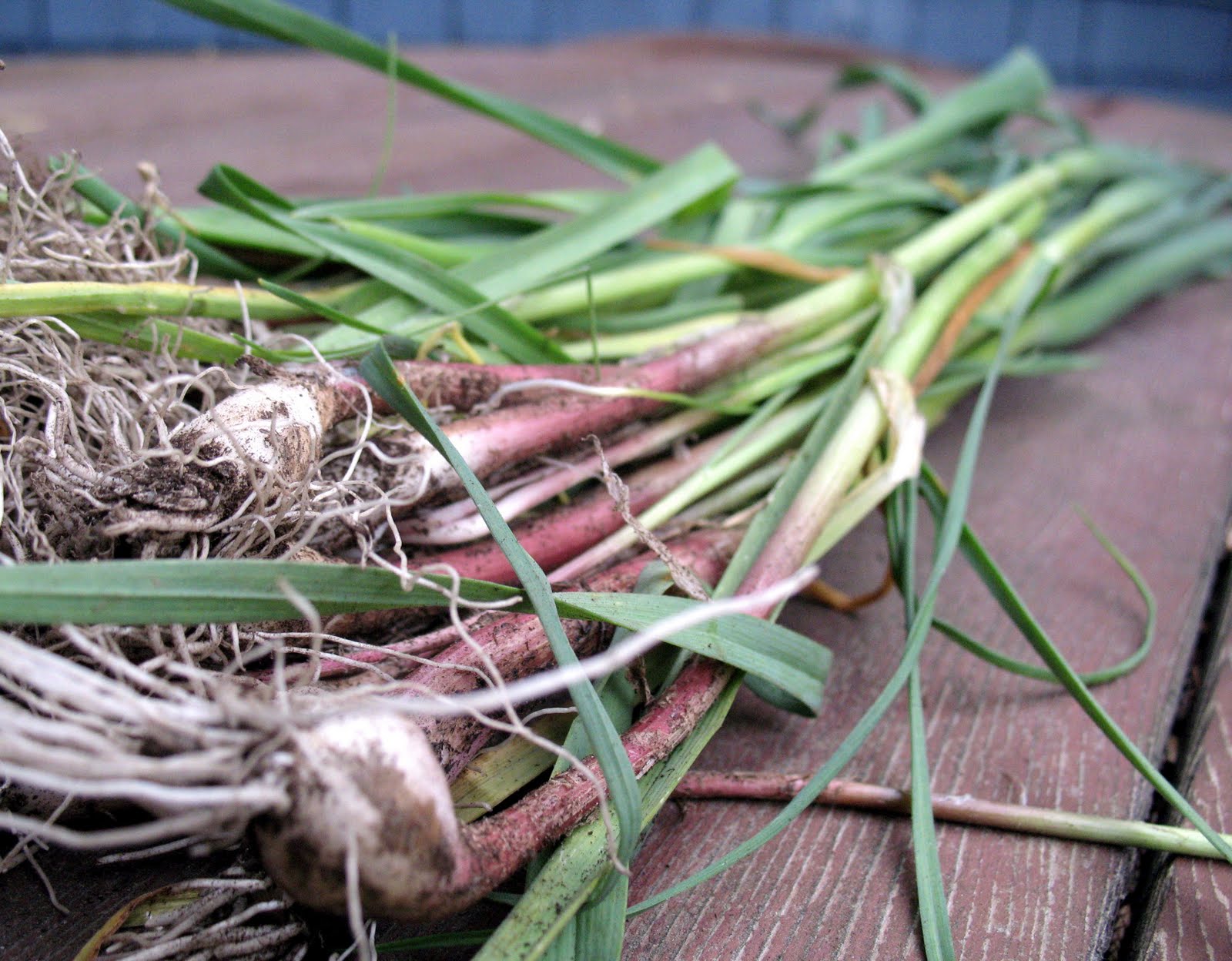
Green garlic, which is available at farmer's markets now (at least in the Pacific Northwest), looks a bit like scallions:


In fact, it's just your standard garlic plant, but uprooted before the cloves have had a chance to fully form and swell (the ones you'll see in the markets are generally a bit thicker than the home-harvested examples above). They're a bit too nippy to eat like scallions, but are lovely when pounded into a pesto, or incorporated into a saute. Cooked, they mellow and soften, yielding a flavor that has both a garlicky depth and a springtime green freshness.

This particularly recipe, adapted from the lovely Chez Pim, is like green garlic itself: both springtime-light and full of flavor. Shrimp and green garlic are sauteed with a simple sauce of curry powder and fish sauce. In my limited Southeast Asian seasoning pantheon, fish sauce is always bff with lime juice, and seldom ventures out alone. And certainly not with curry powder. But they work shockingly well together, forming a sauce whose flavor seems to be much greater than the sum of its simple parts. Pulling up green shoots before their full prime can be a bit sad. But with green garlic, and dishes like this one, it's a fairly delicious sacrifice.


Shrimp with Green Garlic

adapted from Chez Pim, but simplified and tweaked a bit
serves 2-3


1 Tbsp neutral oil, like canola
1/2 cup (or more, if you have it) green garlic, julienned into 2" matchsticks
1 lb shrimp, shelled (I like to sit mine in a saltwater brine for about 15 minutes before draining and cooking to add flavor and moisture, but that's optional)
1 tsp curry powder
1 Tbsp fish sauce
splash water (1-2 Tbsp)
cooked jasmine rice for serving

Heat the oil in a heavy skillet over a medium-high heat. When hot, add the green garlic, and saute, stirring often, until it softens but doesn't color (~3-5 minutes). When the green garlic is soft, add the shrimp, cooking a few minutes until just shy of done (time will vary depending on the size of your shrimp and how well-done you like them, but it shouldn't take long). Sprinkle on the curry powder, stir to combine and toast the powder, then add the fish sauce and water to form a bit of sauce. Let cook a moment to remove the harsh edge, then remove from heat. Serve with the rice.

Sunday, May 09, 2010

Rhubarb Syrup


Am I getting a little tiresome with the rhubarb? First I infuse it into liqueur, then bake it into a custard tart. Forgive me. Ye rosebuds, they must be gathered. At least until the strawberries ripen.

But this rhubarb syrup needs no apology. And you need something to sip while you're waiting for the rhubarb liqueur to age, right? If you are a cocktail hound, like myself, you'll find this syrup perfect for slipping into all sorts of cleverly-named drinks. Rhubarb collinses, rhubarbaritas, rhubarb mojitos, etc. And if you're a mocktail drinker, the syrup can be combined with fizzy water and a squirt of lime for a not-to-sweet refresher with a nicely layered flavor.

If you have the rosy-hued rhubarb (versus its greenish cousin), this syrup creates drinks that are unabashedly pink, of the sort that might as well be sporting a tiny paper parasol. If you're aiming for a manly air, the sweetly blushing appearance won't help. But the flavor is all grown up. If you like, you can fancy it up further by steeping it with a few coins of fresh ginger, a slice of dried star anise, or a splash of rosewater. But purist that I am, I like it straight up best of all. I also make this much lighter than a traditional simple syrup: instead of the 2:1 sugar:water ratio of a standard thick syrup, I make it a less than 1:1. Rhubarb's taste is much more subtle than a brassy lemon or pungent berry puree, and the lighter syrup allows you to pour in more of the rhubarb flavor without being overwhelmed by sweetness.


Rhubarb Syrup

yields ~2 1/2 cups

1 lb rhubarb, washed and cut in 1/4" slices
1 1/4 cups sugar
1 3/4 cups water
optional: a few slices fresh ginger, a slice of star anise, a splash of rosewater or orange flower water

Toss the rhubarb, sugar and water in a pot, stir, and bring to a boil. If you're using any optional herbs or spices, add them now. Lower the heat until it's just enough to maintain a simmer. Cook until the rhubarb breaks down entirely, ~20 minutes. Pour through a strainer, giving the rhubarb goo a stir to allow all the syrup to drip through. Stir in the orange flower water or rosewater, if desired. Cool, and add to the beverage of your choosing.

Tuesday, May 04, 2010

Springtime Asparagus Pizza


I apologize for the "atmospheric" quality of this low-light stovetop shot. There are times when you want to artfully compose a food picture, and capture for all time the best and truest aspect of the meal. And then there are times where you really want to snap the quickest shot you can, because everyone's waiting and ohmygod that looks so good put the camera away and give me a piece already! The pizza didn't stand a chance.

I'll try to get a better picture up here soon. Because I'll definitely be making this pizza again. But as a public service, I felt obligated to get this recipe posted as soon as possible. Because if you have asparagus, you should make this. Now.

Usually I'm of the opinion that it's hard to improve upon the flavor of fresh asparagus. Whether lightly steamed, pan-roasted, grilled, or shaved raw, asparagus don't need much to showcase their flavor. Maybe a drizzle of butter or olive oil, a squeeze of lemon, the lightest shavings of cheese. When it comes down to it, you don't need much more than a pair of fingers to enjoy them. I've tried a variety of involved asparagus preparations, from batter-dipped deep-fried spears at the farmer's market to filled and sauced pastas. But for the most part they just left me hungry for the sweet simplicity of the straight-up vegetable. Until I hit upon this pizza.

This pizza undoubtedly has a lot going on--goat cheese, chili flakes, lemon zest, and (if you dare) anchovies--but it somehow heightens rather than hides the fresh green flavor of asparagus. The earthly spears are perked up by the tangy goat cheese and bright lemon zest, and set on a bed of mellow mozzarella. I realize not everybody is an anchovy lover, but I think the briny fillets add just the right final note.

Springtime Asparagus Pizza

A good quality pizza dough and crazy-hot oven will help you get the best possible pizza. The anchovies, should you desire them, are added after the pizza comes out of the oven (otherwise they bake into dried-out little salt bombs)
.

1 ball of pizza dough, ~10 oz (I'm currently obsessed with the recipe in Artisan Breads Every Day by the esteemed Peter Reinhart)
semolina or regular flour for dusting
~3/4 lb pencil thin asparagus, cut in half and tossed with a drizzle of olive oil and salt
1/4-1/3 lb mozarella, shredded
~2 oz soft goat cheese, crumbled
zest of 1 lemon
1/4 tsp chili flakes
8 oil-packed anchovies (can be omitted or increased according to taste)

Preheat your oven, with a pizza stone if you have, to 500 degrees for 2 hours. If your pizza dough has been refrigerated (as most good pizza doughs will be), let it come to room temperature for 1 1/2 hours.

Place the pizza dough on a lightly-floured counter top, and press outward into a thick disk (leaving a 1" unpressed area along the edge as the crust). Pick up the disk and let it drape over the backs of your hands, letting gravity help you stretch it into a 12-14" circle. If the dough resists, let it relax for a few minutes, then try again. Place the stretched dough on a peel (or overturned cookie sheet or cutting board) that's lightly dusted with semolina or other type of flour.

Scatter the mozzarella on top of the dough, then the asparagus and clumps of goat cheese in whatever artful pattern you desire. Side the pizza onto the preheated stone in your oven, and bake ~7-10 minutes, until the crust browns and the cheese melts.

Remove the pizza from the oven, and let cool for a moment (I like to move it to a rack for just half a minute, to let the steam escape from the crust while I reheat the peel). Transfer to a cutting board and scatter the lemon zest and chili flakes on top. Add anchovies, if desired. Slice and serve.